Cape Town — A quiet revolution is pulsing through the huge residential areas spread out on the edges of Cape Town.
Home to nearly a million people, these areas – known to South Africans as townships — are no strangers to revolution. Hotbeds of anti-government activity in the final years of apartheid, their potholed streets have been pounded by countless angry protestors, the walls of their homes privy to many a mutinous conversation.
But 13 years after liberation , the battleground looks somewhat different. The enemy, once clear, has become vague and ill-defined. Those who once lived in fear of government bullets are now far more likely to be killed by Aids; those who hoped for "a better life for all" (the slogan that swept the African National Congress into power in 1994) are still faced with joblessness, poverty and crime.
Against this altered landscape, it makes sense that if the seeds of revolution are being sown, they are being sown a little differently.
Quite literally, in fact.
For today's weapon-chest is becoming increasingly filled with vegetables:cabbages, carrots, beetroot, spinach leaves and heads of broccoli. One hundred percent organically grown.
It is a revolution fuelled by vegetables.
They are being grown out in the open, in community food gardens created on previously unused patches of land all over the townships – Khayelitsha, Nyanga, Gugulethu, Crossroads – with more springing up every year. Almost all of them are owned and run by township-based women; pensioners in many cases.
A revolution led by grannies, based on spinach?
When the adversary is hunger, sickness and disempowerment, mothers and grandmothers may be the best people to overcome it; and an organic food garden could prove to be a far more effective weapon than an AK-47.
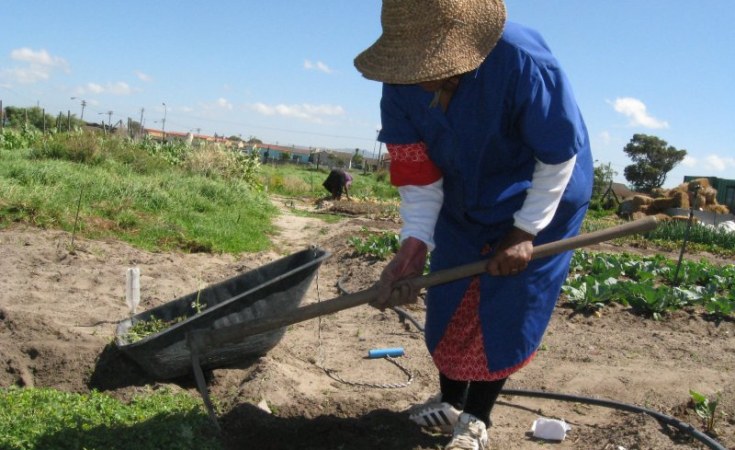
Phillipina Ndamane, 72, is a typical township food gardener. With five other women, she co-owns and runs the Fezeka community garden in Gugulethu, where she lives. The garden is about three quarters the size of a soccer field, and is filled with rows and rows of flourishing vegetables. Each woman has her own plot, on which she grows food for herself, her family and her neighbours. In the middle of the private plots is a communal plot, on which the women grow vegetables which they sell, sharing the profits.
Like her five partners, Ndamane relies on a government pension to make ends meet. At R800 (U.S.$115) a month, this does not go very far in feeding herself, her elderly sister and the nine children she supports – six grandchildren and three others, all orphans. "We can't buy vegetables," she says. "The garden is helping me a lot because we don't [need to] buy the things we grow here – I'm taking some to the house."
The social benefits of Fezeka radiate further, too. As Fezeka co-owner Shaba Esiteng, 77, explains: "We are helping the others who don't work, the sick people... people who have HIV, old people – we help them with our vegetables."
Esiteng is living proof of the nutritional value of the vegetables she grows: "When I first came to the garden, really, I was thin. I was sick. I can feel that I'm strong now… maybe it's because I didn't have any vegetables. I'm very strong now, I'm eating vegetables every day… [and] I'm getting exercise."
"She's fat!" chimes in Joyce Nyebela, 65, laughing. "She wasn't like this [before]; she doesn't get old!"
Nyebela, another Gugulethu resident, is sold on the benefits of gardening: "We come to the garden to take exercise, to move the nerves, to meet people and talk – it's better that way."
Her husband, on the other hand, "just sits, eats and drinks coffee," she says in a disparaging tone. "Men don't want to do anything – they just want to eat and talk and, you know, rule you – that's all."
Doesn't she want him to join her in the garden?
"No, if he wants he must do something, not come to work with me, no. Here it's only women."
Her negative feelings about men are shared by many of the other women who work in communal gardens across the townships – explained partially by the fact that many of the men who have been involved in gardens in the past have had problems accepting women's leadership.
Rob Small, resource mobilisation manager for the Cape Town-based urban agriculture association, Abalimi Bezekhaya ('Planters of the Home') – largely responsible for stimulating the food gardening movement in Cape Town's townships over the last 25 years, and still heavily involved in developing it – explains how this has happened, and how the situation is changing:
"A few years ago the men were saying to the women… that they were being cheeky, now that they were becoming empowered through this movement; and often we were finding group leaders being banished back to the rural areas, with the men sitting in the garden consuming what was left.
"[Now] there has been a major groundswell shift, where women have decided 'none of this anymore' – they've chased the men out and they're leading. They are saying men must work in their own gardens."
And, if it comes to it, women are not afraid to stand up to men who won't listen.
Small recounts: "One day at Siyazama [one of the more prosperous gardens], they were waiting with sticks and whips because this man just wouldn't listen to them, wouldn't cooperate with them. He just wanted to sell everything."
Money is another reason why men and women have struggled to work together, according to Small. "Men just want the money. Women don't just want money – they also want to be able to look after their sick neighbours, their wider community, their children and their grandchildren."
The model according to which the Fezeka garden operates is what Small calls an "emerging livelihood-level model."
Through working with township gardens over the years, Abalimi has developed a "sustainable development continuum," on which gardens range from "survival level," – at which food is grown for immediate consumption – through "subsistence level" to "livelihood level," which involves a mixture of personal and commercial plant-growing. At the top end of the scale is a pure commercial model, where everything grown is for sale.
Though Abalimi supports gardeners wanting to farm commercially, the organisation is in favour of gardens developed at the livelihood level, because of the social benefits it sees radiating out from this model.
"Everyone thinks that the commercial model is the Shangri-La, but it's actually not," says Small. "That provides the least social benefits, in our opinion… No-one understands this livelihood level. We all used to be at livelihood level, in our ancient past. We were living at modest livelihood level where we were embedded in a whole. We weren't super-wealthy but we weren't super-poor – and even if we were poor, we had most of our needs met.
"Women are getting a broad range of benefits [from livelihood level gardens]: health, family wellbeing, networking… mutual support groups, child support groups, community care through vegetables to the poor, the needy – all that starts to happen."
And more and more people are wanting to be part of it.
In the beginning, Abalimi went out and recruited people, persuading them to start gardening as a solution to some of the problems they faced. Now the organisation is inundated with requests from eager township residents wanting to grow their own food. It is at present directly involved with about 50 gardens, and in the last decade has supported the development of about 300.

Sign up for free AllAfrica Newsletters
Get the latest in African news delivered straight to your inbox
Other important players have come on board, most notably the central government's Department of Agriculture and the City of Cape Town, which Small says is "the first city in Africa to have a formal urban agriculture policy approved by executive political leadership."
The journey has not been easy. Pat Featherstone, operations director of Soil for Life – the other significant Cape Town-based NGO which has been helping to build the township gardening movement, and which has operated since 2003 – says there have been huge difficulties with projects: "There's so much that goes on in these communities that makes it really difficult to garden... in fact, often it's not about growing food, its about growing people."
Soil for Life is currently placing more and more emphasis on food gardening at home. "With home gardens, there's no transport needed, no hassle… and people want it," says Featherstone. "People see someone's garden and it's beautiful and they want one. The deal is, if you want a home garden, we'll show you how to do it – and then half the produce is [yours], and the other half we'll buy from you."
For many, communal gardens give them something that nothing else can – a sense of community.
"These women are my sisters," says Regina Shiceka of her fellow Fezeka gardeners. "They are like family. If you have a problem, you can come and talk to them and they will help you."
"Before the garden we were sitting in our houses," says Phillipina Ndamane… [Now] the garden is strengthening us; it's why we are here every day. I enjoy this garden…. I will carry on till I die."
An allAfrica team comprising Helen Kilbey (writer and photographer), Zimkhitha Mbunge and Faatimah Hendricks (photographers), Asanda Jezile (videographer) and Verna Rainers (production), compiled this series on township food gardens.

