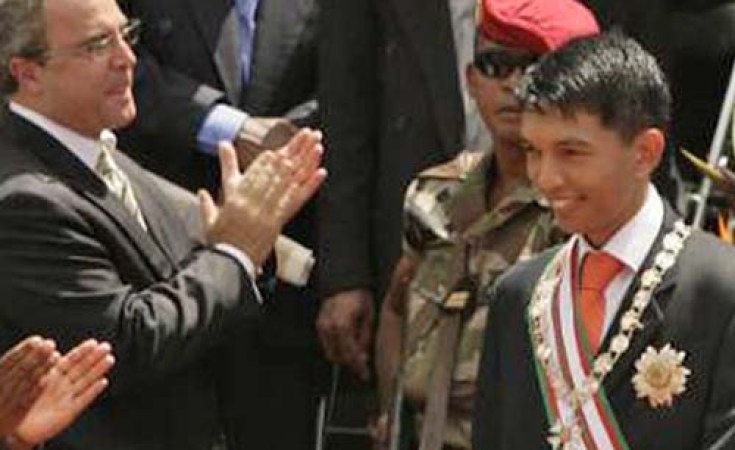
The president of Madagascar's transitional government, Andry Rajoelina, has followed in the footsteps of his predecessor, Marc Ravalomanana and has announced he will not run in the upcoming presidential elections.
However, L'Express de Madagascar reports from Antananarivo that it remains to be seen whether the crisis triggered by Rajoelina's seizure of power from Ravalomanana nearly four years ago has finally ended.
While Rajoelina announced his intention to abstain from standing, he gave the impression that he was not ready to relinquish power.
"To reiterate my announcement of 12 May 2010, I declare that I will not run in the presidential election," he said during an emotional declaration to the nation this week. "It is better that I sacrifice myself than our entire nation of more than 22 million."
L'Express said Rajoelina's announcement was not limited to the issue of his stepping down. He suggested that the elections take place "between the months of May and July," with congressional ballots being cast before presidential ballots. "Combing the two elections could create problems," he argued.
This would change the electoral calendar set by the Independent National Electoral Commission and United Nations experts. L'Express said it remains to be seen what Rajoelina will do if his proposal is refused.
Moreover, Rajoelina repeated that he will not allow Ravalomanana, currently in exile in South Africa, return to the country before the elections.
"We have talked to the heads of the troika (the security wing of the Southern African Development Community, the SADC). It was determined necessary to implement a plan that will prevent conflict in our country until the next President of the IV Republic is elected," he said.
Rajoelina tried to reassure his reporters, saying "It is necessary to have a vision. I am the solution for today, and I will remain so tomorrow," he said.

L'Express added that Rajoelina's statements did little to hide his desire to retain power, skirting the "neither…nor" (neither Rajoelina nor Ravalomanana) solution set forth by the SADC.
As part of his plan, Rajoelina would lead his party through the legislative elections as transitional president of the country. He is set to launch a tour on Saturday, highlighting a series of projects including social housing, the new City Hall and streets in the capital region of Atsinanana.
With an election offensive, he hopes his party will win a parliamentary majority, creating a political monopoly with full legislative power.
L'Express suggests that Rajoelina might also find other ways of reclaiming power.
Adapted from a report in L'Express de Madagascar, translated in AllAfrica's Dakar office by Elise Knutsen.

Comments Post a comment
Quite Right! Neither the DJ, his gangster staff nor his handlers (the French) will let anyone else gain power. Two quotes stand out:
"It is better that I sacrifice myself than our entire nation of more than 22 million."
...since 2009 the country has been sacrificed without regard to the poor, human rights or the future...
"It is necessary to have a vision. I am the solution for today, and I will remain so tomorrow,"
...clear enough...
Will the the destruction of our country continue? How much more must we bare?
After he did a coup d'état and kicked out the democratically elected members of parliament, the international community approved Rajoelina having the power to name the members of government, members of parliament, members of the electoral council, mayors, etc and to remain president until a new president is elected (no wonder Rajoelina is not keen to hold elections). South Africa violated the AU sanctions against Rajoelina by inviting to him to the ANC celebrations in January 2012. France used its military assistance to help shore up Rajoelina's power after the coup. Now Rajoelina wants to stay in power through the election, wants SADC approval to keep Ravalomanana and Ravalomanana's wife out of the country until after the election. The UN has frequently gone along with Rajoelina's plans, supporting France's provision of diplomatic protection (complete with bodyguards) while he was doing the coup; more recently in July 2012 supporting through silence the kicking out of the country of Ravalomanana's wife (in violation of her right to return to her country); now the UN is dragging its feet to start an investigation into major human rights violations by Rajoelina's security forces in southern Madagascar.
This is no victory for SADC's quiet diplomacy as a South African news story reported. Rather it is a tragedy for the Malagasy people. And a terrible precedent of international support for the perpetrator of a coup d'état.
Just today Rajoelina's security forces were in place to repress a protest march that Lalatiana Ravololomanana had said she would lead to commemorate Rajoelina's inauguration of a place he called the "place of Democracy" at Ambohijatovo park 4 years previously. At the time, Rajoelina had said that the place of democracy was where people could come and say whatever they want without needing authorization. It wasn't long after he came to power before his security forces were shooting people who wanted to exercise their right to free speech at Ambohijatovo and no one was allowed to protest there without his permission -- permission he has resolutely refused to give.
Meanwhile today, workers from Rajoelina's favorite construction company were busy tearing out the Queen's Stairs in downtown Antananarivo, replacing them with shinier slabs of rock given by Rajoelina to the people of Madagascar. Never mind that the stairs that were put in place over 100 years ago were still perfectly functional and that taking them out destroys the country's history, that there are other stairs in Antananarivo that are so in need of repair that it puts people in danger to use them, and that doing long-term projects is a violation of the SADC roadmap. But the roadmap is something that Rajoelina has always applied as he sees fit, with SADC never evaluating its implementation or sanctioning him for failure to apply the parts he doesn't want to apply.
In sum, Madagascar is still a long way from free and fair elections and still in the clutches of a coup d'état régime that makes a mockery of things the international community says it holds dear, like democracy, human rights, and rule of law.