Where Does Africa Stand on Water Target?

While the global development target of halving the people without access to safe drinking water has been met ahead of the 2015 deadline, only 61% of the people in sub-Saharan Africa have access to improved water supply, UN bodies says.
  • Comment (2)

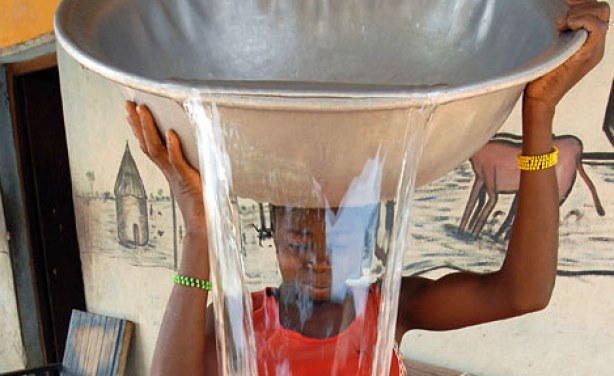
A girl holds a basin of water.

  • Liberia:  Wash Compact Finally Signed

    Heritage, 27 January 2012

    President Ellen Johnson-Sirleaf has finally signed the much talked about Liberia WASH Compact which was developed at the Multi Donor Conference on Water, Sanitation and Hygiene ... read more »

  • Nigeria:  FG, WaterAid Sign New MoU

    Daily Trust, 23 February 2012

    WaterAid has signed a new Memorandum of Understanding (MOU) with the Federal Government of Nigeria to facilitate its mission of transforming lives by working with the people and ... read more »

  • Nigeria:  Boreholes - The Looming Landmine (opinion)

    Leadership, 25 February 2012

    While inaugurating the one-million-gallon-per-day capacity World Bank-assisted mini waterworks at Iponri, Lagos State governor Babatunde Fashola expressed concern over the ... read more »

  • Africa:  Lenny Kravitz Supports Unicef's Water, Sanitation and Hygiene Efforts

    United Nations Children's Fund, 6 March 2012

    Lenny Kravitz - GRAMMY award-winning singer-songwriter, record producer and actor - is using his voice and talent to do more than dazzle the stage and screen. He is throwing his ... read more »

Documents

InFocus


Comments Post a comment

  • mingione
    Mar 7 2012, 09:18

    Folks, this is the 21st Century. I don't even think that Britain wishes for Nigerians to refer to them anymore as "Colonial Masters". We've so often relegated our inability to develop ourselves to some incalculable mistakes made by the British during their short-lived presence on our soil. We must begin now to desist from using these terms which gives many of our modern institutions a way of of taking responsibilities for their actions and ineptness. There is nothing masterful about anything that britain did in Nigeria, other than establishing a lasting educational system and the institution of a Civil Service and how to run a government in an orderly and civil form. Although, we've stretched this form of civility to an extreme level. The kinds of corruption and the scale by which civil servants engage in them was never instituted by the British hence, they called it "civil service". This was supposed to be an institution of a selfless system where the interest of the citizenry and the masses are addressed without fear or favouritism. We've transformed this very noble concept and institution to a money making environment where services are no-longer rendered; save for those who could afford them.

    On the issue pertaining to well-water, i am in total agreement that harmful contaminants are rife in our well water, including arsenic or other chemical contaminants which the general population swallows on a daily basis. Drinking untreated water can be just as dangerous as drinking soda which are severely laden with sugar which can be a major contributory factor to diabetics. Worst still, I would go a step further by banning altogether the burial of human remains at homes or what we call compounds. When the dead bodies decompose, the chemical residues that comes from the body seeps directly to the nearest water table. Unfortunately, there are few medical research facilities in Nigeria to conduct studies in pathogens as to what is killing Nigerians. The government has no endowment funds for institutions to conduct studies on what kills Nigerians. We are technically blind when it comes to issues about our health. We've grown increasingly reliant on foreigners to conduct these studies for us in their respective environments, and yet, we are proud to call ourselves "a functioning government".

    In areas where the soil is took weak to handle a deep well water construction, yes, we stand the chance of having the soil or the land in the general area collapse under the pressure of development. The country and the states in particular have got to develop a comprehensive policy to address this very urgent issue about digging wells for the finding untreatable drinking water. This health hazard has got to receive the attention of the National Assembly, and should be dubbed a "National Emergency".