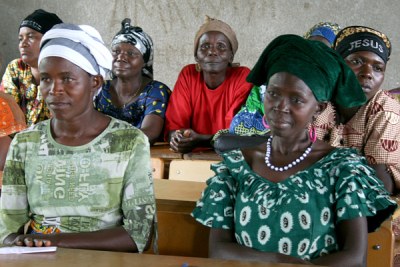
Women Farmers Continue to Battle for Resources
Women farmers battle to access land and financial services, despite comprising more than half of the agriculture workforce, highlighting the need for the first Global Conference on Women in Agriculture currently underway in India.
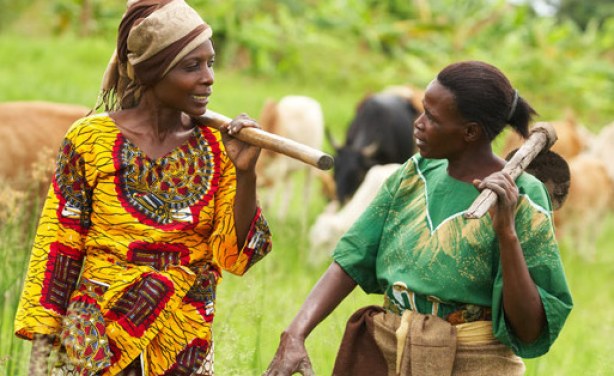
Farmers teaching farmers in Tanzania.
-
Africa: Neglecting Role of Women Farmers Threatens Food Security Initiatives (press release)
Global Conference on Women in Agriculture, 12 March 2012
As developing countries battle multiple threats to food security—soaring prices, crop-crushing weather extremes and dramatic population growth—agriculture experts ... read more »
-
Africa: Celebrating the Power of Women to Nourish the Planet (press release)
Worldwatch Institute, 8 March 2012
Women have proven to be a powerful force in the fight against global hunger and poverty, especially in agriculture. Worldwide roughly 1.6 billion women rely on farming for their ... read more »
-
Africa: The Invisible Guarantors of Food Security (press release)
International Fund for Agricultural Development, 6 March 2012
Empowering young women who are agents of change in their rural communities will be the focus of discussions at the International Fund for Agricultural Development (IFAD) on 8 ... read more »
-
Kenya: Local Sugar Board to Address Gender Disparity
The Star, 6 March 2012
THE Kenya Sugar Board is working on modalities of fast tracking reforms to ensure gender balance. Last Week, justices Abida Ali Aroni, Hillary Chemitei and Said Chitembwe sitting ... read more »
-
Africa: For International Women's Day - an Innovative Agricultural Empowerment Index (press release)
Worldwatch Institute, 7 March 2012
Rural women represent, on average, more than 40 percent of the agricultural workforce in the developing world, but they own only one percent of the land, and face constant barriers ... read more »
-
Kenya: Microloans, Greenhouses Help Women Cope With Climate Change
Inter Press Service, 2 March 2012
At Gakoromone Market in Meru, in Kenya's Eastern Province, Ruth Muriuki arrives in a pickup full of tomatoes and cabbages despite the scarcity of rainfall in the area, thanks to ... read more »
InFocus
-
In Kenya, micro-credit institutions are empowering women farmers by helping them acquire greenhouse technologies to boost horticultural production. Read more »
Comments Post a comment
We need to bring the university where the farmers are. We need branches/affiliates/extention schools in easily accessible areas where farmers have the least access to new farming tecnologies and innovation. We need scientists to travel and live among the people and set us their extension schools in different countries and not just concentrate having the institution in one single country...South Africa....Just think of this ...how on earth do you expect a upcoming brilliant gifted married woman scientst or even single woman to leave the hinterlands of Ethiopia where the traditional culture is so strong and leave her husband, children including those who are still breastfeeding, and extended family behind and go on a scholarship to South Africa? I think we need to think outside of the box and come up with much more creative solutions to connect the local to the global
Yah Ashantwe
You are right to some extent in that universities need to be brought where the farmers are. But honestly that should be national governments responsibility. You don’t expect the donor community to move around countries building universities everywhere. For me, it makes sense to target human resources development whilst forming collaborative efforts with other already established institutions such as in South Africa or even overseas just to tap those research resources which are not home. Perhaps what you should be suggesting is that the student lady should be made to do research which addresses her home area. So sometimes you don’t need to build a university to address a problem. Instead forming collaborative with other institutions might be the way to go for under equipped countries. Once you develop enough personnel through taking advantage of such personnel, you will eventually develop a new crop of leadership which will prioritise construction of research facilities in your local areas which will ultimately contribute to the development of your economy. For example, capacitating research in the South African case you cite was an effort from the government (both arpatheid and the current) with marginal help from donors. So in the case you cite governments should take the lead in making the universities then you will see those who will want to partner you in those initiatives. I also see no reason why a single or married woman from Ethiopia should fail to temporarily relocate with family with the studies. Thats purely patriarchal and male chauvinist tendencies to suppress women personal development that will ultimately serve her family first (through improved remuneration and improved opportunities) and ultimately your nation at large. It is for exactly that types of thinking that such programmes by AGRA have arisen, because for so long women in such societies have been bogged down selfish cultural practises. If you give the wife support in such instances, you will both win. After all chances are that she has been supporting you all her life whilst you followed your egocentric interest. Perhaps what again you probably should be raising is that, the funding for the students should try and cater for spouses and children to allow relocation/travel to avoid any distress on the families. That would be constructive. Lastly, you might want to know that at our institution in Kenya there are several Ethiopians (Males and females). Some women left their families with their husbands in full support and are almost completing their PhDs. In addition, they visit each other and I must say its beautiful to watch. So I suggest you smell the coffee, do the right and support your women.