Zimbabwe: Legislators in Public HIV Testing and Circumcision

The government officials underwent voluntary counselling and public testing for HIV in an effort to encourage other citizens to follow suit.

  • Comment (19)
Photo: Herald

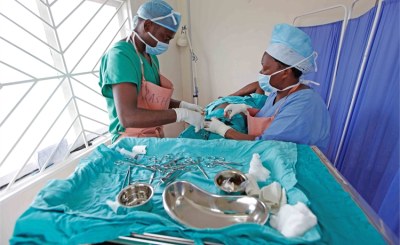
At least 40 legislators were circum­cised under the Zimbabwe Parliamentarians Against HIV and Aids programme.

  • Zimbabwe:  60 MPs Agree to Public Aids Test

    SW Radio Africa, 14 June 2012

    Members of Zimbabwe's parliament are set to lead the way in the fight to stop the spread of HIV in the country, with more than 60 MPs agreeing to a public AIDS test next week. read more »

  • Zimbabwe:  66 000 Risk Losing ARVs Allocation

    The Herald, 23 May 2012

    AT least 66 000 people on anti-retroviral drugs risk losing their allocation if no steps are taken owing to a new regimen and the withdrawal by some donors, a health official has ... read more »

  • Zimbabwe:  Change or Perish (opinion)

    The Herald, 16 March 2012

    Behaviour change is key to stop the spread of HIV. Other programmes like the prevention from mother to child transmission, condom use, universal access and condom use are, in my ... read more »

  • Zimbabwe:  From Brink of Death to Advocate of Rights

    The Herald, 8 March 2012

    A shocking testimony that would have one jump out of their skin is what the launch of Zimbabwe Parliamentarians on HIV (ZIPAH) witnessed last week in Harare. read more »

  • Zimbabwe:  MPs' Initiative in HIV and Aids Fight Spot On (editorial)

    The Herald, 3 March 2012

    Legislators - who of late have been associated with negative things like childish heckling, absenteeism and incessant demands for rewards, and alleged abuse of public funds ... read more »

  • Zimbabwe:  Circumcision for Legislators

    The Herald, 3 March 2012

    Over 170 Parliamentarians from across the political divide have pledged to undergo voluntary counselling and HIV testing. read more »

  • Zimbabwe:  Declare HIV Status, MPs Challenged

    The Herald, 2 March 2012

    PRESIDENT Mugabe has challenged legislators to declare their HIV status to fight the stigma associated with the virus. read more »

  • Zimbabwe:  Condoms in Schools - Let Children Speak (analysis)

    The Herald, 3 November 2011

    RECENTLY, there has been debate that condoms ought to be distributed in schools to curb the spread of HIV. This was not the National Aids Council's (NAC) view, but they were ... read more »

  • Zimbabwe:  Junior MP Says Sex Rampant in Schools

    The Herald, 22 October 2011

    A junior parliamentarian has called on Government to provide contraceptives in schools arguing that unprotected sex among pupils is rampant in high schools. read more »

  • Zimbabwe:  Zimbabwe MP Escapes Forced HIV Test

    The Nation, 12 August 2011

    A Zimbabwean High Court judge has ruled that courts cannot compel individuals to undergo HIV tests where they are accused of infecting their partners with the virus, throwing the ... read more »

  • Zimbabwe:  Court Orders MP to Take HIV Test

    The Herald, 8 July 2011

    BULAWAYO regional magistrate Mr Mark Dzira yesterday ordered the Member of the House of Assembly for Insiza South Siyabonga Malandu Ncube who is facing a charge of deliberately ... read more »

  • Zimbabwe:  HIV Scandal - MP Placed on Remand

    The Herald, 24 June 2011

    THE Member of Parliament for Insiza South, Siyabonga Malandu Ncube, was yesterday formally placed on remand on allegations of deliberately infecting a Bulawayo female journalist ... read more »


Comments Post a comment

  • vhezh
    Jun 24 2012, 09:04

    With this AIDS scourge, we are like people in a burning house. A Swahili proverb says 2 men in a burning house should not argue. Most importantly, when WHO/UNAIDS recommended that VMMC be implemented in countries with high HIV but low MC prevalence, they made 10 other recommendations which have policy and programmatic implications for rolling-out VMMC. These include the recommendation that male circumcision should never replace other known HIV prevention methods, and should always be considered as part of a comprehensive HIV prevention package which includes among other measures, promoting abstinence from penetrative sex, encouraging reduction in number of sexual partners and providing HIV testing and counselling services. In Zimbabwe (and elsewhere in sub-Saharan Africa), the partial protectiveness of VMMC is emphasised and VMMC is offered as part of a standard minimum package of integrated services which includes: HIV Counselling and Testing; screening and treatment for sexually transmitted infections; counselling on safer sexual practices, use of female and male condoms; and a safe MC procedure. The concern that mass male circumcisions may exacerbate the HIV epidemic among women is unfounded. Reducing the number of new infections in men will of course reduce the number of new infections in women. The concern that circumcised men will behave less cautiously because they have been circumcised is unsubstantiated. A range of studies have found no evidence of increased risk taking in circumcised men. There are data showing that male circumcision reduces male-to-female HIV transmission, suggesting some protective effect for the female partner. In addition, there are other HIV non-related benefits to both circumcised males and their female partners, including lower risk of Human Papillomavirus infection, penile and cervical cancer, a possible lower risk of Chlamydia trachomatis infection and last but not least, enhanced sexual pleasure.

  • Human Rights Abuse
    Jun 24 2012, 10:42

    Scaling up male circumcision will NOT reduce new HIV infections!

    Circumcision (sexual-reduction surgery) does NOT reduce female-to-male transmission of HIV by 60% as misleadingly claimed. This is a relative figure only. The actual (absolute) risk reduction was only 1.3% which is NOT clinically significant.

    http://www.salem-news.com/articles/december112011/circumcision-hiv-rg.php

    Alarmingly, in a parallel Ugandan study by Wawer et al. (2009), there was a 61% relative INCREASE (6% absolute increase) in male-to-female transmission of HIV. Several women in the trial became infected with HIV after having sex with their newly circumcised partners.

    Circumcision can only worsen the HIV epidemic because:

    1) Some men may become HIV infected from the circumcision procedure itself when surgical instruments are inadequately sterilized.

    2) At least 25% of men engage in sexual intercourse before their circumcision wounds have healed (half as early as 3 weeks).

    http://www.aidsmap.com/Quarter-of-men-resume-sex-before-wounds-from-circumc ision-fully-healed-in-Zambian-study/page/2227154/

    3) Many circumcised men mistakenly think that they have a "natural condom" so they believe they are "immune to HIV infection" and can be promiscuous with impunity. How wrong they are!

  • Hugh7
    Jun 23 2012, 17:50

    In Zimbabwe in 2005, USAID found 14.2% of non-circumcised men had HIV compared to 16.6% of circumcised men. (Similar differences apply in 10 of 18 countries for which it has figures.) Shouldn't this at least be explained before blundering on with mass circumcision programmes? The "up to 60% reduction" figure amounts to a total of 73 circumcised men who did not get HIV less than two years after 5,400 men were circumcised, while 64 did (and 327 dropped out, their HIV status unknown). Circumcision does nothing to directly protect women, who are at greater risk, and may even INcrease the risk to them. It will make it harder for women to insist that men use condoms. It is a recipe for disaster.

    Zimbabwe has horrendous health problems. The money and resources being spent cutting men's genitals could be used much more effectively on measures that would, for example, ensure children survive long enough to be at risk of sexually transmitted HIV. THEN is the time to worry about that.

  • ML
    Jun 23 2012, 17:41

    From a USAID report: "There appears no clear pattern of association between male circumcision and HIV prevalence—in 8 of 18 countries with data, HIV prevalence is lower among circumcised men, while in the remaining 10 countries it is higher." http://www.measuredhs.com/pubs/pdf/CR22/CR22.pdf

    The South African National Communication Survey on HIV/AIDS, 2009 found that 15% of adults across age groups "believe that circumcised men do not need to use condoms". http://www.info.gov.za/issues/hiv/survey_2009.htm

    From the committee of the South African Medical Association Human Rights, Law & Ethics Committee : "the Committee expressed serious concern that not enough scientifically-based evidence was available to confirm that circumcisions prevented HIV contraction and that the public at large was influenced by incorrect and misrepresented information. The Committee reiterated its view that it did not support circumcision to prevent HIV transmission."

    The one randomized controlled trial into male-to-female transmission showed a 54% higher rate in the group where the men had been circumcised btw: http://www.thelancet.com/journals/lancet/article/PIIS0140-6736(09)60998-3/a bstract

    ABC (Abstinence, Being faithful, and especially Condoms) is the way forward. Promoting genital surgery seems likely to cost African lives rather than save them.

See All Comments