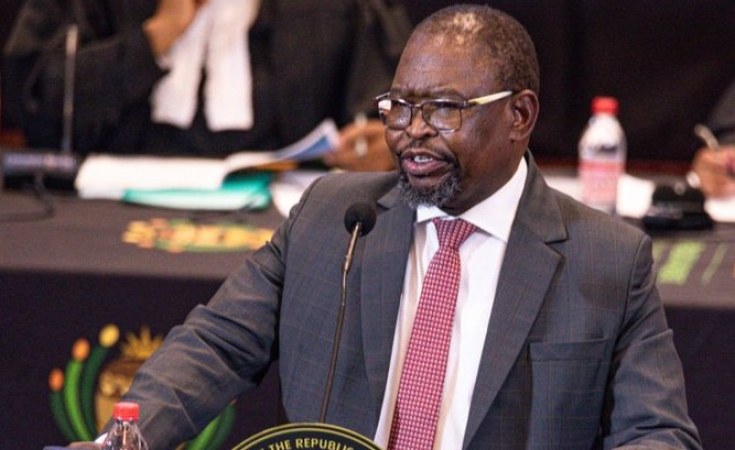
Cape Town — "This is not an austerity Budget" were among the first words South African Finance Minister Enoch Godongwana spoke on his third attempt to present the country's 2025 Budget to South Africa.
"A national budget is not merely an accounting exercise measuring what we earn, what we spend, and what we borrow as a nation. It is a reflection of the difficult trade-offs needed to balance fiscal sustainability while addressing our developmental goals. It is unsurprising then that the increase to Value Added Tax (VAT) proposed on March 12 created so much debate. A vital debate, no doubt, but one that also created some uncertainty.
"There is clarity now: VAT will remain at 15%," Godongwana told members of Parliament in Cape Town.
Keep up with the latest headlines on WhatsApp | LinkedIn
Godongwana said the decision was based on "our commitment to listen to South Africans, and to all the political parties represented in this House."
He described the past two months of working on the Budget, after its rejection by the members of the Government of National Unity (GNU) over the VAT increase, as providing "valuable lessons that will inform how we manage the budget process moving forward."
There's been speculation about what the minister would propose to change in the Budget, as the VAT hike would have provided a valuable source of revenue. Godongwana said the VAT decision meant that the government will be unable to fund some programmes and projects, but it still has "sustainable finances, the social wage and investments in economic growth."
He said the Budget increases non-interest expenditure by an average of 5.4% over three years. "It is also a redistributive budget. It directs 61 cents of every rand of consolidated, non-interest expenditure towards the social wage.
"This is money that will be spent to fund free basic services like electricity, water, education, healthcare, affordable housing, as well as social grants for those in need.
"This budget invests over R1 trillion in critical infrastructure to lift economic growth prospects and improve access to basic services... without compromising the fiscal strategy of sustainable public finances."
Key Points
- VAT will remain at 15%
- Not an austerity budget - it increases non-interest expenditure by an average of 5.4% over three years
- 61c of every Rand of consolidated, non-interest expenditure is directed toward the social wage
- Budget invests over R1 trillion in critical infrastructure
- Additional spending over the medium term reduced by R68 billion
- Real GDP growth projected at 1.4% in 2025 (down from earlier 1.9% projection)
- Government debt projected to stabilize at 77.4% of GDP in 2025/26
- Debt service costs remain high at more than R1.3 trillion over the next three years (R1.2 billion per day)
- The second phase of Operation Vulindlela will focus on seeing through existing reforms, improving local government performance, harnessing digital transformation, and addressing spatial inequality
- General fuel levy will increase by 16c per liter for petrol and 15c per liter for diesel (first increase in three years)
- The 2026 Budget will need to propose new tax measures aimed at raising R20 billion
- An additional R7.5 billion is allocated to SARS to increase effectiveness of revenue collection
- Provincial education sector to receive R9.5 billion to keep teachers in classrooms and hire more staff
- R10 billion is allocated to expand access to early education
- Provincial health sector budget will increase by R20.8 billion over three years
- Old age grant increased by R120 to R2,310 from April 2025, with an additional R10 increase to R2,320 in October
- COVID-19 social relief of distress will be extended to the end of March 2026
- R3 billion is allocated to the Department of Defence for withdrawal from DR Congo
- R1.4 billion is allocated for preparations for local elections
- Public infrastructure spending over three years will exceed R1 trillion, focusing on transport and logistics, energy, and water and sanitation
- New regulations for public-private partnerships (PPPs) will take effect in June 2025
- The first infrastructure bond will be issued in 2025/26

Sign up for free AllAfrica Newsletters
Get the latest in African news delivered straight to your inbox

