

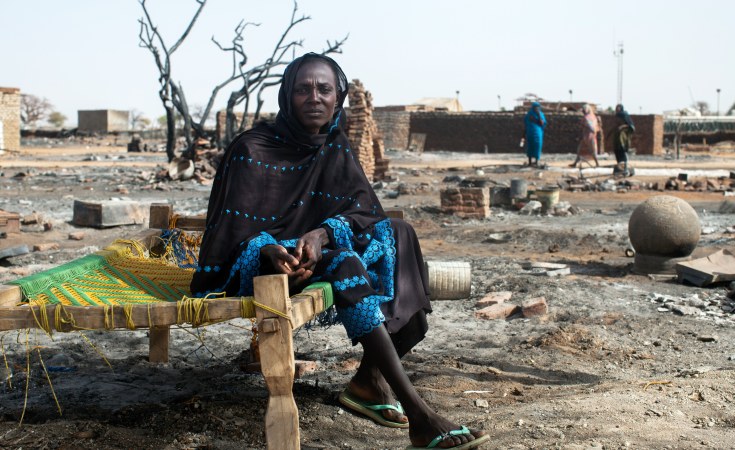
Tawila, Sudan — "We have no shelter except small makeshift structures that barely protect us."
Not too long ago, Tawila, a small Darfur town nestled at the edge of Sudan's largest mountain range, was shaped by the rhythms of everyday life - trading goods and growing and harvesting staple crops from fertile fields.
Today, however, the town is one of Darfur and Sudan's epicentres of displacement, its resources and solidarity stretched to breaking point as hundreds of thousands seek safety there from attacks by the paramilitary-turned-rebel Rapid Support Forces (RSF).
"We have no shelter except small makeshift structures that barely protect us from the heat, and we have no food, clothes, blankets, or even proper sanitation," said Hakeema Mohamed*, who arrived in the town last month.
Keep up with the latest headlines on WhatsApp | LinkedIn
Mohamed escaped from the nearby, famine-hit Zam Zam displacement camp when it was overrun by RSF fighters. The attack left hundreds dead and pushed over 300,000 people towards Tawila, which was already hosting vast numbers of people.
Sudan's westernmost region, Darfur is the stronghold of the RSF, which has been battling the Sudanese Armed Forces (SAF) and allied groups in a two-year conflict that has produced the world's largest displacement and hunger crises.
Formed as a successor to the so-called "Janjaweed" militias behind the Darfur genocide of the early 2000s, RSF forces have committed a string of mass killings since 2023 that rights groups say amount to ethnic cleansing and possible genocide.
Recent attacks have focused on North Darfur, the only state in Darfur where the army still holds ground. Civilians have escaped to Tawila, also in North Darfur, because it is controlled by an armed group that has taken a neutral position in the war.
Residents who spoke to The New Humanitarian - all of them recently arrived from Zam Zam - described harsh living conditions around the town. They also reported serious abuses by the RSF and allied militias that pursued them all the way to Tawila.
Some aid from international organisations is arriving into the town, but residents said they largely rely on each other - with newly arrived displaced people often leaning on those who came before them for support and guidance.
There are also "significant efforts being made by the community, local authorities, and emergency response rooms", said Adam Regal, spokesperson for the General Coordination of Displaced Persons and Refugees in Darfur. "But the need exceeds their capacity."
Displaced people from Zam Zam have used tarpaulins and local grasses to set up makeshift shelters in an open area outside of Tawila. (Mohamed Jamal Alasmer/TNH)
"Urgent and immediate action" needed
Tawila has a long experience of displacement, including during the 2000s Darfur conflict, which saw the state arm the mostly Arab Janjaweed militias to crush a revolt by mostly non-Arab rebels resisting marginalisation by the central government.
Back then, Tawila's own residents were uprooted - and many were forced to move again when clashes broke out in the area early on in the current war. But now, in a reversal, they are the ones receiving and sheltering displaced people.
Tawila is seen as a safe haven because it is controlled by the Sudan Liberation Army-Abdul Wahid (SLA-AW). The rebel group, led by Abdul Wahid al-Nur, took over the area in late 2023 and has maintained a stance of neutrality in the conflict.
Approximately a million people now reside in and around the town, according to Regal, the spokesperson for displaced people and refugees. He said most are from El Fasher - the North Darfur capital - and surrounding displacement camps.
With the rainy season looming, Regal said there must be "urgent and immediate action" from international aid groups and foreign governments to support communities in Tawila.
"There are ways through which aid can arrive immediately if there is seriousness in addressing the situation," Regal said. "If aid does not arrive urgently, this will turn into a humanitarian catastrophe, and we expect people to die of hunger and thirst."
Those who arrived in Tawila last year are staying inside the town - in schools, public buildings, and open fields - but space constraints mean newcomers are living in a desert-like area outside town, with no resources or means of making a living.
Most newcomers said they arrived in extremely difficult conditions after fleeing Zam Zam - Sudan's largest camp, located just south of El Fasher - which was hosting huge numbers of people from other areas in North Darfur and beyond.
A local aid worker in Tawila, who asked not to be named, said he was struck by the contrast between the paltry support displaced people are receiving from aid organisations now compared to the 2000s, when the UN delivered far more relief.
The international aid effort in Darfur has been weak for several reasons: warring parties have blocked access to areas controlled by their rivals; aid agencies have failed to push back effectively; and the overall response is severely underfunded.
Sharing resources
The new arrivals from Zam Zam have built makeshift shelters from local grasses, but they offer no protection from daytime heat - worsened by a lack of tree cover - or from the cold nights typical of areas in the surrounding Jebel Marra mountain range.
Nimma Suliman, a 35-year-old mother-of-eight who fled Zam Zam, said her family struggles to sleep due to the weather conditions as they lack mattresses, blankets, and adequate clothing to keep warm.
"We fear the rainy season will come while we are still in this dire situation," Suliman told The New Humanitarian. "Right now, we need everything: food, medicine, plastic sheets, shade, and shelter."
Health services are also limited for new arrivals. One international NGO has set up health posts close to the encampment - about a 10-kilometre walk across a valley from Tawila - but patients must arrive early and wait in long lines to see a medic.
Zam Zam resident Ali Sharif said people are facing severe medical challenges, with strong, dusty winds triggering waves of coughing and diarrhoea among people, and many also suffering from psychological distress.
"Many people are missing - my own cousin has been gone for about 20 days," Sharif said. "There is no entity searching for the missing despite the reports we have filed. This really affects families emotionally."
Interviewees said they are largely dependent on their families sending money via mobile banking applications, or on local volunteers and other displaced people who are already inside Tawila and have managed to secure slightly better conditions.
On most mornings, people can be seen crossing from Tawila down into the valley, carrying food and supplies. Much of that is then shared collectively, with displaced families dividing what they have to ensure everyone receives something.
Still, the resources of local responders are limited, especially the earlier groups of displaced people, most of whom have not been able to find jobs in Tawila's main market given its relatively small size.
Hadia Awad, a 24-year-old from Zam Zam, said her four children relied on local residents providing meals to get through their first days in Tawila, but since then they have struggled to find enough food.
"Other than those meals, we haven't received any humanitarian aid," Awad said. "We also haven't been able to find work to support ourselves and our children, except for occasionally gathering some straw [for people to] make shade."
A displaced person cooks food at night in an open field outside the town of Tawila. Food is often shared collectively among newly arrived families. (Mohamed Jamal Alasmer/TNH)
RSF abuses
Interviewees from Zam Zam all described enduring horrific abuses by the RSF and allied forces, both when they attacked the camp and on the journeys they took to Tawila.
The UN has estimated that over 400 people were killed during the assault on Zam Zam, which took place over several days in early April, though local sources suggest that is an underestimate.
The RSF has sought to justify the attack by claiming that Zam Zam was a "military zone" used by armed groups supporting the SAF in El Fasher. In reality, the camp was overwhelmingly a civilian space, home to hundreds of thousands of displaced people.
The killings came after nearly two years of similar attacks, during which RSF forces have committed numerous mass atrocities, mostly notably against the non-Arab Masalit community of West Darfur state.
Zam Zam resident Fayza Elmer said her family hid in trenches during the attack, and then watched on as RSF forces went through neighbourhoods stealing people's vehicles and other valuables.
Elmer said her family initially travelled to El Fasher but RSF bombardments forced them to abandon the city and head to Tawila. During that journey, they encountered RSF forces in civilian vehicles and, later on, allied militias on camels.
"We encountered four men riding camels," Elmer said. "They stopped us and said, 'Where are you going, enemy women? Today, we will kill all of you.' They ordered us to leave the main road and unload our belongings from the donkeys."

Sign up for free AllAfrica Newsletters
Get the latest in African news delivered straight to your inbox
Elmer said the armed men took aside the men and boys in her group, and then beat them with whips while searching for money and smartphones. She said they also took her 16-year-old daughter and sexually assaulted her.
"When they ordered us to leave, we refused and insisted we would not go without my daughter," Elmer said. "In response, they poured out all of our drinking water on the ground to make our children suffer from thirst. Later, they brought back my daughter."
Awad, the 24-year-old, described facing similar levels of abuse as her family left Zam Zam with dozens of others, stepping over corpses and wounded people on the streets along the way.
Awad said they encountered a group of camel-riding armed men in the village of Um Hajaleed. She said the men threw her brother to the ground, held a knife to his throat, and demanded money and mobile phones,
"They asked, 'Why haven't you liberated El Fasher?'," Awad said. "We told them we were civilians and displaced people and that they should be the ones offering us help, not robbing us. Their response was: 'You brought this upon yourselves."'
Awad said the fighters dragged the family to an open field, cut the ropes tying their donkeys to the carts -- causing the carts, along with the children, to collapse to the ground -- and then stole the animals and beat the family again.
"We heard reports of rape cases involving those who fled before us and those who came after," Awad added. "Women and girls were forcibly taken from their families, who were beaten or killed if they resisted. No one could defy brute force."
Now in Tawila, Awad - like all the displaced people who spoke to The New Humanitarian - said she is relieved to have escaped the violence. But the humanitarian conditions they face mean the suffering is far from over.
"We have no tents or plastic sheets, so we sleep on bare ground without covers," Aawad said. "Some people are already sick, and we fear illnesses will spread among the healthy."
The names of all survivors of RSF attacks have been changed to protect their privacy and security. Ahmed Gouja reported from Nairobi. Edited by Philip Kleinfeld.

