

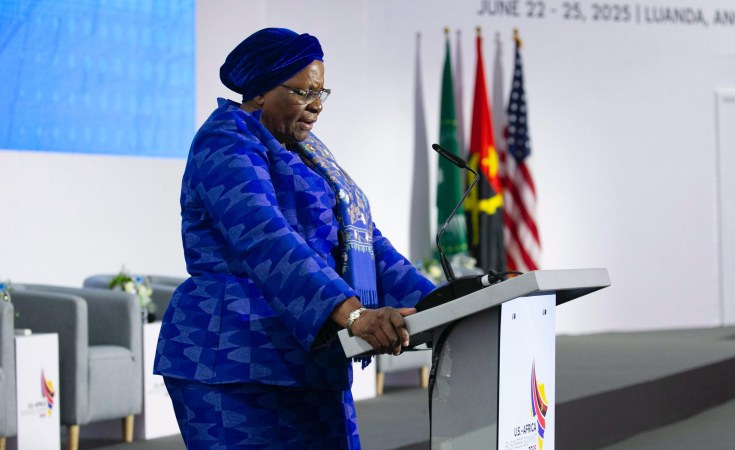
President Netumbo Nandi-Ndaitwah has trimmed the Cabinet from 21 to 14 ministries, advocating a leaner executive and the first female-majority leadership in Namibian history.
However, analysts argue the downsizing has not been matched by concrete policy delivery.
Institute for Public Policy Research executive director Graham Hopwood yesterday told Desert FM that while fewer ministers will sharpen public scrutiny, the wider civil service continues to grow and no cost-saving analysis was done.
He argued that beyond the symbolic optics, parliament has received only the appropriation bill, prepared long before the new presidency, while promised legal and policy reforms remain stuck in drafting limbo.
Follow us on WhatsApp | LinkedIn for the latest headlines
"It's a fairly underwhelming first hundred days...Nice rhetoric, but the jury is still out on turning talk of zero tolerance for corruption into real systems," Hopwood said.
Hopwood warned that mega-ministries, such as the Ministry of Agriculture, Fisheries, Water and Land Reform or the education ministry, risk slower delivery as one minister juggles multiple mandates without deputies or top-tier technocrats.
He applauded the swift dismissal of scandal-hit minister Mac Hengari, yet fears entrenched patronage in Swapo will continue to hamper anti-corruption efforts.
Hopwood emphasised that success now depends on translating bold pledges such as free tertiary education, universal health coverage and job creation, into tangible reforms.
"If she really wants a faster, more accountable government, she must overhaul the culture of a slow-moving civil service and enact access-to-information and whistle-blower laws that turn promises into practice," he said.
Labour analyst Herbert Jauch says slimming ministries is positive on paper, but warns the real test is whether streamlined portfolios can deliver services and jobs.
He credits Nandi-Ndaitwah for cutting "top-heavy structures" and acting swiftly on underperforming officials, yet says efficiency hinges on appointing skilled technocrats and transforming bureaucratic work ethic.
Jauch says the success of the merged ministry of agriculture and fisheries will depend on ending clientelism in fishing quotas and pushing local agro-processing, which could create thousands of jobs if managed by experts rather than political loyalists.
"You need the best possible expertise. It cannot be an appointment based on historical loyalties if you want delivery," Jauch says.
Meanwhile, official opposition leader in parliament Imms Nashinge says the president's opening months have been heavy on symbolism but light on substance.
The Independent Patriots for Change lawmaker states that the consolidation of ministries has created confusion while key pledges lack clear roadmaps.
Nashinge says the administration announced sweeping reforms before consulting stakeholders, leading to back-tracking on details such as which students qualify for tuition-free degrees.
He warns that supersized 'mega-ministries' like the ministries of international relations and trade and education risk overloading ministers and burying priorities.
"The car is really not moving... Consultation should have come first so decisions are clear and credible," Nashinge says.
Nashinge calls for the urgent revamp of the Anti-Corruption Commission, proposing a re-written act that installs a commissioner accountable to parliament and mandates twice-yearly performance reports.
NO CHURCH INVOLVEMENT
Christian Coalition of Churches executive chairperson Shirley Magazi told The Namibian that despite the president's moral messaging, there has been no church-backed campaign to reform civil service responsiveness or tackle corruption at service-delivery levels.
From a church perspective, Magazi says president Nandi-Ndaitwah projects integrity, firmness, prayerfulness and alignment with biblical values, strengthens the nation's spiritual tone, and her support for church-related projects is welcomed.
However, Magazi says the Presidency has yet to fully activate the moral capital of the church.
"[There has been] limited church involvement in policy follow-through: While vocal on morals, the church's moral authority has not been leveraged to push for accountability on pledges such as free education or land reform," she says.
She says the Coalition of Churches expected more concrete engagement with the church in advocating for ethical social justice, accountability and community engagement with national reforms.
"The early signs show a leader rooted in faith - but one who, so far, hasn't tapped that reservoir to drive broader ethical or social reformation," she says.
She says the president could have used the church to rally believers to support national initiatives like crime eradication, anti-corruption monitoring or environmental stewardship - yet no such movement is evident.
Swapo member of parliament Sharonice Busch says Nandi-Ndaitwah continues to demonstrate stern and progressive leadership, whose full fruits will continue to be witnessed as her term continues.
Busch says the president's leadership is characterised by consultation, cohesion, transparency and accountability.
"For me, this speaks to the premium that she places on building a united nation that can materialise her vision for the country.
Her unprecedented expression of her intolerance of corruption has definitely set the tone for everyone working in the public sector; from Cabinet members, to administrators in various offices, ministries and agencies," she says.
Busch says this is crucial in ensuring that the public sector continues to deliver on its social contract to the Namibian people, particularly in terms of effective service delivery and the collective fight against poverty and unemployment.
WOMEN EMPOWERMENT
In terms of gender parity, the president appointed the country's first female vice president, first female National Assembly speaker and ensured a majority-female Cabinet.

Sign up for free AllAfrica Newsletters
Get the latest in African news delivered straight to your inbox
Busch states that Nandi-Ndaitwah's commitment to gender equity and equality is visible and, most importantly, twofold.
"She is able to demonstrate empathy towards victims of sexual and gender-based violence in a manner that is genuine and humane, and she has proven that she has acted with intent by ensuring female representation across strategic governance and leadership roles," she says.
Namibia, as it stands, Busch says, is a global case study of what deliberate women empowerment looks like.
"It is this kind of commitment, from the very top, that I believe will accelerate all other efforts, existing and new, which will root out the systematic barriers that hinder every Namibian girl and woman from reaching her potential," she says.
BUSINESS SECTOR
Namibia Local Business Association vice president Peter Amadhila says the president has done well in a relatively short time.
"Her leadership model takes the current generation into consideration by assigning them direct roles.
I give her 12 out of 10," he says, adding that he wants the president to hold everyone accountable and the entire system placed under a microscope.
Amadhila says he expects higher accountability, transparency and less corruption.
"Our advice is that if she wants to succeed in creating wealth for Namibians, she should align her government strongly with the private sector and capacitate local entrepreneurs," he says.

