

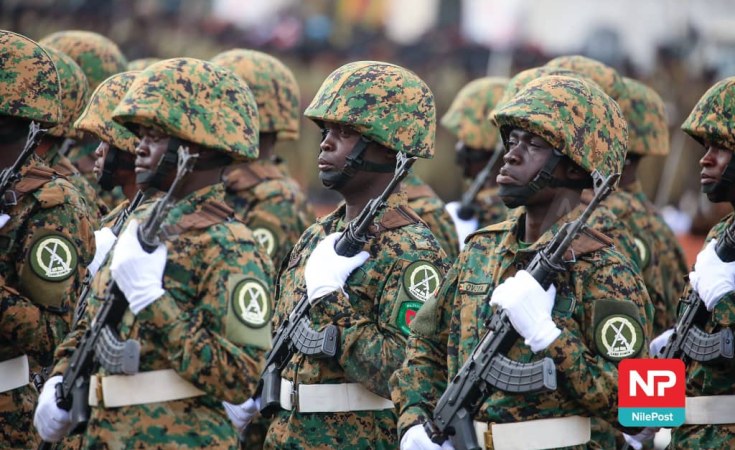
A newly released report has sounded alarm over Uganda's increasingly militarized political landscape, warning that the Uganda People's Defence Forces (UPDF) is tightening its grip on power and threatening the country's fragile democratic foundations.
Titled "The Military and Transition Politics in Uganda," the report is authored by researchers Godber Tumushabe, Andrew Karamagi, Barnet Musasizi, and Job Kiija.
It presents a grim analysis of how the UPDF, though formally a national institution, continues to function as a partisan force loyal to President Yoweri Museveni, who has ruled the country since 1986.
Based on a seven-month investigation, the authors argue that the military has become "the single most decisive factor" in Uganda's political transition.
Follow us on WhatsApp | LinkedIn for the latest headlines
"The UPDF remains Museveni's army," the report states, warning that the country is drifting into a "Warrior-Mad-King" scenario marked by military coercion, personalized rule, and the erosion of constitutionalism.
The report traces this regression to the weakening of the 1995 Constitution's vision of a military under civilian control.
Instead, the UPDF has been restructured to concentrate authority around the Commander-in-Chief, with minimal parliamentary oversight and growing autonomy from civilian institutions.
Historically, Uganda has never had a truly national army, the report notes. From the colonial King's African Rifles to the NRA and now the UPDF, the military has consistently served narrow political interests.
Despite promises of reform, it continues to act as a tool for suppressing dissent, harassing opposition leaders, and enforcing regime survival.
Among the examples cited are the deployment of soldiers into Parliament during debates on the Coffee Bill, and the violent clampdown on opposition supporters during the March 2025 Kawempe by-election.
The report further warns that Museveni is crafting a parallel military regime through the 2021 UPDF Establishment and the UPDF (Amendment) Act passed in May 2025--both of which were enacted without meaningful civilian input.
The authors argue that the military's influence now spans far beyond security, infiltrating religion, cultural institutions, public administration, foreign policy, and the economy--forming what they call a growing "military-industrial complex."
Special units such as the Special Forces Command (SFC), now led by Museveni's son and Chief of Defence Forces Gen Muhoozi Kainerugaba, have been implicated in abductions, torture, and extrajudicial operations with impunity.
The report is especially critical of Parliament, accusing the ruling NRM-dominated House of facilitating Museveni's consolidation of authoritarian power.

Sign up for free AllAfrica Newsletters
Get the latest in African news delivered straight to your inbox
It describes the UPDF (Amendment) Act as "an undeclared coup d'état" that undermines Article 1 of the Constitution, which vests power in the people.
It also warns that the rise of the SFC as a "praetorian guard" mirrors the emergence of dynastic authoritarianism in countries like Togo and Equatorial Guinea--raising fears that Uganda could follow a similar path.
Despite these stark warnings, the report does acknowledge the UPDF's contributions to peacekeeping, humanitarian missions, and national security.
However, it cautions that these achievements are increasingly eclipsed by the political misuse of the military.
With the 2026 general elections looming, the report calls on both domestic actors and the international community to recognize the urgency of democratic renewal.
Without serious reforms to reestablish civilian oversight and reverse the militarization of governance, the authors warn, Uganda could face a volatile and possibly violent transition.
"The gun is yet to be subordinated to civilian control," the report concludes. "Uganda's democratic project is in peril unless the militarization of governance is decisively addressed."

