

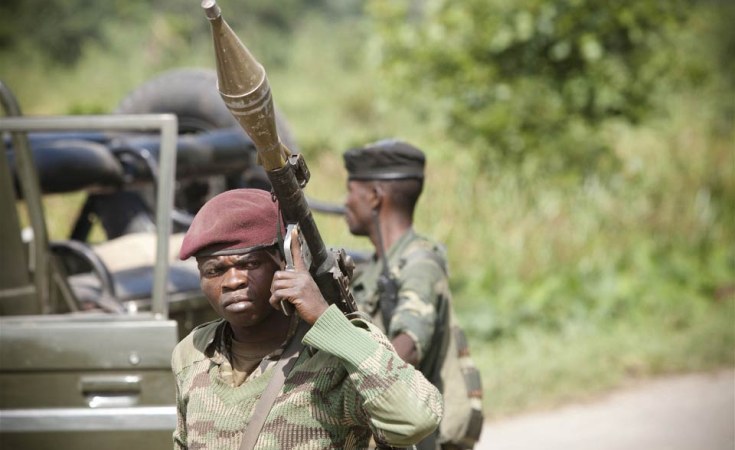
Goma, Democratic Republic of Congo — "Many people are arrested, some disappear, and families don't know where their loved ones are."
After the Rwanda-backed M23 rebel group seized eastern Democratic Republic of the Congo's largest city in late January, it promised change for people long subjected to state violence and the fallout of armed insurgencies in the surrounding countryside.
Yet more than six months on, reporting based on interviews with dozens of local residents, visits to alleged abuse sites, and photographic evidence paints a grim picture of human rights violations and widespread repression under the new rebel administration.
Follow us on WhatsApp | LinkedIn for the latest headlines
The abuses documented by The New Humanitarian - building on the findings of human rights organisations - include cases of alleged summary executions, mass arrests of those accused of links to the national army or allied militias, forced conscription, and a harsh crackdown on civil society activists.
"Many people are arrested, some disappear, and families don't know where their loved ones are," said the president of a civil society group in North Kivu, the province where the M23 rebellion is most active.
The president, who like all sources in this story is anonymous for security reasons, said many young people in Goma are being "killed or sent to military training" because they are suspected of being members of local militias that have supported the Congolese army.
In addition to human rights abuses, Goma residents say the rebel takeover has triggered a deep economic crisis, with the banking sector shut down by the government in Kinshasa, the capital city, unemployment soaring, and demand for basic goods collapsing amid worsening poverty.
By contrast, every weekend at the Saloon -- one of the city's popular upscale nightclubs -- a crowd largely made up of members of the new administration enjoy bottles of $150 champagne, brashly displayed on tables.
Few residents interviewed for this investigation expect the rebel group to withdraw anytime soon, with its forces still fighting against the army despite a recent ceasefire deal and a pledge by both sides to pursue full peace talks.
Getting through the current disaster - and the humanitarian needs it has created - has required people to pull together, said one Goma resident, describing how her family has had to cut back on food but still supports others in need.
"We can't let a neighbour go without food," said the resident. "We lend each other charcoal embers and beans. Sometimes, when we have a little more, we invite the neighbourhood children to the table. Sharing is our shield."
Liberation or occupation?
Mostly led by Congolese Tutsis, the M23 reignited a rebellion in 2021 after years of dormancy. It is now spearheading one of the country's largest insurgencies, seizing swathes of territory in the east, including its most prized capture, the North Kivu provincial capital Goma, which fell amid heavy fighting that left hundreds dead and led to mass burials.
The group initially justified its insurgency on the basis that the Congolese government had failed to implement a prior peace deal with the group, and by arguing that minority Tutsi communities in the east were being discriminated against.
However, the rebels - descended from a long line of Rwandan-backed armed groups in DRC - have since broadened their campaign, drawing in national political figures that are not Tutsi, and even threatening to march on Kinshasa.
In Goma, as elsewhere, the group has signalled plans for a long-term occupation by establishing its own administration - independent of Kinshasa - overseen by Corneille Nangaa, the head of the M23's political wing, the Congo River Alliance (AFC in French).
Nangaa has sought to portray rebel governance as a liberation, touting improved security, better public services, and ongoing development projects such as road construction.
In several interviews, he has described allegations of human rights abuse as false. He says the M23 is a professional army with a code of conduct, and that security has returned to the areas it operates in.
Other M23 officials have said Goma faced "a daily nightmare" prior to its takeover because of abuses and corruption carried out by the national army and allied militias. They say they ended these abuses, while helping displaced people in the city return home.
Read more: Camp closures and forced deportations The M23/AFC say they helped facilitate the return of hundreds of thousands of people who had sought refuge in Goma, but displaced people say their camps were forcibly closed and that they were compelled to leave.
The New Humanitarian interviewed more than 20 displaced people who returned home after the camp closures for a story published last month.
Most described returning to scenes of ruin: homes reduced to rubble, schools and clinics damaged by artillery fire, farmland scattered with unexploded bombs, and a local economy crippled by closed banks and scarce cash.
The closure of the camps constituted a violation of displaced people's human rights, according to rights groups.
The M23 has denied closing the camps and says people returned home willingly.
Some displaced people have also been forcibly transferred by the M23 to Rwanda, according to Human Rights Watch, which described the transfers as war crimes.
Many of the deportees were originally from the village of Karenga, in Masisi territory. Karenga is considered a stronghold of the FDLR, the armed group founded by the exiled Rwandan Hutus behind the 1994 Genocide against Tutsis in Rwanda.
The FDLR is strongly opposed by both the M23 and the Rwandan government.
On 12 May, The New Humanitarian witnessed a round-up operation of Karenga residents at a primary school in Sake, a town that is close to Goma. M23 soldiers - armed with rifles and whips - surrounded a group of women and children, while men had already been taken away.
Many of the men were transported to a stadium in Goma on the same day and presented to the press. An M23 official then burned the identity cards of at least two detainees, claiming they were fake and that the men were Rwandan.
In interviews, some residents acknowledged some improvements under the rebel administration, such as cleaner streets and a more stable power supply. Many said they had resigned themselves to the new rulers and were simply trying to get on with life.
Most were also clear-eyed about the prior government administration and national security services, which frequently carried out arrests, killed activists and dissenters, and were riddled with widespread corruption.
Still, most described the M23/AFC as an occupying force - particularly because of its reliance on weapons and thousands of Rwandan troops - and said living conditions in Goma, a city of some two million people and a key hub for humanitarian relief and regional commerce, have deteriorated by nearly every measure.
Mass round-ups
Security and human rights were cited as the chief concern.
Young men in particular fear mass round-ups that the M23 has been conducting in an attempt to root out elements of the army and pro-government militias - known as Wazalendo - that did not abandon Goma and returned to civilian life when the rebels took power.
The round-up operations intensified after attacks in April and July on the outskirts of Goma by anti-M23 armed groups. People have been detained based on information from rebel informants, many of them former Wazalendo fighters, or because of physical features such as scars, tattoos, dreadlocks, dishevelled attire, or lacking identity documents.
The New Humanitarian witnessed several round-ups, documenting men of various ages being taken away in trucks to unknown destinations, or to public spaces where they are often subjected to abusive checks.
"Two M23 vehicles passed through our neighbourhood. They took a lot of men, dozens of them," said one witness who lives near Katindo, a military camp that housed Congolese soldiers and their families before the arrival of the M23.
The witness to the early May round-up said they heard gunshots near the camp - which has been demolished by the rebels - and that two young men who were trying to escape the M23 forces were killed.
In another neighbourhood in a northern part of Goma, The New Humanitarian watched a round-up - also in early May - that left residents in tears, begging for the release of their relatives after hundreds of men were arrested and subjected to checks.
A 21-year-old detainee said people were taken to Goma's airport, and that those who didn't comply were beaten. He said neighbourhood leaders and members of an association for motorbike taxi drivers - a source of income for many young men - were asked to vouch for identities.
Another man in his twenties, who was detained in a separate operation, said he was forcibly conscripted and transferred to a military camp 80 kilometres north of Goma, in Chanzu, near the border with Uganda.
He said he had been part of one of the Wazalendo militias and was identified by a former comrade-in-arms who became an informant. In Chanzu, he said he was one of 300 men detained - only a small minority of whom had volunteered to be there.
The man alleged that instructors at the camp were officers from the Rwandan national army, whose presence in DRC constitutes a belligerent occupation under international humanitarian law, according to Human Rights Watch.
The man said he spent just over a month in detention, during which time he received ideological training - allegedly from Rwandan instructors that claimed Goma and Bukavu, the provincial capital of South Kivu, belong to Rwanda - and endured repeated abuse.
"We were often whipped. If you just ask to go to the bathroom during training, you are whipped. Several people have died of disease there and from the beatings," said the man.
"Many innocent people get caught in these operations"
Other arrests and rights abuses have targeted individuals accused of criminal activity, those who have criticised the rebels, or people for reasons that remain unclear.
Journalists and civil society activists have been particularly affected, with some threatened, detained, or assaulted during home raids. This has created a chilling effect that has silenced dissent in the city.
The New Humanitarian spoke to an activist from La Lucha, a civil rights protest movement that emerged in 2011. He said three M23 soldiers recently came to his home and arrested him.
"I was locked in a tiny cell in the dark. It smelled of urine. I was beaten and threatened. I was told I wouldn't survive the night," the activist said. He was eventually released after the intervention of a friend who is part of the AFC/M23 and fled the country soon after.
The New Humanitarian also investigated multiple killings in February and March, visiting crime scenes, photographing evidence, and interviewing relatives of the dead and eyewitnesses where possible.
Among the allegations documented was a man shot after a dispute with a neighbour whose partner was an M23 officer, and an individual who was killed for failing to produce an identity document.
In two other cases, The New Humanitarian documented individuals who were executed and found with military uniforms over civilian clothes. Some wore full fatigues with flak jackets; one had a camouflage poncho placed over his body.
In both cases, bystanders identified victims as local residents and said they believed M23 fighters were responsible. The New Humanitarian could not independently verify these claims or determine whether the military uniforms on the bodies had been placed there to frame them as combatants, or were taken by the victims from clothing discarded by militias and the army when the M23 seized control.
The M23 is also accused of abuses during anti-crime operations. These actions came as crime surged following a prison break when the rebels took control, and after the army and militia forces dropped arms, increasing the circulation of weapons.
Public anger over the rising crime has posed a major challenge to the legitimacy of the M23/AFC, but residents say their heavy-handed tactics - exacerbated by the absence of police, functioning prisons, and courts - have deepened people's fear.
"Crime is a huge problem and they want to address it, but the problem is that many innocent people get caught in these operations," said a woman whose brother was taken by the M23 during one recent crackdown.
The woman said her brother had come to her neighbourhood to visit their sick mother but aroused suspicion because he didn't live there and had no identification on him.
The anti-crime efforts have not deterred criminals from operating, with most people staying at home past 6pm, and some residents in remote parts of the city abandoning their homes altogether due to the risk.
Local media regularly carry reports of dead bodies turning up on the streets, often citing witnesses who blame armed men in civilian clothes. Many suspect they are former Wazalendo fighters.
In Lac Vert, a western suburb of Goma, a neighbourhood watch member showed The New Humanitarian a house where criminals had recently broken in and killed two occupants - a brother and sister.

Sign up for free AllAfrica Newsletters
Get the latest in African news delivered straight to your inbox
"Since then, all the neighbours have left - they were too scared," he said. He added that security issues existed long before the M23 takeover but that the situation is now "getting worse".
An economic crisis
Compounding the insecurity is a deepening economic crisis in Goma that the M23/AFC have failed to resolve, fuelling widespread frustration among residents.
The Kinshasa government has closed local banks as a way of financially suffocating the rebel movement, but it is mainly the population that suffers. Cash machines are empty, the US dollar is scarce, and the exchange rate has soared.
Adding to the strain are cuts to international aid, predominantly by the US, which have forced many relief organisations to reduce or suspend operations, costing thousands of jobs that offered above local wages and supported numerous households.
An economics professor at the University of Goma described the city's economy as "in a coma". He said a large number of businesses were looted when the M23 took control, and that no effort has been made to revive them.
A teacher with five children said he went three months without receiving his civil servant salary because of the bank closures, and that when he was paid via mobile money, he lost some of his earnings on transaction fees. He said he has gone into debt to feed his family.
In Goma's main markets, food is available, but buyers are scarce. One vendor said she now earns a quarter of what she did before. Another explained that she used to sell vegetables to Kinshasa, but the closure of Goma's airport has cut off that trade.
Traders said their businesses have also been hit by a series of heavy taxes imposed by the rebel administration - an attempt to address the group's cash shortages, despite its ongoing exploitation of mines and other economic activities.
Traders and motorbike taxi drivers also complained about a mandatory weekly community cleaning initiative where residents are told to sweep homes and streets. Under M23/AFC orders, neighbourhood leaders hand out tokens as proof of participation.
One taxi driver called the exercise "forced labour" and said that while the streets are cleaner, the pause means lost income for him and others who can't open shops or work until after 11am.
Other businesspeople with more formal companies said they fear losing out as the rebels seek to impose monopolies in sectors like waste management, security, and mineral transportation - favouring a handful of private firms, all with ties to Rwanda.
Despite the daily hardships and escalating abuses, many say they feel trapped in silence.
"Right now, you can't even open your mouth to demand anything," said a man who has lived in Goma for over a decade, currently in the Karisimbi commune, a residential part of the city.
The man, interviewed earlier this year, said his 17-year-old brother had been forcibly taken by the M23 during a recruitment drive. The boy had never touched a weapon and dreamed only of becoming an engineer, he said.
Edited by Philip Kleinfeld.

