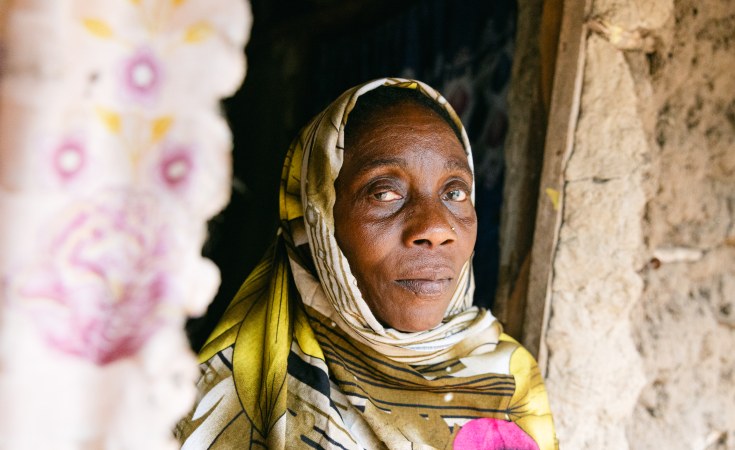
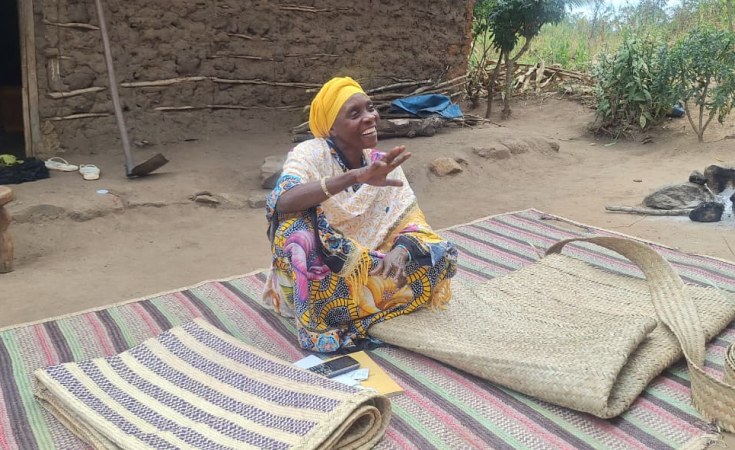
Dar es Salaam, Tanzania — In the small Tanzanian village of Mbwewe, Fatuma Saidi Majogo sits on a woven reed mat, surrounded by the dusty ground and traditional huts. She has a basket and crafting materials laid out around her. Her eyes, once clouded by pain and darkness, now sparkle with gratitude as she shares her story.
Because just a few years ago, her story was different.
Trachoma, a painful eye condition, threatened to take her sight. The disease was turning every daily duty into a battle and threatening her role as her family's provider.
For eight years before she noticed troubling changes in her vision, Majogo served as the chairperson of her village in Chalinze district in Pwani Region, a remote hamlet 73km from Dar es Salaam.
She stepped into the role in 2017, initially serving as acting chairperson after the previous chairperson passed away, and in 2019, she won the election and held the role for another five years, overseeing the affairs of her village and several households under her care. Majogo even guided eight fellow residents to treatment for the same eye condition she would later face herself.
She recalls that in the early days of 2017, looking into a small mirror, she noticed her eyesight changing. She didn't need anyone to tell her something was wrong; she'd seen others in her community suffer similarly. Her eyesight blurred, and she felt an intense, burning sensation, making writing nearly impossible.
"My eyes felt hot, even when they were closed," Majogo said. "At night, I couldn't sleep because of the pain. I kept scratching my eyes, but nothing helped."
Her eyes itched constantly, and she often scratched them until they burned. Her condition soon affected her ability to perform her duties. Her sight began to fail in 2022. She began to have difficulty seeing and relied on her grandchild to guide her between meetings and community activities.
As a result, she informed her local government leader that she could no longer fulfill her duties. It was a difficult decision, stepping down from the role she had held with pride, but without her sight, she could not serve effectively.
"I could only see two letters at a time. It broke me," Majogo said, so she stepped back and let others take over her responsibilities.
But what exactly is trachoma?
[Trachoma] is a bacterial eye infection caused by the bacterium Chlamydia trachomatis. Repeated infections may cause eyelid curling over years or decades. If left untreated, trachomatous trichiasis results in a slow and torturous descent into blindness as the lashes scrape the lens of the eye, slowly destroying it as time passes, eventually leading to blindness.
There are several symptoms associated with trachoma, including mild itching and irritation of the eyes and eyelids, discharge containing mucus or pus, swelling of the eyelids, and sensitivity to light (photophobia). In the absence of medical care, the impairment may be irreversible.
Trachoma is one of 21 diseases identified by the WHO as Neglected Tropical Diseases (NTDs), which are prevalent in tropical regions that have been neglected compared to other infectious diseases. Trachoma is responsible for the blindness or visual impairment of about 1.9 million people. It also poses a threat to 103 million people in some endemic areas, according to the WHO. It mostly affects people living in low- and middle-income countries, where water sources are scarce, sanitation is poor, and access to healthcare is limited.
Women are at higher risk due to social and cultural norms that place them in caregiving roles. It is reported that trachoma is four times more likely to require surgery in women than in men, and women bear the greatest share of the economic burden caused by blindness.
Determined to seek help, Majogo travelled to Kibaha, a district far from her village, where doctors diagnosed her with trachoma, a neglected tropical disease that can cause blindness if untreated.
She was referred to a specialist facility for surgery, but the cost—400,000 Tanzanian shillings (about $150)—was far beyond her means. Without the money on hand, she returned home to raise the funds. She gathered the money, returned to the hospital in Msasani.
Majogo underwent her first operation soon after, but her vision did not improve. It wasn't until her second surgery, performed in December 2024, that her sight returned.
She traveled to a clinic in Changalikwa, for the surgery, where she underwent corrective eyelid surgery on both eyes.
Majogo said that she did not pay for the surgery as it was free of charge, thanks to the support of Sightsavers, an organization dedicated to eye health, through their Trachoma Elimination Programme.
Majogo was fortunate to receive free surgery thanks to the support of Sightsavers, a key organization dedicated to fighting neglected tropical diseases (NTDs) like trachoma in Tanzania. The organization's efforts are part of a larger collaboration with Tanzania's Ministry of Health, which has made significant strides in reducing the trachoma burden since launching the Neglected Tropical Disease Control Program in 2009.
Once widespread in 69 councils, trachoma now persists in only seven, thanks to the implementation of the National Master Plan for NTDs and WHO's recommended SAFE strategy - Surgery, Antibiotics, Facial cleanliness, and Environmental improvements - aimed at eliminating trachoma by 2030. This coordinated approach helps ensure that people like Majogo have access to treatment and support, bridging the gap between need and care in Tanzania's rural communities.
Majogo is deeply grateful for Sightsavers' support and urges all Tanzanians who may have similar symptoms or need testing to come forward and get treated.
"They operated on me," she said, "and I didn't have to pay a single shilling." The organisation provided her with medicine, food, and transportation. The day after her surgery, they returned to gently remove the bandages from her eyes.
She often wonders how different her life might have been if she hadn't received help sooner. As a farmer, her vision loss once limited her ability to plant, harvest, and sell crops, the main source of her family's income.
"If you have symptoms, go and get tested."
Her experience with the disease not only affected her personally but also inspired her to help others. She now works with Sightsavers to combat trachoma in her village. She goes door-to-door in her community, checking people for symptoms of the disease. Whenever she spots symptoms, she takes careful notes. If she's unsure about someone's condition, she encourages them to participate in screenings when the organization returns to take people to hospitals for testing.
Out of the eight people she helped, two have died - but not from surgery or trachoma. The other six are still alive and continue to visit her.
"They still come and say, 'Thank you. Because of you, we were able to know what was going on with our eyes,'" she said.
Since her recovery, Majogo has become one of the most effective "case finders" in her area, identifying people with eye problems and encouraging them to get tested. She said some people are afraid that if they go for surgery, they won't be able to see afterwards.
"I am fighting for Tanzanians," she said. "There are still sick people in their homes refusing to go for testing. I want to go back into the villages, find them, and tell them my story so they are not afraid."
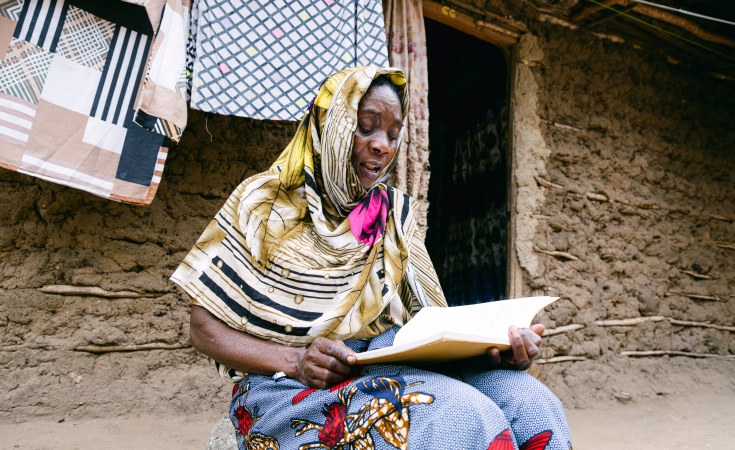
"Now I can see, read, and write again," she said. "I'm living my normal life again."
Majogo now also participates in social gatherings, attends celebrations, and works alongside her neighbours. The mat she and her family sit on, the cultivation of crops around her home, all these are things she now does herself. Her regained eyesight means she can also continue caring for her five grandchildren. She also does her agriculture and household duties, activities she had struggled with before her surgery. Many of her grandchildren are in school, and she helps them with their homework.
"If they get something wrong, I can guide them, and that makes me happy," she said.
She said that the experience was without pain but painkillers and antibiotics were provided immediately after the surgery, and she used them for several days. She said that she did not face stigma or discrimination from her family or community, but instead, she found love and care.
Her message is clear.
"My fellow Tanzanians, women and men, please, get your eyes tested," she said. "Don't be afraid. Eyesight is more important than hearing. If you lose your hearing, you can still see and work. But without vision, life is very difficult."
Chironda was in Tanzania as part of a workshop and field visits hosted by Sightsavers and Tanzania's Ministry of Health, in collaboration with other partners, including Uniting to Combat Neglected Tropical Diseases, a global advocacy organisation that exists to end NTDs by mobilising resources.

