

Debating Ideas reflects the values and editorial ethos of the African Arguments book series, publishing engaged, often radical, scholarship, original and activist writing from within the African continent and beyond. It offers debates and engagements, contexts and controversies, and reviews and responses flowing from the African Arguments books. It is edited and managed by the International African Institute, hosted at SOAS University of London, the owners of the book series of the same name.
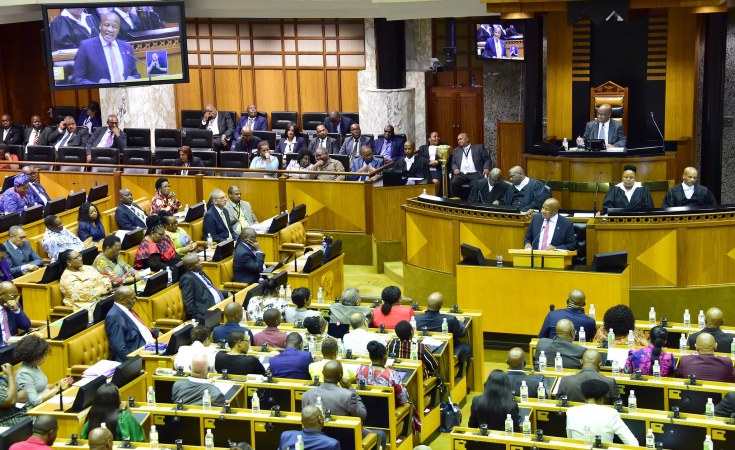
There is an article titled "The Long and Uphill Road" in a June 2025 edition of the South African weekly Financial Mail. It belabours the dynamics of the current South African coalition government partnership between the once rival parties of the African National Congress (ANC) and the Democratic Alliance (DA). Such articles are common: politics makes good news, the two parties' differences are contentious and exciting, and their ability to continuously resolve their differences resonates with a local and global readership who like hearing about how South Africa continues to be a bastion for reconciliation.
The position of the two parties on whether this new Government of National Unity (GNU) will survive their internal infighting is, as ever, dull. Neither have the support nor the guts to govern alone, so they must go together. The article inadvertently represented each party's positions symbolically. The position of the ANC, spoken by secretary-general Fikile Mbalula, was taken from the eulogy of a fallen comrade. The DA's came from their leader, John Steenhuisen. As ever, the ANC speaks from a dying place, and the DA will always seize the opportunity to improve its PR.
Follow us on WhatsApp | LinkedIn for the latest headlines
This place-of-speaking dynamic is of interest in how their coalition currently functions. Both bring the partisan need to convince voters that they should be re-elected - something difficult to prove when you're now working with the team you opposed for the last two decades. But both also have the task of gaining public consent for the 'higher' greater good they supposedly work for as members of the South African government. But rather than (precious/differing) views causing chaos, there is a narrative order this coalition inevitably ascribes towards.
A recent book by former DA leader Tony Leon, entitled Being There: Backstories from the Political Front, gets at what I mean. The core of the book - as advertised in the blurb - is a recreation of his diary that depicts what occurred during the coalition negotiations between the ANC and the DA. The rest of the text collects other instances in Leon's political life: meeting Yasser Arafat, working in Argentina, rethinking his relationship as the opposite leader to Nelson Mandela's own GNU government. "Timing, chance, circumstance and career," he writes, "can affect your life and the direction it takes." Being there, as the title lays bare, is noticeably important.
And he does prove himself important. He got into the negotiation room through a phone call from DA leader John Steenhuisen. He kept a diary to "keep a careful account of what happened". Now published, we too can be there through his eyes. The figure he writes of himself does not take centre stage. Political experience, both as a long-standing member of parliament and as one of the few to have attended the Convention for a Democratic South Africa (CODESA) talks in 1993, grants him the authority to be in the background and provide useful comments when needed.
He quotes former SACP central committee member Joe Slovo in one instance. This comes during an early deadlock involving the two very different approaches to governance - DA prefers "devolution-of-power" whereas the ANC likes "cooperative governance". Leon offers Slovo's appeal for all involved to "lift ourselves above ourselves" to find a suitable compromise. He's quick to point out the cliché in the preceding sentence, but this type of figuration is quite on-character for Leon. Most of his political life has been as the person providing helpful advice to those in power and rarely putting the full spotlight on himself. He's there - and provides use - akin to the red and blue colors on a tap.
His appeal to a struggle stalwart is smart. Slovo is not just above party politics - he's a representation of the old democratic ideal of common ground for a better future. Apparitions for future ideals are valuable in a democratic order like South Africa, where clichés - like correcting historical imbalances - run campaigns. Note here that Slovo, though dead and invoked to create a common ground, is difficult to place as a neutral agent. Labels, however ideologically erroneous and contradictory, like "communist," "terrorist," "liberal," "prisoner," and "old man" all apply to him and how he is remembered. Ultimately, Leon's well-placed appeal led the negotiation down a path of transcending differences towards an agreeable, better outcome for both parties and probably South Africa: a country decidedly not led without both ANC and DA.
The theoretical framework here is crucial. Effective coalition partnership in democracies requires a mastery of non-neutral methods. Not, that is, strict compromises - remember, the voting public does not want their party to placate the enemy's demands. Rather, by non-neutral, I mean a Fregenian sense, a "kind of neutral informational content", where the same reference bears different meanings, all of which function without irrationality. It's the words and phrases that make both supporters and opposers agree because it provides them a means to prove what they believe.
Awesome for party politics, but what of liberal democracy? And what lesson, if any, can be applied to broader African coalition governance?
Liberal democracies need free speech for impartial news to inform the public. This public, drawing conclusions from what they know, deliberates and elects those who will advance everyone's ability to be free. It's not necessarily wrong for a party to stand for an ideology which directs the beliefs the members of the group hold. This is especially true when, following a Rawlsian approach to liberal democracy as noted by Charles Simkins, "if it leads to long-term improvement in the prospect of the least advantaged". We can be "misled" if it helps us in the long run to be freer. Impartiality is a veil of need that can additionally allow for irrational functioning.
Proportional-representation democracies tend towards coalitions. Such a system was implemented in South Africa precisely because constitutional specialist Kader Asmal saw its necessity in a multicultural country. This is to avoid future returns to a history of domination by one group over another. Across Africa, where borders were drawn in Berlin and devoid of thought for self-governance, coalitions are equally logical in their attempt to avoid tribalism taking hold.

Sign up for free AllAfrica Newsletters
Get the latest in African news delivered straight to your inbox
Proportional-representation systems across Africa face the same fundamental challenge: how to make coalition governance appear natural rather than forced. How, in another way, do they advance the consent of the people for their liberal ends? Leon's book does demonstrate the deliberate craft required to transform ideological opponents into governing partners through careful narrative construction.
Coalition government is not an aberration in proportional-representation democracies; it is their natural condition. South Africa's experience reflects both the faux-zenith and the difficulty of such arrangements. Narrative construction becomes not a distraction from governance but one of its central instruments: the means by which rivals justify partnership to their own constituencies while sustaining a functional state.
Yet it carries a cost, whether or not it shows its rhetorical irrationality. The more politics becomes an exercise in shared storytelling, the more it risks dulling the contest of ideas on which liberal democracy ultimately depends. The challenge, in South Africa and beyond, is to ensure the narrative serves the citizenry, not just the survival of those who govern. And, importantly, the pros and cons of narrative signs relationship with democratically neutral speech must be understood.
Kris Van der Bijl is a writer and researcher from Cape Town, South Africa. He holds a Master of Arts degree in Creative Writing from the University of Cape Town. He writes at the intersection of literary criticism, culture, and politics, with a focus on Southern African narratives. His work has appeared in publications like Wasafiri, The Johannesburg Review of Books, and News24.

