

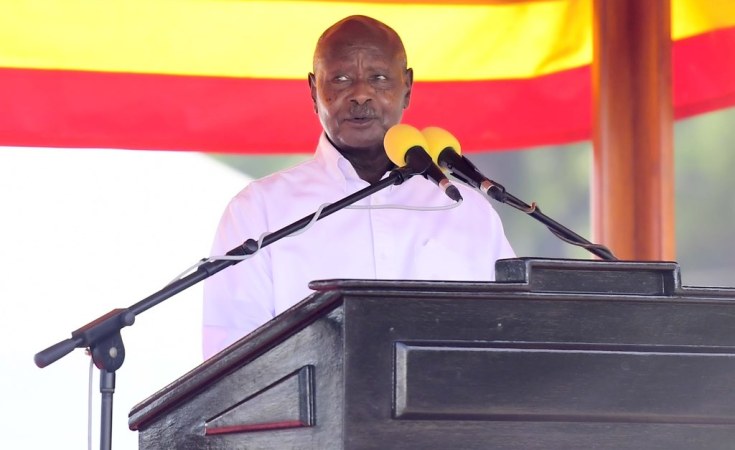
President Museveni, who is also the NRM presidential flag bearer has unveiled the party's manifesto for the forthcoming five years.
The manifesto was launched during a ceremony held at Speke Resort Hotel in Munyonyo .
In his manifesto speech, witnessed by thousands of ruling NRM supporters and officials who painted Munyonyo yellow, Museveni put emphasis on protecting "the gains," for the last 60 years of the NRM.
Highlighting five crucial points in the 2026- 2031 manifesto, Museveni singled out peace and security as the springboard for the country's development.
Follow us on WhatsApp | LinkedIn for the latest headlines
"We are not just talking about this manifesto but the work of the NRM for Uganda and with Uganda for the last 60 years. Ensuring a qualitative leap to high middle income status is our logical next step, given what we have gone through. Everything we are saying is linked," Museveni said.
According to the president, peace has been ensured by the people and the UPDF, noting that no one can attempt to start war with Uganda or else they would regret it.
"Our army is very strong and nobody can bring war here or we destroy them."
Museveni however said the only problem is security which is characterised by crime but said this will be tackled.
Taking pride in the country's security, Museveni said this has led to development of social infrastructure like schools and health centres and economic infrastructure like roads and railway.
However, the president is quick to point out that development without wealth is nothing.
"There is a different between development and wealth. Wealth is in the home of people. When you go to rallies, people want districts, cities but if you start with wealth, there is no way we can go wrong," he says.
He says NRM leaders must ensure people are involved in wealth creation.
"As leaders you must know that to strengthen NRM more and durably, you must do what we in the student movement did in 1960s when we started campaign in the cattle corridor as those people were very backward. When we analysed the problem and taught them, they are now wealthy despite infrastructure not being good. They have money, have built good houses. If you see you are a leader and say development, but you don't says anything about wealth of the people, it is where problems come from."
According to Museveni, wealth creation is key if Uganda is to move to a higher middle-income status.
The president said wealth creates jobs that will ensure unemployment is fought, citing the state minister for transport, Fred Byamukama who earns about shs700million from the sale of eggs at his farms but also employs 26 people.
"There are a few public service jobs which are not enough for all Ugandans. The bigger number of jobs is in private sector and it is created through personal wealth and in the process, you create jobs," Museveni said.
He added, "This thing of people who can't think properly must end. You find people going to Middle East to look for jobs! The people in Middle East should be coming to work here."
Museveni said Uganda can easily create more jobs than its population.
"Uganda has 40 million acres of arable land but if we only used 7 million we would create over 104 million jobs .Let us get out of sleep. It is wealth that creates jobs."
According to the NRM flag bearer, services are another avenue for creating wealth and jobs for Ugandans.
He however said with all the produce got, the country needs a market for its goods.
"When we talk of patriotism and pan Africanism, it is not theory but survival. Our population must know what needs to be done. If we produce, the internal market is there but not enough and leads us to East Africa."
Museveni also talked about strategic security that he said is key for survival of the country and East Africa at large.
He said East African federation will ensure this, urging young people to push for this.
He also mentioned using the knowledge economy to further developing Uganda, citing the Kiira EV plant in Jinja as one of the examples of this type of economy.
"Once government has funded research and products, Ugandans should come and buy shares in these factories. It must be government supporting our scientists and the population co-own the factories."
He said in the next five years, government will focus on a number of issues affecting masses including fighting poverty and creating jobs, noting that this will be through programs like the Parish Development Model and Emyooga where government will inject more cash to help Ugandans get out of subsistence production and join the money economy.
Speaking during the same function, the NRM secretary general Richard Todwong said the 2021- 2025 manifesto has mostly been accomplished.
He said the economy has doubled in spite of global shocks like covid and that by end of 202 5 /26 financial year, it will have grown to shs254.2trillion.

Sign up for free AllAfrica Newsletters
Get the latest in African news delivered straight to your inbox
"Ugandans are now wealthier because poverty declined to 16.1% by 2025 while proportional of households in subsistence economy is now has also gone down. The shilling has been the most stable currency in Africa and gained value as many other currencies lost theirs," Todwong said.
Inspire of above achievements, Todwong said there remains uncompleted business which he said the NRM intends to complete this term.
He mentioned creating wealth for the remaining 33% households still in subsistence production, resolving land use rights, fragmentation, adding value to agricultural products before exporting them, developing more tourism sites and investing in irrigation to enhance agriculture among others.
Museveni's manifesto
Peace - ensuring stability and national security as a foundation for progress.
Development - driving infrastructure and industrial growth.
Wealth - empowering citizens to create and sustain household incomes.
Services - improving access to quality health, education, and social services.
ICT - harnessing technology and innovation for national advancement.
Market - expanding access to domestic, regional, and global markets.
Strategic Security - safeguarding Uganda's sovereignty and long-term interests.

