

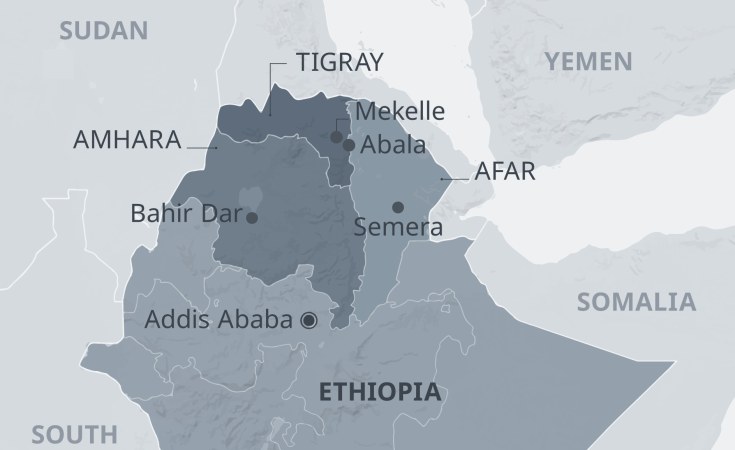
Addis Abeba — The Tigray People's Liberation Front (TPLF) has accused the guarantors of the Pretoria Peace Agreement--the United States, the European Union, the African Union, and the United Nations--of failing to act on their commitments, alleging that a "silent genocide" continues in Tigray nearly three years after the accord was signed.
In a statement issued on 29 September 2025, the party urged the international community to intervene to halt what it described as the ongoing destruction of the region. "We appeal to the international community: act now. Do not allow Tigray's destruction to continue in silence. Honor your commitment to peace, protect the innocent, and prevent another unheeded tragedy," it said.
The TPLF cited worsening humanitarian conditions, referencing the recent death of one-year-and-four-month-old Naod Hailesselassie, killed by a hyena inside an internally displaced persons (IDP) shelter in Mekelle. The party described the incident as emblematic of "the daily torment of thousands displaced from Western Tigray--struggling to survive without food, medicine, shelter, security, or dignity."
The party argued that the Pretoria Agreement--signed in November 2022 with pledges for peace, the return of displaced persons, and the withdrawal of occupying forces--remains largely unimplemented. "Most provisions remain unfulfilled, IDPs remain stranded, and occupation persists. The catastrophe deepens, and the silent genocide continues," the statement read.
Follow us on WhatsApp | LinkedIn for the latest headlines
According to the TPLF, hundreds of thousands have died in IDP camps over the past five years due to hunger, disease, exposure, and lack of protection. "This is not misfortune--it is systematic neglect, carried out under the guise of 'peace,"' the statement said.
The party demanded "the full implementation of the Pretoria Agreement: the immediate removal of occupying forces and the safe return of IDPs," while condemning what it called the guarantors' failure to uphold their responsibilities.
In May 2025, NEBE revoked the TPLF's legal status, citing the party's failure to implement "corrective measures" ordered by the Board to meet requirements tied to its special status, including convening a general assembly within six months.
TPLF rejected the decision, insisting that its legitimacy is guaranteed under the Pretoria Cessation of Hostilities Agreement (CoHA) and not through NEBE's conditional framework. The party previously dismissed both its suspension and subsequent revocation as "legally insignificant."
Recently, Lt. Gen. Tadesse Werede, President of the Tigray Interim Administration, has dismissed the National Election Board of Ethiopia's (NEBE) decision to revoke the legal status of the Tigray People's Liberation Front (TPLF) as "unacceptable," stressing that the matter requires a political solution rather than bureaucratic sanction.
TPLF's appeal to the African Union
On May 2025 Addis Standard reported, citing TPLF's letter. that Debretsion requested the African Union to take three urgent steps: to convene an emergency session of the High-Level Panel on Ethiopia to mediate the legal status dispute; place the matter on the agenda of the AU Peace and Security Council to assess NEBE's compliance with the Pretoria Agreement; and pressure the Ethiopian government to suspend the NEBE's decision until proper AU guidance is provided.
The TPLF also alleged that the AU Panel itself had previously recommended its legal reinstatement, but has failed to reconvene or enforce that recommendation.
In a letter addressed to AU Commission Chairperson Mahmoud Ali Youssouf on 15 May and copied to key AU and Peace and Security Council (PSC) officials, Debretsion warned that the Ethiopian Election Board's 14 May decision to revoke TPLF's legal status, which reclassified the party as an illegal political party, threatens to unravel the cornerstone of the Pretoria Agreement, which brought an end to the devastating two-year war in the Tigray region.
"This act fundamentally violates the validity and integrity of the Pretoria Agreement," wrote Debretsion, calling the decision a "unilateral" move by the federal government that reframes a political matter as a technical administrative issue.
NEBE justified the revocation on the basis of the TPLF's failure to meet legal requirements under Proclamation No. 1332/2016, including holding a general assembly after it was provisionally registered in August 2024. However, the TPLF has consistently maintained that it never accepted the "special registration," arguing that the Pretoria Agreement restored its pre-war legal status de facto and therefore made re-registration unnecessary.

Sign up for free AllAfrica Newsletters
Get the latest in African news delivered straight to your inbox
The NEBE's decision invokes Article 99 of Proclamation No. 1162/2019, which enforces full dissolution of a political party, prohibits further activity, and mandates the liquidation or reassignment of its assets.
"The TPLF never requested to register as a new party," the party stated in its May 9 release. "We are demanding the restoration of our previously recognized legal status based on the Pretoria Agreement."
Furthermore, it was reported the President of the Tigray Interim Administration, Lt. Gen. Tadesse Werede, has warned of a "visible cloud of war" amid mounting tensions and called on the federal government to honor key provisions of the Pretoria Peace Agreement.

