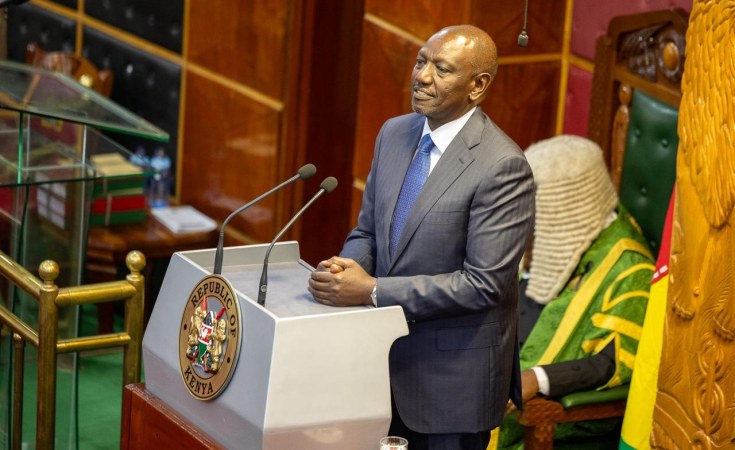
Nairobi — President William Ruto has revealed that his long-term infrastructure plan -- including major road, rail, water and energy projects -- was shaped after consultations with leaders across the political divide, among them former President Uhuru Kenyatta and the late ODM leader Raila Odinga.
Speaking during his State of the Nation Address in Parliament, Ruto said the scale of Kenya's development needs requires national consensus, not partisan competition, and that both Uhuru and Raila had emphasised the centrality of infrastructure in transforming the economy.
Ruto told MPs that Raila, in their discussions, stressed that no country has industrialised without first investing heavily in roads, energy, and food security, noting these three pillars are fundamental to job creation, manufacturing, and regional competitiveness.
Follow us on WhatsApp | LinkedIn for the latest headlines
"I discussed this vision with the late Rt. Hon. Raila Odinga, who reminded me that no nation has industrialised without roads, energy, and food security," the President said.
He added that former President Uhuru Kenyatta had also supported the need to scale up infrastructure investments, building on past projects such as the Standard Gauge Railway, highways, and digital backbone expansion.
"I have also engaged former President Uhuru Kenyatta, who emphasised the necessity of scaling up infrastructure investments," Ruto said.
The President's remarks signalled an attempt to frame large-scale infrastructure as a non-partisan national priority at a time when Kenya is pursuing new financing models to curb reliance on external borrowing.
Ruto has unveiled a vast development plan -- including building at least 50 mega dams, adding 10,000 megawatts of new power generation, expanding irrigation to 2.5 million acres, dualing 2,500 kilometres of highways, and extending the Standard Gauge Railway from Naivasha to Kisumu and later to Malaba.
He said these plans, which could cost at least Sh5 trillion over the next decade, require a unified national approach, and the establishment of a National Infrastructure Fund and Sovereign Wealth Fund to support long-term financing without increasing Kenya's debt burden.
By disclosing consultations with Uhuru and Raila, Ruto sought to underscore infrastructure as a shared national agenda that transcends political affiliations and leadership eras.

