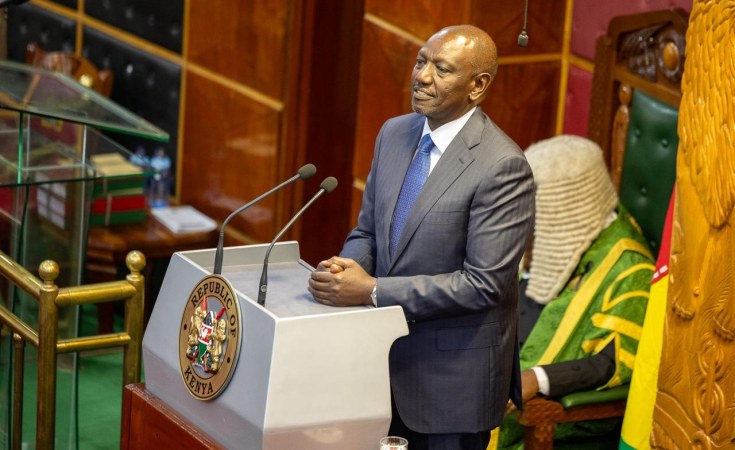
Nairobi — President William Ruto has unveiled an expansive four-pillar development blueprint centred on a skilled workforce, irrigation-led agricultural transformation, major energy expansion and modern transport infrastructure -- setting the stage for what he described as Kenya's boldest attempt yet to join the ranks of first-world economies.
Delivering his third State of the Nation Address to Parliament, Ruto said Kenya must break from the complacency that slowed earlier progress, warning that while the Asian Tigers accelerated their growth through discipline and long-term planning, Kenya remained stuck in "ordinary expectations". He argued that nations such as Japan and South Korea rose not because of special advantages but through "leadership, discipline, strategic investment and an uncompromising rejection of mediocrity". He cited Japan's transformation from 2,000 kilometres of paved roads to more than 1.1 million, and South Korea's rise to a GDP per capita of over US$36,000 against Kenya's US$2,200.
Ruto's first priority focuses on building a highly skilled workforce through stronger research and innovation capabilities. A new State Department for Science, Research and Innovation will drive STEM expansion and strengthen Kenya's innovation ecosystem. He pointed to Safaricom and M-Pesa's global reach as evidence that Kenyan companies can compete internationally. The President said the government will raise the national research fund from 0.8 percent to 2 percent of GDP, bridging an initial shortfall of KSh 180 billion, with a long-term goal of growing a KSh 1 trillion research fund within the next decade. He added that the education budget has risen from KSh 490 billion in 2021 to over KSh 700 billion, enabling improved facilities, more teachers and stronger universities and TVET institutions.
Keep up with the latest headlines on WhatsApp | LinkedIn
The second pillar centres on an ambitious water-harvesting and irrigation plan. Ruto announced the construction of at least 50 mega dams, 200 medium and small dams and thousands of micro-dams to irrigate 2.5 million acres within seven years, covering regions including Mandera, Isiolo, Machakos, Garissa, Kisumu, Laikipia, Embu, Turkana, Nyeri, Kilifi, Kiambu and Bungoma. He said the strategy would end Kenya's reliance on erratic rainfall, unlock agricultural potential in arid counties, and feed agro-industrialisation in SEZs, EPZs and county industrial parks. Kenya spends more than KSh 500 billion annually importing food, he noted, insisting that irrigation is critical to reverse the trend and transform the country into a net exporter.
On energy, the third pillar, the President said Kenya's firm power capacity -- currently about 2,300MW -- is insufficient for the country's aspirations in manufacturing, agro-processing, digital services, e-mobility and AI-driven industries. He said the government will generate an additional 10,000MW in the next seven years using geothermal, solar, wind, hydro and nuclear power. The expansion, he said, is essential for supporting a technology-enabled future and positioning Kenya as a green industrial hub.

Sign up for free AllAfrica Newsletters
Get the latest in African news delivered straight to your inbox
The fourth pillar focuses on modernising transport and logistics to reinforce Kenya's status as a global and regional gateway. The Ministry of Roads and Transport has mapped 2,500 kilometres of highways for dualing and 28,000 kilometres for tarmacking over the next decade. Ruto will launch the dualing of the 170-kilometre Rironi-Naivasha-Nakuru-Mau Summit road next week, alongside the Rironi-Maai Mahiu-Naivasha route. He said major corridors across Kiambu, Machakos, Kericho, Kisumu, Busia, Laikipia, Nanyuki, Meru, Mombasa, Lunga Lunga, Migori and Isebania will also be expanded. The Standard Gauge Railway will be extended from Naivasha to Kisumu and ultimately to Malaba beginning January 2026.
Ruto said public-private partnerships will support the modernisation of JKIA as well as the Mombasa and Lamu ports, alongside efforts to address challenges facing Kenya Airways. He emphasised that efficient transport and logistics are central to national competitiveness, lowering the cost of doing business and strengthening Kenya's role as the aviation and commercial capital of East and Central Africa.
