

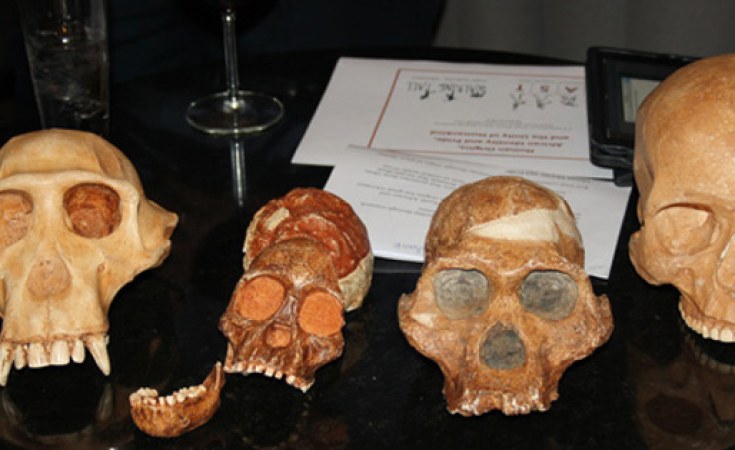
Addis Ababa — A new fossil discovered at Woranso-Mille, Ethiopia, has revealed that Lucy's species co-existed with another relative species, Arizona State University researcher Yohannes Haile-Selassie reveled today.
The Australopithecus deyiremeda, a little-known early human ancestor that lived 3.4 million years, was discovered in 2009.
Ethiopian Heritage Authority Director-General, Abebaw Ayalew, and Arizona State University Institute of Human Origins' Director and Researcher, Professor Yohannes Haile Selassie, gave a joint statement regarding the puzzle that followed the discovery.
During the briefing, Arizona State University paleoanthropologist Yohannes Haile Selassie said the species, first hinted at in 2009 with the discovery of a mysterious fossilized foot at Burtele in the Woranso-Mille area of the Afar Region, has long puzzled scientists.
Keep up with the latest headlines on WhatsApp | LinkedIn
Studying the juvenile jawbone that matched the same age and geological layer as the foot, scientists were able to confidently assign the foot to Australopithecus deyiremeda.
Not only this discovery reveled the co-existence but assures lucy is the ancestor species to human kind or close to human kind than Australopithecus deyiremeda which has more primitive features than Australopithecus afarensis.
The discovery indicated that the unique features show combination of climbing ability and bipedal walking.
Professor Yohannes added that the updated understanding of Australopithecus deyiremeda offers valuable clues about early human diversity, showing coexistence between Australopithecus afarensis and Australopithecus deyiremeda.
The species lived at the same time and in the same area as Lucy's species, Australopithecus afarensis, long considered the dominant early human ancestor of that era, it was learned.
Ethiopian Heritage Authority Director-General, Abebaw Ayalew, said the discovery of Australopithecus deyiremeda is additional evidence that proves that Ethiopia is a cradle of humankind.
This would also strengthen Ethiopia's place in the birthplace of humankind and enhance Ethiopia's place in additional research area, he added.
The Director added that to a long ancestry of groundbreaking findings that span from remains dating back 6.4 million years to Homo sapiens Idaltu, the closest known ancestor of modern humans.
Accordingly, the discovery of this new fossil material further strengthens the argument that Ethiopia is the cradle of mankind, he noted.
Out of the 23 most ancient human origin relics found globally, 14 of them have been discovered right here in Ethiopia therefore this rich heritage continues to draw researchers from around the world.
As Ethiopia owns a large number of important artifacts related to the history of human origins, the government has decided to build a major museum dedicated to this sector, he stated.

Sign up for free AllAfrica Newsletters
Get the latest in African news delivered straight to your inbox
He stressed that on the need to nurture a new generation of scientists, following in the footsteps of renowned researchers such as Professor Yohannes Haile-Selassie.
The Director-General finally applauded the discovery and commended the research team for their dedicated work in bringing the finding to global attention and emphasized on the need to cultivate more researchers to drive even greater achievements in the field.

