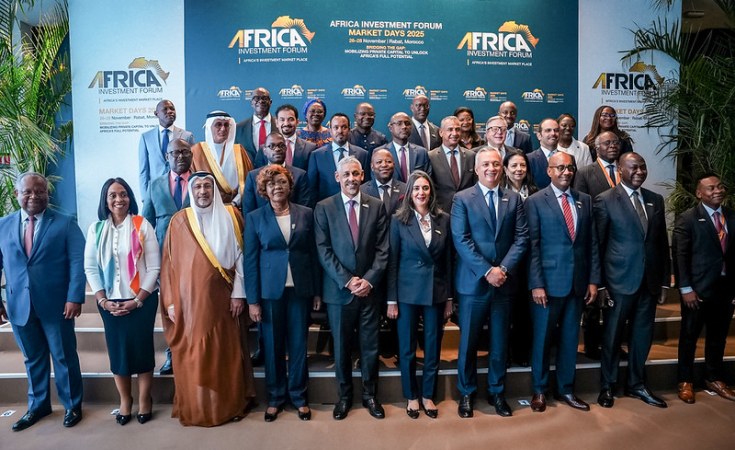
African finance ministers convening at the 2025 Africa Investment Forum (AIF) have urged a decisive shift from showcasing potential to delivering bankable projects, stressing that private capital --not aid -- must drive the continent's economic transformation.
At a Ministerial Dialogue on Accelerating Private Investment Through Conducive Enabling Environments, following the event's opening plenary, ministers from Côte d'Ivoire, Ethiopia, Guinea, Mauritania, Morocco, and Zambia shared perspectives on improving regulatory frameworks, building investor trust and supporting resilient business ecosystems capable of attracting long-term private sector participation.
Côte d'Ivoire's Minister of Economic Planning and Development, Nialé Kaba, called on African nations to strengthen project preparation and follow-up mechanisms to attract private investment.
"Africa's problem is that opportunities and projects are not mature," Kaba said, highlighting Côte d'Ivoire's reforms, including streamlined investment codes and single-window services, which propelled private investments from 12% of GDP in 2020 to 20% today.
Zambian Minister of Finance and National Planning Situmbeko Musokotwane reported that the country is emerging from its debt crisis following a recent ratings upgrade. Over the past three years, Zambia has signed nearly $2 billion in public-private partnership projects and attracted more than $7 billion in new mining investment.
According to Musokotwane, Zambia is mobilising billions in private energy investment and streamlining project approvals to under 45 days to address the crisis. Musokotwane drew attention to the Lobito Corridor, a privately financed rail link poised to become Africa's first east-west transcontinental railway. This vital artery will connect Zambia and the Democratic Republic of Congo to Angola's Atlantic coast, reshaping regional trade.
From Morocco, Economy and Finance Minister Nadia Fettah pointed out that investors seek profitability and execution-ready projects, not promises of potential.
"We are being asked for ready projects, delivered with speed and strong execution capacity," Fettah said, advocating for year-round preparation of regional project pipelines. Highlighting sectors like railways, aviation, and data centres, she underscored that by pooling resources and coordinating efforts, African nations can overcome the limitations of individual market sizes and successfully pursue large-scale infrastructure initiatives.
Mauritania's Minister of Economic Affairs and Development, Abdullah Suleiman Sheikh Sidiya, hailed Africa's strategic shift from the aid-dependent image of the 1990s, stating: "Africa is becoming a sought-after destination--not only for cooperation but increasingly for investment."
Guinea's Minister of Planning and International Cooperation, Ismael Nabe, said the country is positioning itself to replicate successful development projects across Africa by leveraging international partnerships.
Citing the importance of robust project preparation in mitigating investment risk, Nabe showcased Guinea's UK-Export Finance-backed Administrative City -- a model inspired by initiatives in neighbouring Benin.
He described the Africa Investment Forum's platform as a "compass" for private-sector-led development and a catalyst for co-financing and innovation. "What is working in one country, like Côte d'Ivoire, can be adapted and scaled in Guinea and beyond," he said, underscoring the potential for blended financing with partners such as the African Development Bank Group, Exim banks, and Middle Eastern funds.
With Guinea's population rapidly growing and predominantly young, the minister said the country aims to harness these opportunities through shared success stories, co-creation, and strengthened international collaboration.
Ethiopian Finance Minister Ahmed Shide spoke of sweeping reforms aimed at transforming the economy, including foreign exchange liberalisation, customs modernisation, and the establishment of a securities exchange. To fund ambitious flagship projects like the Bishoftu International Airport, Shide said Ethiopia is pioneering innovative financing tools such as securitisation, blended finance, and credit enhancement, positioning the nation as a continental aviation powerhouse.
The well-attended ministerial forum underscored a unified message: Africa's development model has shifted decisively toward private capital. The ministers outlined the path forward, requiring governments to drive a pipeline of execution-ready projects, bolstered by robust reforms and enhanced regional integration, to unlock the continent's vast economic potential.
Click here for photos.


