

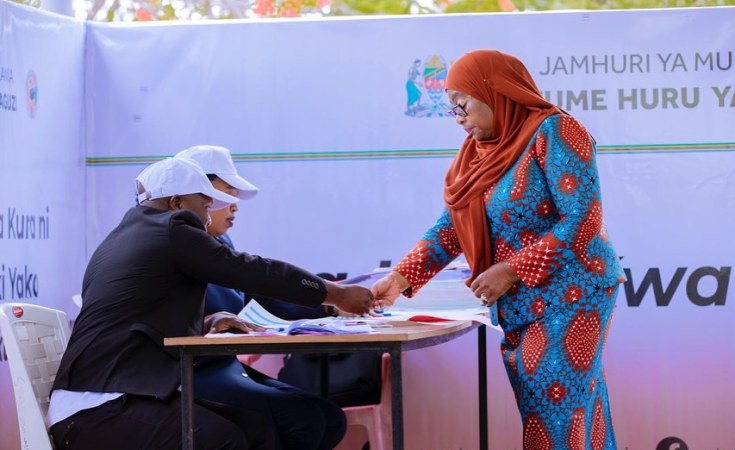
On October 29, 2025 Tanzania went to the polls. Or rather, a few Tanzanians went to the polls, in some cases seemingly under duress, but many stayed at home. When the implausible results were announced - a claimed 98% vote for incumbent President Samia Suluhu Hassan on an 87% turnout (compared to an 84% vote for the late President Magufuli on a 50.7% turnout in 2020, and a probable real turnout this year of around 35%) - many took to the streets in protest.
It is hard to be sure exactly what happened as the government has not encouraged efforts to find out, but some things are already clear. Protests occurred not just in the capital Dar es Salaam, but in Mwanza and Arusha, and at Namanga on the border with Kenya.
Everywhere, the government responded with brutal repression. The verified evidence is mounting that certainly hundreds and potentially thousands of protesters and innocent civilians were killed and wounded not only by government soldiers but by armed men in plain clothes. At least two journalists were killed by security forces, and one Tanzanian journalist who survived gave a graphic description of the brutality of the crackdown. Most Tanzanians had never seen anything so violent on their own streets.
Follow us on WhatsApp | LinkedIn for the latest headlines
This violence followed an election campaign in which every credible opposition party had been effectively excluded or hamstrung. The presidential candidates for the two largest, Tundu Lissu for Chadema and Luhaga Mpina for ACT Wazendeleo, had been prevented from running by the electoral commission, backed by the courts. Lissu (who survived an assassination attempt in 2017) has been imprisoned on charges of treason since April. Chadema refused to take part in the elections, and ACT Wazalendo candidates were physically harassed and obstructed from campaigning. On election day, so blatant was the ballot-rigging that even the African Union and SADC observer missions concluded that the elections did not meet democratic standards. The AU accused the government of "compromising election integrity" so that the elections "did not comply with AU principles, normative frameworks, and other international obligations and standards for democratic elections", with an environment that was "not conducive to peaceful conduct and acceptance of electoral outcomes".
Many Tanzanians have concluded that the governing CCM is determined to hang on to power by hook or by crook. Any pretence at democracy is over: never again would a free choice be offered by this party. As Michelle Gavin has commented, "Public trust is at an all-time low."
Governments that shoot their own citizens to stay in power shoot their own legitimacy. It suggests the CCM has become a party not of the people but against the people. President Hassan has announced an inquiry into the post-election deaths, admitting (unlike her foreign minister) that there were some. But will it actually reveal who decided to shoot the protesters, let alone who decided to exclude the opposition and manipulate the results of the election? To be credible to Tanzanian citizens, there should be an inquiry headed by an independent outsider, as Kofi Annan did in Kenya after the election violence in 2007-08 left over a thousand Kenyans dead. Rumours are swirling as to who gave the orders and who carried out the shooting, and civil rights groups are said to be preparing to refer the matter to the International Criminal Court (ICC). But as head of the party and supreme commander of the armed forces as well as head of government, ultimate responsibility for these decisions rests firmly with President Hassan herself. If she did not take them, then she is merely a puppet of those who did.
It is ironic that had the CCM run a free and fair election, allowing all opposition candidates to run, it may still have won. But given the anti-incumbent votes in other African countries (like Botswana and Malawi), and the Gen Z protests that had erupted in Kenya and elsewhere, the CCM decided to take no chances, and put no trust in the judgement of the wananchi, the common people.
The CCM has been the longest ruling party in Africa, in power since independence in 1961. Nyerere set the example of stepping down voluntarily as President to allow a successor to take over. He put in place a robust internal democracy that created a regular turnover of MPs and leaders. But this was always balanced by a willingness to resort to force to protect the state's interest, for example over villagisation. Multipartyism was only restored in 1992 after Nyerere's retirement. Over the years the CCM's internal democracy decayed until it was effectively killed off by President Magufuli, who brooked no dissent. Part of Magufuli's popular appeal was his determination to crack down on the corruption which had grown over the CCM's unlimited access to power, but with his death from Covid-19 in 2021, that campaign slackened. The party, addicted to power and the rewards it can bring, returned to its old ways, and corruption is reportedly rising again.
There remain well-intentioned technocrats in the government - the Central Bank Governor Emmanuel Tutuba, former Minister of Finance (now Prime Minister) Mwigulu Nchemba - who want a growing economy to provide jobs for the young and finance for development. But this action will have set back those efforts and make it even harder to accelerate growth and create jobs.
This crisis could nevertheless be a moment for reform, as it was in Kenya after the post-election violence of 2008. The two main protagonists, Uhuru Kenyatta and William Ruto, were indicted by the ICC. Though the prosecutions may have failed, the political impact was salutary, discouraging future resorts to violence. A public consultation and constitutional reform devolved power to the Kenyan regions so that politics was no longer a winner-takes-all competition at the centre. Even in China, after the Tiananmen Square massacre killed the prospects for democratic reform, the Chinese Communist Party responded by hugely expanding economic opportunities, assuaging the concerns of youth with jobs and money.

Sign up for free AllAfrica Newsletters
Get the latest in African news delivered straight to your inbox
But elsewhere in Africa, autocratic governments and leaders have responded to protests with nothing more than repression. The sad state of Zimbabwe's economy and society, the conflict and political trauma in Ethiopia, and the economic and political stagnation in Cameroon illustrate what will happen if the CCM opts for the path of repression. Some outside powers, unconcerned about governance, may support them - as the UAE and China have been doing in Tanzania. The EU seems divided between those that wish to demonstrate concern and those who want to remain engaged. Though it has less influence that it once did, and the US has withdrawn, if the CCM continue on their current path, it will have a chilling effect on international and domestic investment, people will leave, and the prospects for ordinary Tanzanians, except those in the party elite, will get worse.
Can the CCM restore its lost legitimacy, provide justice for the victims of the violence, re-establish internal democracy, reconnect with the people, and open up political competition, inside and out? If so, it must do it fast. Without drastic reform, without restoring its legitimacy, the precious gains in stability and progress since independence risk being lost - and the CCM will be lost with it.
Nicholas Westcott is Professor of Practice in Diplomacy at SOAS University of London and a former British diplomat in Africa. He has a doctorate in Tanzanian history.

