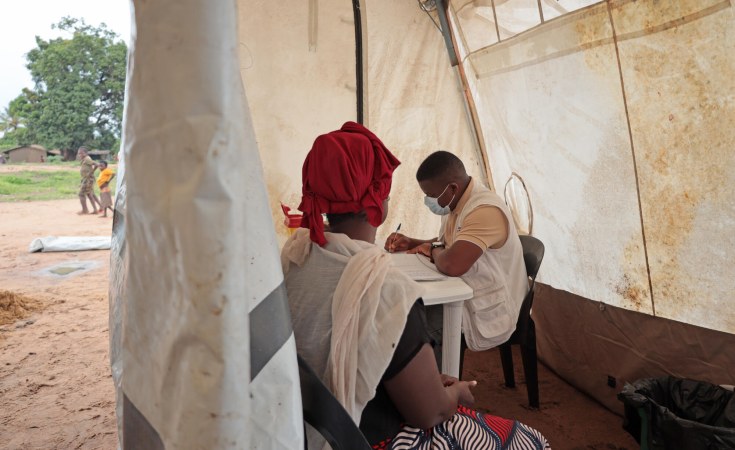
To respond to the needs of the more than 100,000 people who were forced to flee their homes in northern Mozambique a few weeks ago, Médecins Sans Frontières (MSF) launched an emergency intervention in Nampula province. Since 4 December, MSF teams have been providing medical care and essential services in the areas of Eráti district with the highest concentration of displaced families.
During the month of November, a non-state armed group carried out multiple attacks in Nampula province, triggering the third and, so far, largest wave of displacement in northern Mozambique since July 2025. This wave of displacement is part of a broader humanitarian crisis caused by the eight-year-long conflict in Cabo Delgado, which has periodically spilled over into neighbouring provinces, including Nampula. Over 100,000 people fled their homes, according to the latest IOM data.1 In total, over 300,000 people have been forcibly displaced in northern Mozambique since late July.
While some displaced families have begun returning to their places of origin, these movements are not always the result of genuine safety or readiness. In certain cases, people make the difficult choice to go back influenced by the prospect of receiving assistance.
"They explained that support would only be given there, in people's home areas," says José Maurício Alige, displaced from Mazua. "But people are afraid to go back. They are still carrying the nightmare in their hearts."
Keep up with the latest headlines on WhatsApp | LinkedIn
Some people hop on vehicles that take them back to their villages to access aid, only to come back to Alua Sede and Alua Velha afterwards. Others prefer to remain in displacement sites despite the dire living conditions, citing ongoing insecurity, destroyed homes, and lost livelihoods.
"It's better to stay here and be hungry than going back," says Carita Varine, who fled repeated attacks in Memba district.
This approach to aid distribution leaves people without assistance at their point of greatest vulnerability, while also exposing them to further harm and undermining the principles of neutral, needs-based humanitarian response.
MSF is providing medical consultations, maternity services, nutrition support, and psychosocial counselling in Alua Velha, Alua Seda, and Miliva. In terms of health conditions, malaria remains the leading cause of consultations, followed by acute diarrhoeal diseases, respiratory infections, and skin conditions. In collaboration with the Ministry of Health, MSF is also supporting vaccination campaigns to protect displaced families from preventable diseases.
"Between 4 and 15 December, we have conducted over 860 medical consultations," says Emerson Finiosse, an MSF medical doctor. "There is a high prevalence of malaria, with over 30 per cent of positive cases among the people who reach us."
"Also, many women who come to our mobile clinics for ante-natal consultations are receiving this service for the first time, meaning that they had never started this important process before," says Finiosse. "This is a worrying indicator of the state of the health system even before sudden displacements occur."
The ongoing rainy season intensifies public health concerns, with a cholera outbreak confirmed in the districts of Eráti and Memba. In response to critical water and sanitation needs, MSF is constructing emergency latrines and water points. Additionally, MSF has rehabilitated an unused well in Miliva, ensuring safe drinking water for the community. Twelve new water taps have been installed in Alua Sede, which have capacity to serve 1,800 people per day.
The precarious living and sanitation conditions, in temporary shelters and with host families, raise health and protection concerns. The lack of adequate shelter forces many displaced people, most of whom are children, to sleep in open spaces or informal arrangements, exposing them to harsh weather and disease. Access to food remains one of the most pressing needs.
Our teams witness the challenges faced by displaced people and the mounting pressure on host communities, highlighting the urgent need for transparent, neutral and needs-based humanitarian assistance that is delivered where people are.

Sign up for free AllAfrica Newsletters
Get the latest in African news delivered straight to your inbox
MSF has launched a three-month emergency intervention in Eráti district, Nampula province, to address people's escalating humanitarian and medical needs. We continue to provide vital healthcare services to host communities and people coping with violence and displacement in northern Mozambique. In Cabo Delgado, MSF runs projects in Mocímboa da Praia, Macomia, and Palma, and we are supporting the response to a cholera outbreak in Nanlia. We provide general outpatient consultations, emergency care, maternity and paediatric services, treatment for HIV and tuberculosis, and mental health and psychosocial support.
In the first half of 2025, we carried out nearly 100,000 outpatient consultations and conducted group mental health activities for over 35,000 people. We run mobile clinics and outreach activities, refer patients to health centres, and support medical facilities and hospitals in collaboration with the Ministry of Health.
