Luanda — Angola’s continued placement under enhanced monitoring by the Financial Action Task Force (FATF) has once again exposed deep structural weaknesses in the country’s banking system.
More than the existence of laws, what is at stake is Angola’s ability to demonstrate, in practice, an effective separation between political power, bank ownership, and financial supervision. The high concentration of politically exposed persons (PEPs) within the financial system — often concealed through opaque corporate structures — continues to undermine institutional credibility in the eyes of international regulators and partners.
When the FATF placed Angola under enhanced monitoring in October 2024, the decision was framed as a technical alert. It led to clear political-institutional and economic consequences: heightened international scrutiny, increased compliance costs for correspondent banking relationships, and a higher perception of country risk.
The overlap between political power and the banking system is not new in Angola. Over the years, several financial institutions have disclosed — in their shareholder structures — the direct or indirect presence of senior party officials, public office holders, and candidates for elected positions. A 2017 survey published by Expansão showed that Banco Comercial Angolano (BCA) led the list of banks with parliamentary candidates among their shareholders — a pattern that persists today, often masked by intermediary companies.
Follow us on WhatsApp | LinkedIn for the latest headlines
One of the most illustrative cases is that of Banco Sol. Official documents from 2024 indicate that Sansul S.A. holds 51 percent of the bank’s share capital. Sansul is linked to the MPLA through GEFI, the ruling party’s business holding company. Although not illegal, such ownership raises clear concerns about governance, independence, and international reputation of the financial system.
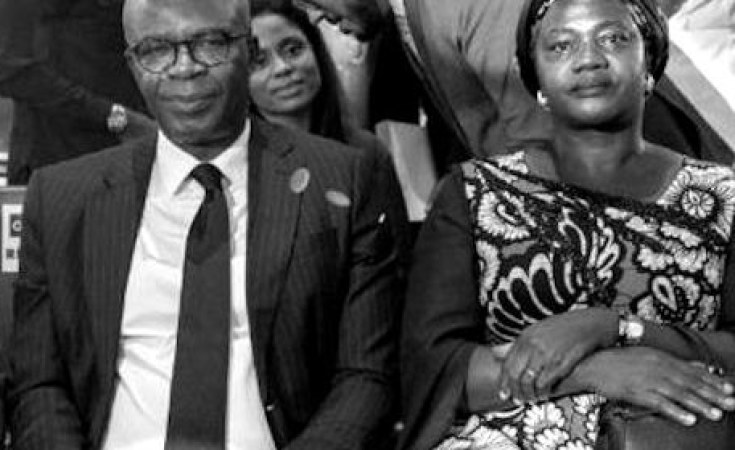
These concerns gained renewed relevance with the announcement of Emília Carlota Dias’s candidacy for secretary-general of the Organização da Mulher Angolana (OMA), the MPLA’s women’s wing, which is scheduled to hold its eighth congress between 27 February and 2 March. Carlota Dias is a member of parliament and sits on the MPLA’s Political Bureau. She is also married to Manuel António Tiago Dias (both on the photo), the governor of the Banco Nacional de Angola (BNA) — the institution responsible for supervising the banking system.
If her candidacy succeeds, Carlota Dias will join the Secretariat of the Political Bureau, the party’s main executive body. At the same time, the MPLA — through GEFI and Sansul — retains majority ownership in a commercial bank supervised by the BNA. GEFI is widely regarded as the ruling party’s principal private financing vehicle.
Party, Finance, and the State
This configuration reveals a structural pattern of interpenetration between the ruling party, the financial system, and state institutions. In October 2021, Banco Sol entered into a formal microcredit agreement with the OMA. The arrangement established a credit line reserved exclusively for OMA members, making party affiliation an explicit condition for access to financing. Loan amounts ranged from 350,000 to 7 million kwanzas, under predefined interest terms.
Microcredit activities in Angola fall under the regulation and supervision of the BNA. By allowing a commercial bank to condition access to credit on membership in a ruling party structure, the regulator contributes to blurring the boundaries between party, state, and finance. In this context, safeguards designed to manage risks associated with politically exposed persons lose substantive effectiveness, becoming procedural formalities incapable of preventing conflicts of interest that are increasingly absorbed into the normal functioning of the system.
This convergence — party leadership, bank ownership, and financial supervision — does not automatically constitute illegality. For international regulators, correspondent banks, and FATF evaluators, however, it reinforces the risk of conflicts of interest or, at minimum, the perception of institutional capture.
Formally, Angola now has a robust legal framework for preventing money laundering and terrorist financing. Law No. 5/20 of 27 January, reinforced in 2023, adopts a broad definition of politically exposed persons, extending beyond senior public office holders to include spouses and relatives up to the third degree, subjecting them to enhanced due diligence by financial institutions.
The legislative intent is clear: to mitigate heightened risks of abuse of public office, conflicts of interest, and capture of the financial system by political interests. Yet the prevalence of PEPs in positions of economic control, combined with persistent shareholder opacity, highlights a significant gap between the letter of the law and its effective implementation.
The concealment of beneficial ownership through intermediary companies or generic categories such as “others” continues to obstruct the identification of real interests — precisely one of the central issues raised by the FATF in its recommendations to Angola.
The permeability between political power and financial institutions is not a recent phenomenon. In 2016, the MPLA elected Valter Filipe, then governor of the BNA, to its Central Committee. At the time, analysts widely interpreted the move as a violation of the principle of central bank independence, formally integrating the country’s top monetary authority into the ruling party’s leadership structure. The episode became emblematic of the fragility of institutional barriers between party, state, and the financial system.

Sign up for free AllAfrica Newsletters
Get the latest in African news delivered straight to your inbox
BNA has repeatedly affirmed its commitment to strengthening the regulatory framework and complying with international standards. The FATF’s focus, however, is not on legislative output but on demonstrable results: independent supervision, rigorous management of PEP-related risks, applied sanctions, and effective transparency regarding beneficial ownership.
For international partners, the core question remains straightforward: can Angola demonstrate that banking supervision decisions are genuinely insulated from political and party influence?
As Angola remains under enhanced FATF monitoring, the central issue is no longer the existence of laws or declarations of institutional intent, but the coherence between adopted norms and applied practices. A banking system exposed to a high density of politically exposed persons and marked by blurred boundaries between party, state, and financial supervision will struggle to convince international regulators that it operates with effective independence. Credibility, in this context, is not proclaimed — it is demonstrated.
