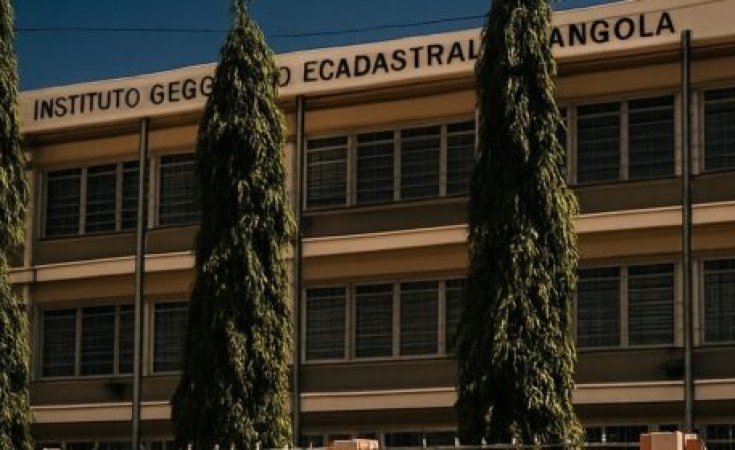
Luanda — Public land returned to the State in 2020 was quietly diverted inside Angola’s own institutions between 2021 and 2024. The IGCA falsified registries, erased beneficiaries, undervalued the land by 96-fold, and enabled private subdivision among companies linked to senior officials.
Angola has once again exposed a truth its government works hard to bury: public assets are not merely mismanaged — they are actively fed into networks of political patronage operating inside the State itself. A new investigation shows how 82.6 hectares of State land on the outskirts of Luanda were quietly diverted to private interests through an internal scheme at the Instituto Geográfico e Cadastral de Angola (IGCA). It is a case that reveals not just corruption, but institutional collapse — the kind that thrives when no one in power expects to be held accountable.
The plot originally belonged to União Cervejeira de Angola (ÚNICA), a brewing venture with Portuguese and Angolan shareholders. In 2020, the company formally returned its surface rights to the State. By law, the land should have gone back into the public inventory. Instead, it vanished into a manipulation engineered from within the registry.
Cadastral records obtained by Maka Angola show the land was reassigned to a private company, Sarajeu – Comércio e Serviços, under a 2021 file number. But there was no application from Sarajeu that year. The file was fabricated. Officials had literally erased the original beneficiary’s name with correction fluid and scribbled in a new one: “Celso Rosa,” a cousin and frontman for IGCA deputy director, Silva Venâncio Hossi.
Follow us on WhatsApp | LinkedIn for the latest headlines
A second IGCA document made the deception undeniable: Sarajeu’s real application was submitted only in August 2022. That means the 2021 file used to justify the concession wasn’t a clerical error — it was an inside job.
Tampering with land registry files — the documents that anchor property rights in any functioning State — is not a bureaucratic irregularity. It is the administrative equivalent of breaking into a bank vault. And in Angola, it appears to have been done by the people entrusted with keeping the vault secure.
Yet the case moved with astonishing speed. Just two days after a municipal inspection on February 7, 2023, the Minister of Public Works, Urbanism and Housing, Carlos Alberto Gregório dos Santos, approved a 60-year concession using the falsified file number. No development followed. The purpose was never development. The purpose was extraction.
A 96-fold lie
If the administrative fraud was brazen, the financial dimension is staggering. In 2014, ÚNICA paid 33 million kwanzas — roughly US $336,000 — for the land. By 2023, the State suddenly claimed the very same 82.6 hectares were worth just 343,500 kwanzas (around US $374). A 96-fold collapse in value in a country where land fees have been rising is not incompetence. It is choreography.
Even this insulting amount was never paid by the beneficiary. That is how deeply the system is rigged: the thieves do not even bother to hide the theft.
Private carving of State land
Sarajeu never attempted to develop the plot. Instead, it subdivided it for private gain. Portions were transferred to Habiperfect – Prestação de Serviços e Consultoria and to A Roda – Comércio e Prestação de Serviços, the latter owned by the Ministry’s own general counsel, Rui Narciso, and his wife.
These transfers were illegal under Angola’s Land Law, which forbids passing concession rights to third parties within the first five years and without prior State authorization. IGCA technicians nevertheless produced the location sketches needed to formalize the subdivision, and a notary office authenticated the transfer.
In any country with functioning institutions, this would be called what it is: coordinated institutional corruption.
A system designed to be captured
Land governance in Angola has long been one of the easiest doors through which political networks enrich themselves. The country still lacks an updated national land inventory. Responsibilities are scattered across ministries. Oversight is weak by design. This fragmentation allows land to be traded like political currency, far removed from public scrutiny.
The Mabuia case shows how effortlessly the system can be bent: forged registry files, accelerated ministerial approvals, front companies connected to senior officials, absurd undervaluations and, finally, the silent disappearance of public land into private hands. The opacity surrounding the remaining 42.07 hectares — now effectively controlled by the IGCA deputy director — is not an anomaly. It is standard operating procedure.
A government that promises reform — and delivers protection
After receiving a detailed questionnaire on the case, the minister met with Maka Angola and promised to review land concessions issued between 2022 and 2024. The promised order has not been made public. The official at the centre of the allegations, deputy director Hossi, has not answered a single question.

Sign up for free AllAfrica Newsletters
Get the latest in African news delivered straight to your inbox
This is the pattern of President João Lourenço’s administration. He rose to power on a platform of renewal but has instead presided over the consolidation of institutional capture under a new circle of allies. His anti-corruption campaign has been cosmetic, targeting opponents while shielding the machinery that enables looting from within.
Under Article 61(6) of Angola’s Land Law, any transfer of concession rights made without authorization — and before five years of effective use — is legally void. Nearly every action taken after ÚNICA’s renunciation violates this requirement. As legal scholar Rui Verde concludes:
“The entire chain collapses under its own illegality. What remains is a façade of legality masking a null act.”
The cost of looking away
Angola’s leaders want foreign investors to believe the country is changing. The Mabuia case suggests the opposite. When land — the most basic national asset — can be falsified, transferred, subdivided and privatized by the very officials charged with protecting it, no reform narrative survives.
This is not an isolated scandal. It is a window into Angola’s political economy, where institutional capture is not a by-product of governance — it is the system itself.
