

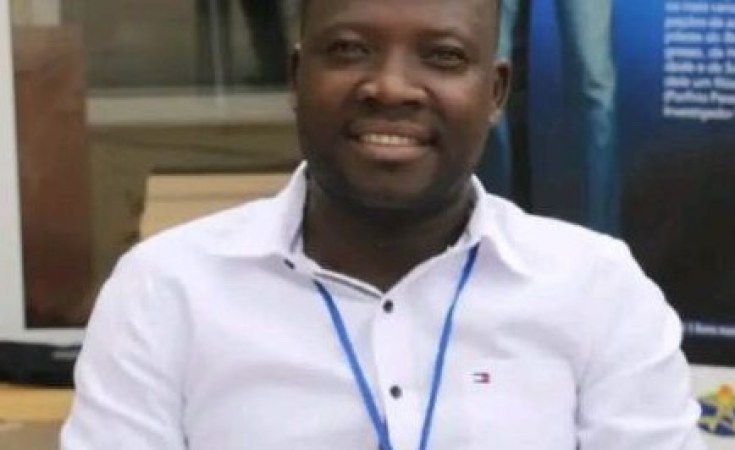
Luanda — A public broadcaster journalist is charged with terrorism for texts describing a taxi strike that urged citizens to stay home. The case raises urgent questions about press freedom and criminal law in Angola.
The Public Prosecutor's Office accuses two Russian citizens and two Angolans of jointly committing the crimes of espionage, terrorism, terrorist organization, influence peddling, and criminal association. In this second article of the series, we examine in detail the case of Amor Carlos Tomé, a sports journalist at Angola's public broadcaster Televisão Pública de Angola (TPA), portrayed in the indictment as the principal executor of an alleged Russian operation of terrorism and espionage aimed at staging a coup d'état against President João Lourenço.
On 8 January, the Luanda District Court, 3rd Criminal Section, will begin hearing the defendants in the adversarial pre-trial phase. The accused are the Russian nationals Lev Lakshtanov (65) and Igor Ratchin (38), Francisco Oliveira "Buka", Secretary for Youth Mobilization of UNITA (JURA), and journalist Amor Carlos Tomé — all detained on 7 August 2025.
In addition to the crimes imputed to all four defendants, the public prosecution attributes four additional charges specifically to Amor Carlos Tomé: public incitement to crime, active corruption of a public official, influence peddling, and fraud.
Keep up with the latest headlines on WhatsApp | LinkedIn
In Article 113 of the indictment, prosecutors claim that the defendants orchestrated "acts of rioting, vandalism, looting, and destruction of public and private property." As evidence, they submit "notes produced by the defendant Amor Carlos Tomé," allegedly extracted from his mobile phone.
What do these notes — dated by the prosecution to 10 July 2025 — say?
- "Protests over the increase in diesel prices and the consequent rise in taxi fares continue."
- "Following the civil society announcement of a march on Saturday, two political parties have joined the initiative: the Liberal Party and PRA-JA."
The indictment then introduces what it presents as the main evidence of the alleged Russian terrorism, with Amor Carlos Tomé cast as the conductor of events. In Article 115, the PGR accuses the journalist of having written an incendiary text about the taxi drivers' strike of 28, 29 and 30 July 2025, which paralyzed Luanda and coincided with acts of vandalism and looting, whose repression by security forces resulted in dozens of deaths.
Given the seriousness of the accusation, we reproduce below the key excerpts of the text, excluding redundant passages:
- "Luanda may experience true chaos in the coming days."
- "Thousands of taxi drivers have announced they will halt services."
- "Drivers claim it is unsustainable to comply with the fares set by fleet owners due to the constant and unsustainable rise in fuel prices, which is pushing thousands of taxi drivers into silent bankruptcy."
- "In an open letter addressed to taxi vehicle owners and managers, the New Alliance of Taxi Drivers of Angola (ANATA) calls for a total shutdown of private transport and declares it will not be responsible for damage caused to vehicles seen operating."
- "The association warns that any vehicle put into circulation will be at the owner's own risk."
- "Vehicles attempting to break the strike may be stoned, and no association will take responsibility for the damage. The tone is serious, and the warning is clear."
- "Either we stop for three days now, or we will spend the rest of our lives lamenting. Three days of sacrifice are worth more than a lifetime of exploitation."
- "The coming days may mark the collapse of urban transport in Luanda…"
- "'Stay at home!' is the slogan being launched."
According to the prosecution, the text was published on Facebook on 15 July 2025, on the pages Angola Aberta and Gingona Comunica.
From there, prosecutors build the alleged link between the Russian defendants and the leadership of ANATA, claiming that the text written by Amor Carlos Tomé was "adopted" by the association's vice-president, Rodrigo Luciano Catimba, between 17 and 19 July, in statements to Rádio Despertar and other outlets, as well as in at least two press conferences, where "all statements were aligned" with Tomé's text.
The indictment further reproduces two additional texts attributed to the journalist. One, dated 20 July, entitled "Protests Across the Country," reproduces a list of failed government programs compiled by protest organizers. The second, dated the following day, refers to the decision by several taxi associations and cooperatives to halt services on 28, 29, and 30 July.
In Article 127, the prosecution establishes a temporal link between the unrest that began on 28 July and the arrival in Angola, on that same day, of defendant Lev Lakshtanov. The indictment adds that images included in the case file show Igor Ratchin photographing street events on 28 July, allegedly while heading to the airport to meet Lakshtanov.
According to the prosecution, on 29 July Igor Ratchin produced a text intended to "dissimulate the presence of the organization Africa Politology in the country" and to suggest that security forces had received instructions to kill protesters. The text was allegedly translated from Russian into Portuguese by Lev Lakshtanov.
The indictment then claims that Amor Carlos Tomé reported to the Russians "on all occurrences during the demonstrations," including the provisional figures announced by Interior Minister Manuel Homem: 22 deaths, 200 injured, and more than 1,200 detainees.
Finally, prosecutors infer political alignment between the defendants and prominent figures from both major parties, accusing them of having published, on the website Angola 24 Horas, opinion pieces by General Higino Carneiro (a potential MPLA presidential candidate) and Abílio Kamalata Numa (former UNITA secretary-general).
In Part II, we will examine the alleged "mission" of Amor Carlos Tomé in producing content and recruiting journalists in furtherance of the supposed Russian-backed coup against President João Lourenço.
A core contradiction runs through the prosecution's narrative.
The taxi strike repeatedly cited as the trigger for unrest was not a call for demonstrations or street mobilization. On the contrary, taxi associations publicly urged citizens to stay at home and avoid public circulation during the shutdown. The strike was framed as a withdrawal of services, not as an invitation to occupy the streets.
Yet the same actors are now being held criminally responsible for riots, looting, and street violence that occurred precisely in the absence of the transport services they had suspended. Several leaders of taxi associations are currently detained and charged with terrorism, even though their public messaging explicitly discouraged people from going out.
This inversion exposes a fundamental problem of causality and responsibility. How can actors who called for immobility and non-participation be held liable for violence carried out by third parties? The indictment offers no clear answer. Instead, it collapses the distinction between calling for a strike, calling for protest, and commanding violence, treating them as interchangeable — a move that dangerously lowers the threshold for criminal liability and places collective social action itself under suspicion.
Analysis: When Description Becomes a Crime
A close reading of the indictment against Amor Carlos Tomé reveals a troubling pattern: the transformation of journalistic description of public facts into evidence of criminal intent. None of the excerpts cited by the prosecution contains an operational instruction, a direct order, or an explicit call to violence. What they contain is the narration of foreseeable events in a context of social tension widely acknowledged by the authorities themselves.

Sign up for free AllAfrica Newsletters
Get the latest in African news delivered straight to your inbox
The "notes" extracted from the journalist's phone refer to protests, announced marches, and political positioning — factual, publicly available information. Their criminalization raises a fundamental question: since when does reporting facts amount to incitement to crime?
The central text identified as evidence of terrorism employs alarmist language — common in coverage of strikes and social crises in Angola — but merely reproduces warnings and positions publicly assumed by taxi associations, while anticipating plausible social consequences of a transport shutdown. It contains no operational commands, logistical coordination, or direct calls for violence.
The prosecution then makes a decisive logical leap: because ANATA leaders used similar language in public statements, it concludes that they had "adopted" Amor Carlos Tomé's text, retroactively transforming it into a guiding document for violent acts. This inference lacks material proof and conflates discursive correlation with criminal coordination.
By attributing criminal intent to the publication of opinion pieces by figures from both the MPLA and UNITA, the indictment penalizes not illegal content but pluralism and political criticism. Reporting, opinion, and dissent are fused into a single penal framework.
In the specific case of Amor Carlos Tomé, the prosecution fails to demonstrate specific intent — a conscious and direct will to provoke violence or subvert the constitutional order. Instead, it constructs a narrative in which reporting, anticipating social scenarios, and maintaining political contacts are reclassified as terrorism.
The implications are profound. It is this inversion — between informing and inciting, between describing and commanding — that lies at the heart of the Amor Carlos Tomé case. And it is on this ground that the proceedings will inevitably be tested in court.

