

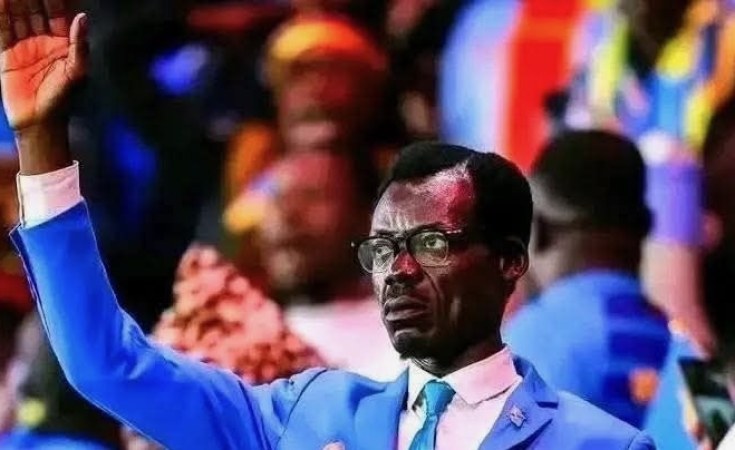
A viral AFCON moment featuring a DRC Congo Patrice Lumumba look-alike, has captivated the tournament and brought back memories of Congo's first revolutionary prime minister
During the ongoing Africa Cup of Nations that started in 2025, an interesting moment captured the attention of the continent. As the cameras panned across the stands, a supporter of the Democratic Republic of Congo appeared on screen, and almost instantly, social media erupted. The clip went viral not because of a goal, or a celebration, but because of the man's striking resemblance to Patrice Lumumba, the Congo's first Prime Minister and one of Africa's most iconic revolutionary leaders.
For some, the moment was humorous. For others, curious. But for Africa, it carries a deeper meaning; the sudden and unexpected return of a revolutionary memory long buried but never erased. The man is Michel Kuka Mboladinga, a 53-year-old Congolese football supporter popularly known as "Lumumba Vea". At the ongoing continental football tournament, Mboladinga has become a viral sensation for performing as a human statue, standing silent and motionless throughout DR Congo's matches, his presence evoking the image of a leader whose ideas still haunt Africa's unfinished liberation.
Who was Patrice Lumumba?
Keep up with the latest headlines on WhatsApp | LinkedIn
Patrice Lumumba is not just a historical figure. He represents dignity, courage, and uncompromising resistance to imperial domination in Congo and Africa. His face, sharp, and determined, has with time become an icon of African defiance.
Patrice Lumumba was born in 1925 in what was then the Belgian Congo, one of the most brutally exploited colonies in Africa. Belgian colonial rule was marked by extreme violence, forced labor, racial humiliation, and the extraction of immense wealth, particularly rubber and minerals, at the cost of millions of Congolese lives.
Lumumba was among the political leaders in the 1950s, at a time when anti-colonial movements were sweeping across Africa. Unlike many leaders groomed by colonial authorities, Lumumba was fiercely independent. He believed that political independence without economic control was meaningless. For him, freedom meant that Congo's vast natural wealth, copper, cobalt, diamonds, gold, should benefit the Congolese people, not foreign corporations.
In June 1960, when Congo gained formal independence from Belgium, Lumumba became the country's first Prime Minister. At the independence ceremony, he delivered a speech that would define his legacy. In front of the Belgian king and international dignitaries, Lumumba openly condemned colonial oppression, racism, and exploitation. It was a moment of truth that shocked the colonizers. That speech made Lumumba a hero to the oppressed -- and an enemy to imperial powers.
Lumumba assassination
Within months of independence, Congo was plunged into crisis. Belgium supported the secession of the mineral-rich Katanga region. Western intelligence agencies worked to destabilize Lumumba's government.
In January 1961, Patrice Lumumba was arrested, tortured, and assassinated. His body was dismembered and dissolved in acid in an attempt to erase him completely. For decades, the truth about his murder was denied or hidden. But history, like memory, cannot be destroyed so easily. Lumumba became a martyr of African liberation, a symbol of what happens when leaders refuse to compromise with imperialism.
The viral moment shows that even when African states downplay or sanitize radical histories, people still remember. Or at least, they remember enough to ask questions.
Lumumba's relevance today
More than six decades after his assassination, Lumumba's warnings remain painfully relevant. The DRC continues to suffer from external interference, armed conflict, and the plunder of its minerals, now essential for global technologies like smartphones and electric vehicles. Foreign corporations profit, while Congolese communities face displacement, violence, and poverty.

Sign up for free AllAfrica Newsletters
Get the latest in African news delivered straight to your inbox
Across Africa, similar patterns persist; debt dependence, privatization of public goods, and political elites aligned more closely with global capital than with their own people. Lumumba understood early on that a political flag without economic power amounts to illusionary freedom.
Read more: Congolese activists decry US-Congo mineral deal
This AFCON moment is powerful because of its accessibility. A face can lead to history. For young Africans who may never encounter Lumumba in formal education, this viral moment can serve as an entry point into a broader understanding of African resistance, Pan-Africanism, and anti-imperialist struggle.
Unfortunately, DR Congo were eliminated by Algeria on January 6, 2026, with Algeria advancing to the AFCON quarter-finals. Hopefully, the Lumumba look-alike will continue to appear in the stadium.

