

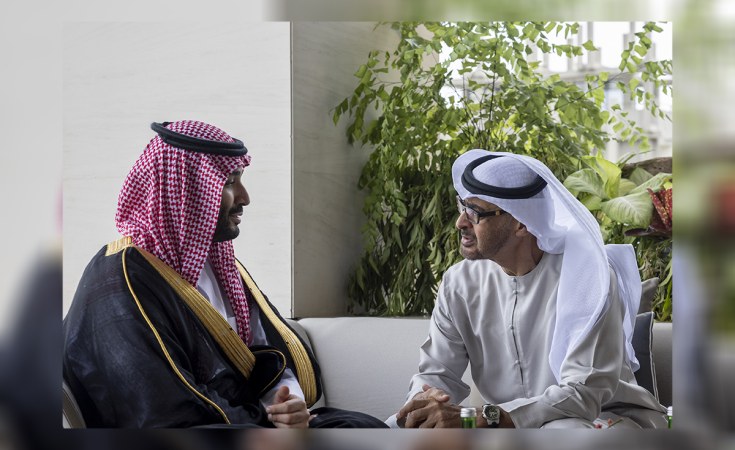
Addis Abeba — In early 2026, Saudi Arabia issued an unusually forthright public accusation against the United Arab Emirates (UAE)—a fellow Gulf Arab state and former coalition partner in the Yemen conflict—alleging that Abu Dhabi had undermined its national security. The language employed by Riyadh is among the most direct it has ever used toward the UAE, signaling deepening unease within the Saudi leadership over Abu Dhabi's increasingly autonomous foreign policy.
Saudi Arabia's active pushback against the UAE in Yemen and beyond signals the beginning of an open rivalry between the two Gulf powers for the foreseeable future. Simultaneously, the Kingdom's assertive engagement could end the era of the UAE's self-assured dominance in dictating political outcomes in the Horn of Africa.
Of course, with its close ally Israel establishing a foothold in Somaliland, its strong ties with the Ethiopian federal government, and its intervention in Sudan, the UAE will remain a powerful geopolitical player in the region. What is changing now is that it can no longer attempt to unilaterally determine the fates of political actors in the Horn of Africa.
The alliance formed to counter the UAE appears to have solidified, and its members are now demonstrating their security cooperation and effectiveness. According to Middle East Eye, Egypt has shared critical intelligence with Riyadh and has taken an active role in Saudi operations against the UAE-backed STC in Yemen.
Follow us on WhatsApp | LinkedIn for the latest headlines
Saudi Arabia's strengthened relations with Türkiye, defense alignment with Pakistan, and the prospective integration of Egypt into a coordinated security bloc elevate Riyadh and its allies into a consolidated regional power axis with extra-regional reach.
Riyadh's enhanced posture is likely, at least in the foreseeable term, to deter UAE-backed actors in the Horn of Africa from pursuing adventurist strategies predicated on Emirati power without accounting for countervailing consequences. This deterrent effect reduces the probability of escalation of an Ethiopia-Eritrea conflict centered on 'Red Sea access,' primarily by constraining Ethiopian risk-taking.
How Gulf tensions alter Ethiopia, Eritrea, and Tigray calculus
What must be underscored is that the anticipated stalling of Ethiopia-Eritrea tensions does not stem from a resolution of underlying conflict drivers, nor from any durable political accommodation between Abiy Ahmed and Isaias Afwerki, as some have suggested. Rather, it is the product of an external geopolitical counterbalancing effect. Accordingly, this stasis should be understood as medium-term. Whereas, this dynamic affords a disarrayed Tigray a brief window to reorganize and critically reassess its strategic failures and corrective options.
The Kingdom's assertive engagement could end the era of the UAE's self-assured dominance in dictating political outcomes in the Horn of Africa."
Tigray's current condition is defined by elite fragmentation, producing political disarray and internal rivalry. This fragmentation was further exacerbated by the assumption of an "inevitable" Ethiopia-Eritrea conflict, which generated urgency and fear among Tigrayan elites, driving premature alignment choices without adequate strategic deliberation or systematic exploration of long-term interests.
Current developments, by displacing the prevailing sense of urgency, create a rare transient window to convene Tigrayan elites into a unified political platform and consolidate Tigray's strategic position. While difficult, this represents the sole viable pathway out of the prevailing political quagmire.
For this to happen, the primary burden falls on the Tigray People's Liberation Front (TPLF), which retains declining political and military control in Tigray but lacks the strategic leadership capacity required in this crisis. Establishing an inclusive political platform therefore depends on the party's willingness to acknowledge that it no longer possesses the legitimacy or capability to exercise exclusive leadership. While the TPLF has repeatedly identified its own strategic failures, this acknowledgment must translate into enabling a broad-based platform that consolidates Tigrayan elites and institutionalizes collective strategic leadership.
The TPLF should not risk misreading the Saudi-UAE dynamics as advantageous to its real or perceived alignment with Eritrea. The projected stalling of Ethiopia-Eritrea tensions could reduce Eritrea's strategic burden and correspondingly weaken its presumed incentive to treat the TPLF as a reliable ally or to extend full political or material support. The argument here is that the current developments provide Tigray a window to turn inward, reducing the urgency that has exacerbated its political crisis.

Sign up for free AllAfrica Newsletters
Get the latest in African news delivered straight to your inbox
Nonetheless, a plausible scenario is that stalled Ethiopia-Eritrea tensions may redirect Ethiopia's militarized capacity toward domestic dissident actors, including Tigray, through coercive measures. Consequently, Tigray must rapidly establish a unified platform to consolidate its position, mitigate vulnerability, and safeguard long-term interests. Collective strategic leadership, grounded in legitimacy and operational efficiency, would enable Tigray to engage with Ethiopia constructively and reduce the likelihood of zero-sum confrontations. AS
Editor's Note: Desta Gebremedhin is a student of Peace and Conflict Studies at Mekelle University and a former senior journalist with BBC World Service. He can be reached at destaasefa@proton.me

