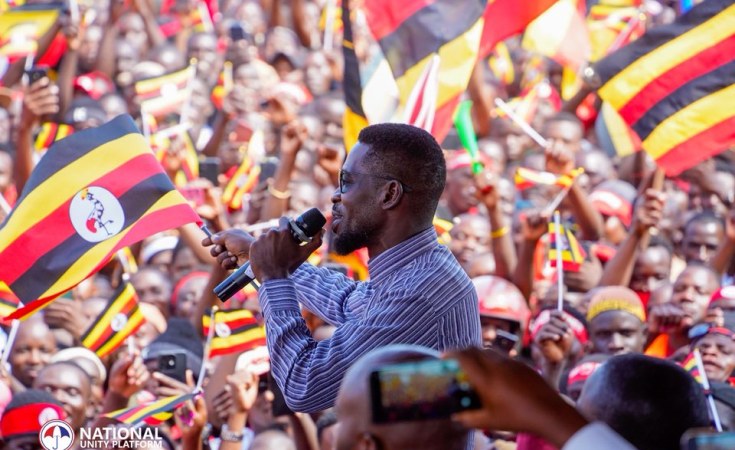
In the January 15, 2026 general elections, the opposition faced a challenging and highly competitive political environment. Although opposition parties maintained a visible presence nationwide, the results reflected a decline in their overall performance compared to the 2021 elections, amid claims of state repression and logistical challenges.
President Museveni of the National Resistance Movement (NRM) was declared the winner with 71.65 percent of the vote. The opposition was led by Robert Kyagulanyi, popularly known as Bobi Wine, whose share of the vote declined from the previous electoral cycle.
Speaking to the Nile Post in an interview, Frank Gashumba, the chairperson and co-founder of the Council for Abavandimwe a body representing the Banyarwanda community in Uganda said that having observed elections since 1996, he believes the restraint exhibited by security forces denied the opposition sympathy votes that had previously boosted its performance.
Gashumba who is also the Vice Chairpereon Patrotric League of Uganda(PLU) Central Region further attributed President Museveni's strong showing to the impact of the Parish Development Model and improved security management during the electoral process.
Keep up with the latest headlines on WhatsApp | LinkedIn
Excerpt;
How would you describe the recent election?
First of all, it was the most peaceful election cycle in Uganda's history. I have witnessed elections from 1996, 2001, 2006, 2011, 2016, up to 2021, and I can confidently say this was the most peaceful. I want to commend all the security agencies that ensured the campaign period and polling were smooth. Yes, there were minor incidents, but they cannot be compared to previous elections.
Teso, Museveni has spent 25 years without great support but now he gained the region. As long as President Museveni is still alive and strong first of all in 2031, he will contest again. Museveni has extra natural powers
Where do the recent elections leave the opposition in Uganda?
In my view, there is no real opposition leadership in Uganda. The opposition exists mainly among the voters, not the leaders. Many opposition politicians are driven by personal survival rather than ideology or national vision.
Some individuals who can only manage the role of councillor present themselves as opposition candidates. Others who believe they can manage mayoral or parliamentary positions also disguise themselves as opposition figures. They take advantage of constituencies that are known to be anti-government and use that sentiment to secure opposition tickets.
There is a large percentage of Ugandans who genuinely want change, but unfortunately, most opposition leaders are focused on political survival rather than offering meaningful leadership.
MP Hillary Kiyaga (Dr Hilderman) has announced plans to challenge the results in Mawokota North led by his lawyer Elias Nalukoola. What is your view?
Counsel Nalukoola is my friend, but frankly, I see him as unserious in this matter. [Dr] Hilderman should be very careful. Court cases are not jokes if you lose, you may end up paying heavy legal costs.
Many people who have not truly interfaced with President Museveni do not understand the system they are fighting. I advised Hilderman not to go to court, just as I advised Mathias Walukagga to prepare for 2031 instead of challenging the results. Unfortunately, he did not listen and insisted he had strong grounds.
The NRM appears to have regained significant support compared to 2021. What caused this shift?
After the 2021 elections, the Commander-in-Chief and President of Uganda, who is also the chief strategist of the NRM, went into deep reflection to understand what went wrong. Personally, I believe nothing contributed more to President Museveni's success in 2026 than the Parish Development Model (PDM). Over 3.5 million Ugandans have benefited from PDM. While one million shillings may seem small to some, to an ordinary Ugandan it makes a huge difference. Many Ugandans voted for President Museveni because of PDM.
Secondly, the message of "protecting the gains" resonated strongly. The biggest gain Ugandans value is peace and stability, and President Museveni is widely seen as the guarantor of that peace.
Lastly, the peaceful nature of this election played a big role. In previous elections, violence often worked in favor of the opposition through sympathy votes. This time, restraint by security agencies denied the opposition that advantage.
With President Museveni winning by a wide margin, what does this mean?
There is a section of Ugandans who believe President Museveni should retire, and many of them are in the opposition. However, the current opposition leadership has failed to convince Ugandans that they are ready to lead the country.
Ugandans view Bobi Wine more as an entertainer or pop star than a president. People attend his rallies to see a celebrity, not a future head of state. Ugandans are not foolish they listen, analyze, and judge carefully. Running a country is not a joke. That is why many Ugandans chose President Museveni over an inexperienced alternative.
Some candidates are disputing election results. What is your message to them?
The law is clear. If you believe you were cheated, go to court. Present your evidence and let the judges decide. If the ruling goes in your favor, excellent. If it doesn't, life must go on. There is no other option.
Voter turnout was low. What contributed to this in your view?
The Electoral Commission failed in civic education. Although government allocated funds, very little was done to sensitize Ugandans. I speak to media managers regularly, and many confirm they received no funding or materials from the Electoral Commission.
Secondly, many NRM supporters believed President Museveni would win anyway. Another group of Ugandans was never adequately educated on the importance of voting. For this, the Electoral Commission must take responsibility.
You have strongly advocated for the rights of Banyarwanda who are Ugandan citizens. What progress has been made?
For years, Banyarwanda Ugandans were discriminated against based on their names and physical appearance. They were denied national IDs and passports. We went to all institutions the Uganda Human Rights Commission, the Office of the Prime Minister, Parliament but no one helped.
We finally wrote to President Museveni. Within four days, he responded and agreed to meet us. After investigations, he confirmed that Banyarwanda Ugandans were being unfairly treated. He issued an executive order clarifying that the authority to determine citizenship lies with local leaders, not NIRA officials or the Minister of Internal Affairs. Today, if local leaders confirm you are Ugandan, you must be issued an ID or passport. Since June, our people are no longer discriminated against.

Sign up for free AllAfrica Newsletters
Get the latest in African news delivered straight to your inbox
Have confiscated documents been returned?
Yes. The executive order also directed that any confiscated IDs or passports be returned once local leadership verifies citizenship. I have not received any case where someone followed the procedure and was denied documents.
Do you expect any cabinet appointment?
That decision lies entirely with the President. But we never fought for positions. We fought for dignity and equal treatment. Denying someone a national ID is economic strangulation; you can't open a bank account, buy land, or get a job. Now that our people can access documents, we are satisfied and grateful.
Why don't you contest for an elected position?
I am too honest to be elected. Voters often want sweet lies and empty promises. I admire leaders like Mother Teresa, Martin Luther King Jr., Malcolm X, and Gandhi they changed lives without holding political office. You don't need a title to transform lives. My happiness comes from seeing people's lives improve, not from holding office.
Your message to elected leaders?
Focus on transforming lives. Sixty years after independence, some Ugandans still lack clean water and basic sanitation. That is unacceptable. Leadership must be practical and results-oriented. Every family should have a source of income. Endless political talk without action is useless. Leaders must prioritize economic empowerment and real development.
How do you rate the outgoing Chief Justice?
I think he tried his best. Sometimes there are pressures and forces people don't see. We wish him well in retirement.
