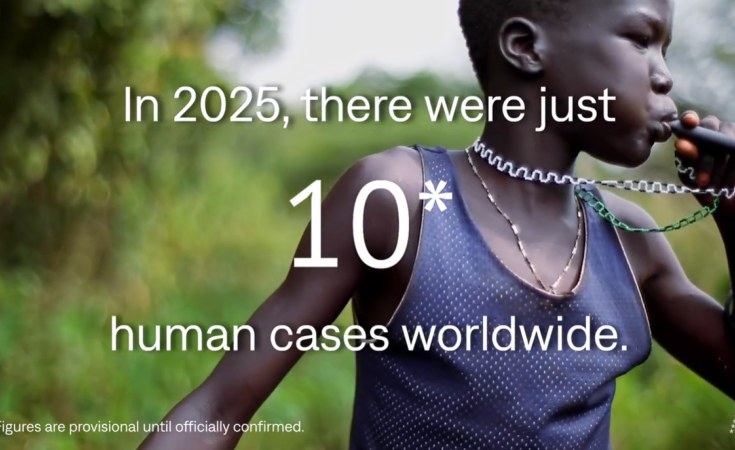
Atlanta — Only 10 human cases of Guinea worm were reported worldwide in 2025, the lowest number ever recorded, bringing the ancient disease closer than ever to eradication. The Carter Center announced the historic provisional figure following the one-year anniversary of the passing of the Center’s founder, former U.S. President Jimmy Carter.
“President Carter always said he wanted to outlast the last Guinea worm. While he didn’t quite get his wish, he and Mrs. Carter would be proud to know there were only 10 human cases reported in 2025. And they would remind us that the work continues until we reach zero,” said Carter Center CEO Paige Alexander.
Poised to be only the second human disease eradicated after smallpox, the 10 Guinea worm cases mark a 33% decline from the 15 cases reported in 2024.
Keep up with the latest headlines on WhatsApp | LinkedIn
When The Carter Center assumed leadership of the global Guinea worm eradication campaign in 1986, an estimated 3.5 million human cases occurred annually in 21 countries in Africa and Asia.
“This campaign reflects the values that shaped my grandparents’ lives — the conviction that hope, hard work, and respect for everyone can change the world. Seeing Guinea worm cases reach historic lows is one of the clearest expressions of that legacy and our commitment to the communities where trust has been earned,” said Jason Carter, Carter Center board chair and eldest grandchild of President and Mrs. Carter.
Together with partners, including the countries themselves, the campaign has reduced the waterborne, parasitic disease by more than 99.99% since 1986 and averted more than 100 million cases of this devastating disease among the world’s most marginalized and neglected populations.
Guinea worm is one of 21 neglected tropical diseases (NTDs), a group of preventable and treatable diseases that affect more than 1.7 billion people around the world. The Carter Center announcement comes on the seventh anniversary of World NTD Day, which is celebrated each year on Jan. 30.
‘Each Number Represents a Person We Know’
“Guinea worm causes immense suffering — not just for the individual but for their family and community as well. Every case is a real person we know by name. They are enduring a disease we know how to prevent, and we’ve been given this rare opportunity to wipe it out completely. We’re energized by this year’s progress, but zero is the only acceptable number, and that’s why our commitment to finishing this job is unwavering,” said Adam Weiss, director of the Carter Center Guinea Worm Eradication Program.
People typically contract the debilitating disease when Guinea worm-contaminated water is consumed. Approximately one year later, a meter-long, spaghetti-sized worm exits the body through a painful blister in the skin — often on the legs and feet. Guinea worm sufferers often seek relief from the burning sensation by immersing their limbs in water, which then releases larvae from the worm, contaminating the water and continuing the cycle of infection.
Guinea worm is slated to be the first parasitic disease eradicated in history and the first without a medicine or vaccine. Eradication efforts are driven by strong partnerships, community-based interventions, and behavior change, with a network of hundreds of thousands of community-based volunteers trained to provide health education. Learn more about the disease.
2025 Case and Infection Numbers by Country
In 2025, two of the 10 provisional human Guinea worm cases were detected in South Sudan and four each in Chad and Ethiopia. Angola, Cameroon, the Central African Republic, and Mali reported zero human cases for the second consecutive year.
The worms that infect animals are the same species (Dracunculus medinensis) as those that infect humans; therefore, eradication requires stopping infections in both. Once the global epicenter for Guinea worm animal infections, Chad reduced Guinea worm infections in domestic animals by 47%, its sixth consecutive year of progress. In 2025, Chad reported infections in 147 animals, Mali reported 17, Cameroon 445, Angola 70, Ethiopia one, and South Sudan three. Despite reductions in four countries, the global provisional total for animal infections rose slightly, driven by increases in Cameroon and Angola.
As in past years, people in endemic countries received cash rewards for reporting cases of Guinea worm in 2025. Health workers then delivered targeted health education and investigated every report, a system that is essential for detecting remaining cases. In 2025, national programs collectively investigated more than 1 million such rumors, nearly all within 24 hours of notification.
All human and animal Guinea worm figures remain provisional until officially confirmed by each country at the eradication campaign’s global annual meeting, typically held in April.
For a disease to be declared eradicated, every country in the world must be certified free of human and animal infections, even in those where transmission has never been known to occur. To date, the World Health Organization has certified 200 countries free of Guinea worm; only six have not been certified.
Innovative Research Continues
Scientific research is finding innovative solutions to the challenges of the disease’s final stages. When infections in animals emerged, researchers launched targeted studies into domestic dog behavior, local water use patterns, and parasite genetics to understand how transmission persisted.
Recent innovations include the development of a diagnostic test that can be used for disease surveillance amongst dogs. This tool, combined with enhanced community-based surveillance, can provide national programs additional information to guide evidence-based decision making and further target program interventions.
World Health Assembly Resolution Accelerates Progress
Momentum toward eradication was further strengthened in May 2025, when the 78th World Health Assembly adopted resolution WHA78.14 to renew global commitment to accelerate Guinea worm eradication. Chad, one of the few remaining endemic countries, led the effort, with the support of a dozen other countries.
“The World Health Assembly’s Guinea worm resolution underscores global recognition that eradication is achievable — and that success depends on maintaining focus even as cases become increasingly rare and geographically isolated,” said Dr. Kashef Ijaz, Carter Center vice president for health programs. “The final cases of any eradication program are the most challenging, requiring persistence, ingenuity, and the resources to work in difficult, remote, and often insecure areas. Guinea worm is no different.”
New Documentary Tells Guinea Worm Story
Increased public attention reignited with the Oct. 1, 2025, release of the independent documentary “The President and the Dragon.” The film chronicles the decades-long fight against Guinea worm disease and the extraordinary individuals who refused to accept that eradication was impossible.
Directed by Waleed Eltayeb and Ian D. Murphy, “The President and the Dragon” follows an eclectic team of public health workers, local volunteers, and former child soldiers as they navigate treacherous terrain and active conflict zones to track Guinea worm cases. The film is available on Amazon, Apple, Google Play, Tubi, Hoopla, and other platforms in more than 60 countries. Proceeds from every rental support the Carter Center’s mission. Watch the trailer and learn more.
Honoring Leadership and Legacy
Dr. William H. Foege, the Carter Center’s first executive director and a pioneering force in global health, passed away on Jan. 24, 2026. A central architect of the Center’s global health work, Dr. Foege helped launch efforts not only against Guinea worm disease but also river blindness and lymphatic filariasis. His tenacity helped eradicate smallpox — and Guinea worm is now close to becoming the next disease to vanish.

Sign up for free AllAfrica Newsletters
Get the latest in African news delivered straight to your inbox
Partnerships and Funding Support
The Carter Center leads the global Guinea worm eradication campaign, working closely with national ministries of health and a variety of global institutions, including the World Health Organization, the U.S. Centers for Disease Control and Prevention, UNICEF, and other vital partners.
Many generous foundations, corporations, governments, and individuals have made the work to eradicate Guinea worm disease possible, including funding support from the Gates Foundation; the United Kingdom’s Foreign, Commonwealth & Development Office; the government of Japan; Schreiber Philanthropy; and a partnership with Alwaleed Philanthropies. Funding support from the United Arab Emirates began with His Highness Sheikh Zayed bin Sultan Al Nahyan, founder of the UAE, continued under His Highness the late Sheikh Khalifa bin Zayed Al Nahyan, and has grown under His Highness Sheikh Mohamed bin Zayed Al Nahyan, president of the UAE, and the Mohamed Bin Zayed Foundation for Humanity.
BASF Agricultural Solutions has donated ABATE® larvicide (temephos) since 1990, and LifeStraw® has donated personal pipe filters and household cloth filters since 1999. The DuPont Corporation and Precision Fabrics Group donated nylon filter cloth early in the campaign. Learn more about our partners.
#DefeatGuineaWorm
#BeatNTDs
Contact: Emily Staub, EmilyStaub@cartercenter.org
The Carter Center
Waging Peace. Fighting Disease. Building Hope.
A not-for-profit, nongovernmental organization, The Carter Center has helped to improve life for people in over 90 countries by resolving conflicts; advancing democracy, human rights, and economic opportunity; preventing diseases; and improving mental health care. The Carter Center was founded in 1982 by former U.S. President Jimmy Carter and former First Lady Rosalynn Carter, in partnership with Emory University, to advance peace and health worldwide.
