

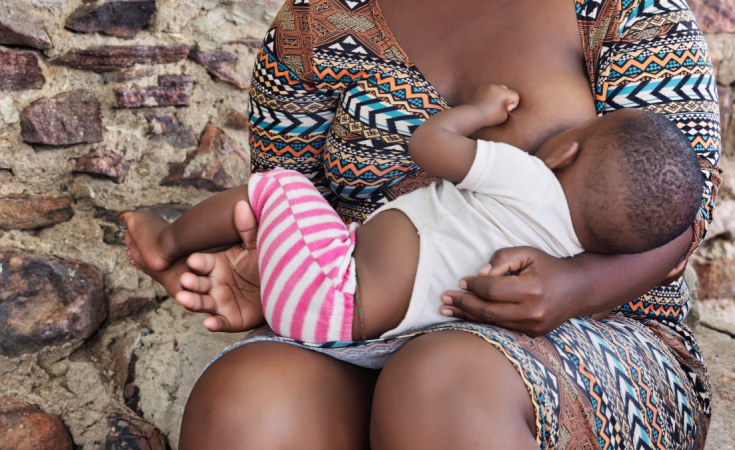
Many mothers who work as domestic workers have to make an impossible choice: keep your job or breastfeed your child. It's a decision that carries lifelong health consequences for their babies. A decade-old proposal could help break the cycle.
- The World Health Organisation says children should be given nothing other than breast milk for the first six months. But many domestic workers are often left with an impossible choice: breastfeed your child or pay the bills — and that has a massive knock-on effect that could affect a child for life.
- The Unemployment Insurance Fund (UIF) could help with partially paid maternity leave of up to four months , allowing her to breastfeed exclusively for longer. But even if more employers registered their domestic workers — just 20% of people do — the UIF has been mired in massive operational mismanagement for years, leaving many entitled to funds left without .
- A coalition of South Africa's leading maternal health, nutrition and early childhood development experts say a languishing proposal for a monthly cash transfer , in the form of a maternity grant, for low-income pregnant women could be the answer.
When Priscilla* had her first child, it never even occurred to her that she could keep her job and breastfeed. Breaks for breastfeeding and expressing milk were for office workers, not live-in domestic workers like her.
So, during her eight-week maternity leave, she carefully planned out how things would work.
Keep up with the latest headlines on WhatsApp | LinkedIn
Priscilla's employers already told her that when she moved back into their home after her leave, she would have to hire a nanny to look after her child while she was working. The child would have to remain upstairs, in her room, with the hired nanny. Priscilla's full attention, it was made clear, was to be given to their household and their children — not even a phone call could distract her.
Priscilla needed the job, so despite the demands, she acquiesced. They had, after all, paid for half of her salary for the eight weeks of maternity leave. And she could still breastfeed in the mornings, evenings and at lunchtime; during the day, the nanny could give the baby formula. The formula would add another cost but at least it would keep the peace.
But that's not how things turned out.
Most of the time, her lunch was spent watching over her employers' children. So, for weeks, she was left with heavy breasts and wet clothing, only made worse by the response of her body when she could hear her baby cry upstairs. After about four months, her child only wanted formula.
Like many domestic workers who decide to have children, Priscilla wasn't left with much of a choice. It was either breastfeed her child or pay the bills. But that choice has a massive knock-on effect that could affect a child for life.
The World Health Organisation says children should be given nothing other than breast milk for the first six months of their life. Breast milk helps to make babies' immune systems stronger, as it contains their moms' antibodies . Studies show that children breastfed for less than six months are more likely to miss developmental milestones , such as when they use words and walk. Breastfed babies are less likely to be obese when they're older, which can lead to chronic diseases like diabetes, cancer and heart disease.
The fix is as simple as it is complicated.
Had Priscilla's employer registered and paid into the Unemployment Insurance Fund (UIF) it could have covered two-thirds of her income for up to four months of maternity leave , allowing her to breastfeed exclusively for longer. But even if more employers registered their domestics — even though it is legally required, researchers estimate that just 20% of people do — the UIF has been mired in massive operational mismanagement and allegations of corruption for years, leaving many entitled to funds left without .
A coalition of South Africa's leading maternal health, nutrition and early childhood development experts says a languishing proposal for a monthly cash transfer , in the form of a maternity grant, for low-income pregnant women could be the answer.
Back to work
Just 32% of South African children are exclusively breastfed for the first six months of their lives — and one of the biggest reasons women stop breastfeeding is because they have to go back to work.
Domestic workers are in a predicament that leaves breastfeeding or even expressing and storing milk complicated. An online survey of 2 625 domestic workers in 2023 found that Priscilla's situation is typical; less than one in five domestics thought they should be entitled to daily breastfeeding or expressing breaks.
In detailed interviews with 13 of the women, they wondered how it would even work logistically. Where would they store expressed breastmilk? What about the stigma around it? ("When it's in a bottle, it's not, like a nice colour," said one.) But most, like Priscilla, said they wouldn't even ask, in fear of losing their jobs.
South African law requires that employers allow four months of maternity leave . But it doesn't mean they have to pay salaries; it just means someone can't get fired if they do choose to take it.
Research published in BMJ Global Health shows that paid time off work helps. The study examined how longer paid maternity leave affected rates of exclusive breastfeeding in 38 low- and middle-income countries. For every additional month of paid maternity leave, nearly six more mothers out of every 100 breastfed exclusively.
That's one of the drivers behind the maternal support grant ( MSG) . Despite having been a decade in the making — and the social development department confirming in September that it had adopted the grant as an official policy initiative — the maternal support grant has not been tabled before Cabinet and Parliament hasn't started the process of amending legislation. Last year a draft policy was sent back to the social development department for further revision because of cost concerns.
It starts in the womb
A cost-benefit analysis published in PLOS Global Public Health in February 2024 found a maternal grant investment could save the government R13.8-billion each year. While that is just a sliver of the R277-billion of the 2024/25 health budget , that single intervention during pregnancy could prevent a chain reaction of expensive health problems later on.
A grant would help mothers better afford nutritious food during pregnancy and cover transport costs to and from antenatal visits, to check up on their health and get vaccinated. Babies born dangerously underweight need costly treatment , which can keep them in hospital for weeks and months, requiring equipment such as breathing support for underdeveloped lungs, feeding tubes and incubators.
Those babies are also at higher risk for stunting , which is when children are too short for their age because of chronic malnutrition, which affects one in four children in South Africa. Stunted children are more likely to struggle in school, earn lower adult wages and have an increased risk of diabetes, obesity and heart disease. It also puts additional pressure on the economy .
As Liezel Engelbrecht, a nutritionist from the DG Murray Trust , which is working with Hold My Hand , Change Ideas and Grow Great on the grant proposal, points out, the biggest predictor of stunting is not what children eat — it's what their mothers eat during pregnancy.
Stunting starts in the womb, when poor maternal nutrition slows foetal growth and continues through the baby's first two years. After that, opportunities for catch-up growth are limited, and the effects are largely irreversible.
"What happens in the first two years is what you're going to sit with for the rest of your life," she says.
Practically impossible
Priscilla's first child came with a warning from her employers: "They told me, 'If you have a second baby, we're going to fire you.'"
A year later, she was pregnant again. Her employers said she could keep her job, and that they would again pay half of her salary for eight weeks. But she had to move out of their home. She found a room in a flat in Johannesburg CBD, but quickly found how difficult it was to make ends meet.
Priscilla now had to pay rent and transport as well as formula, clothing and nappies. A few months later, she moved back in with her employer, leaving her firstborn and her infant in the care of different women in her apartment building, yet another cost.
Breastfeeding her second child was practically impossible — she only saw the children on the weekends.
The money trail
A single person who is the primary caregiver for a child under the age of 18 and makes less than R52 800 per year can apply for a monthly child support grant , which provides R560 per child. That's about one-third below the food poverty line of R796 , the minimum needed to buy a month's nutritious food for one person.
Even that much cash helps — a 2024 study found that children who received it were 31% less likely to be stunted when compared with children who did not receive it.
But the child grant arrives too late to protect that critical window of child development.
The maternal grant would work like this: pregnant mothers making under R5 000 per month would be registered for the grant during their visits to the clinic. The grant would include nine payments of R560, which would begin in the second trimester; six months before birth and three after. The child support grant would automatically take over after that.
Because the grant would be set up through the existing South African Social Security Agency (Sassa) infrastructure , it wouldn't rely on the employer or the UIF.
And that's what labour lawyer Michael Bagraim says is key. It's not just about the increased grant amounts and when they kick in — it's about how the money gets to people.
Unlikely scenarios
"Go online and try and register a domestic worker on the UIF," says Bagraim, who speaks regularly to frustrated employers who are unable to register a whole spectrum of individuals for the fund, not just domestics. "You'll pull out your teeth. You're not going to go [into the office] and stand in a queue for five hours, especially if you're an elderly person. They'll wait for a fine, if they ever get one, of course."
Amidst allegations of corruption, delayed payments, underspending and mismanagement, the acting director general of the labour department, Jacky Molisane, was grilled in a July Parliamentary briefing because of the UIF's serious and persistent service delivery problems.

Sign up for free AllAfrica Newsletters
Get the latest in African news delivered straight to your inbox
In August last year, Cosatu said its call centre is "bombarded with queries from workers who cannot claim their rightful benefits" and reiterated its call to place the UIF under administration and investigate the allegations of corruption".
Sassa also faces problems — from payment system failures and hundreds of millions in irregular payments to contractors and the suspension of CEO Busisiwe Memela-Khambula .
But Bagraim says, workers who were never registered for UIF are still legally entitled to the maternity benefits they would have received if their employers had complied with the law.
That would leave the domestic worker with two unlikely scenarios — report the employer to the labour department's inspectorate, or go directly to the employer in the hope that the threat of a criminal sanction will get them to pay.
Bagraim admits that going through the labour department doesn't usually work. And most domestic workers wouldn't take the risk of confronting their current or past employer for fear of losing their job or a reference for future employment.
'Maybe if I sell my stove'
Priscilla, who earned a relatively good income for a full-time live-in domestic worker, of R7 500 a month, would have earned too much to qualify for the maternal grant. But if her employers had registered her for UIF — and paid in the 1% of her salary required, with Priscilla's 1% taken out of her salary for the fund — she could have been eligible for two-thirds of four months' pay from the fund per child, a total of roughly R40 000. That's if the UIF coughed up the cash.
Priscilla's employers ultimately meted out what they promised. She was fired from her job when her second child was nearly two, replaced by a domestic worker without children.
After help from Izwi, the domestic workers alliance, to process a backdated maternity claim, she eventually received a payout of R31 000 from the UIF.
Two years later, she is still unemployed, and the money has long run out.
"Maybe if I sell my stove, I can get a thousand rand or two. That is how I am surviving, selling the stuff that I have."
*Priscilla is not her real name.
Hannah Crowe is a freelance global health journalist based in London. She completed a fellowship with Bhekisisa through May and June 2025, reporting on housing and maternity protections for domestic workers.
This story was produced by the Bhekisisa Centre for Health Journalism. Sign up for the newsletter .

