

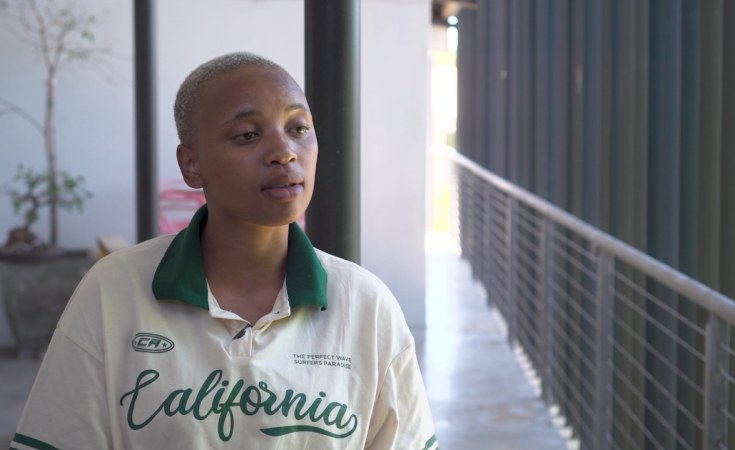
For the past three years, Buhle Sikade, 22, has been using an injection that gives her almost foolproof protection against getting HIV through sex — medicine that around 456 000 other HIV-negative people in South Africa will be able to get from 360 government clinics for free from April 1 . Here's what it's done for her and how it works.
- For the past three years, Buhle Sikade, 22, has been using an injection — called lenacapavir (LEN) — that gives her almost foolproof protection against getting HIV through sex.Around 456 000 other HIV-negative people in South Africa will be able to get the jab, lenacapavir (LEN), from 360 government clinics for free from April 1 .
- LEN is taken once every six months and injected into the fat under the skin in someone's tummy. The health department told Bhekisisa the country's first LEN shipment will arrive in mid-February, after which samples will be quality-tested by our medicines regulator and stock will be dispatched to depots and clinics.
- Mia Malan spoke to Sikade for a recent episode of Bhekisisa 's TV programme, Health Beat . Watch the interview or read an edited transcription to find out why Sikade has been using LEN — and what it's done for her.
For the past three years, Buhle Sikade, 22, has been using an injection — called lenacapavir (LEN ) — that gives her almost foolproof protection against getting HIV through sex. Around 456 000 other HIV-negative people in South Africa will be able to get the medicine from 360 government clinics for free from April 1 .
LEN is taken once every six months and injected into the fat under the skin in someone's tummy .
Follow us on WhatsApp | LinkedIn for the latest headlines
Sikade moved from Willowvale in the rural Eastern Cape to Masiphumelele, a township near Kommetjie in the Western Cape in 2016. She and her brother came to stay with her aunt to look for jobs and "better opportunities".
It was in Masiphumelele, where one in four adults has HIV, that Sikade heard about a study for young HIV-negative women like her, which would test if LEN would keep them HIV negative.
She joined the trial, Purpose 1 , which kicked off in 2022, right from the start. When the results of the study were announced in 2024 — not a single of the 2 134 women who got LEN contracted HIV — she continued to use it, because the company which makes LEN will give it for free to all study participants who need it until the medicine becomes available for free in state clinics on April 1.
The health department told Bhekisisa the country's first LEN shipment, funded by the Global Fund to Fight Aids, TB and Malaria , will arrive in mid-February, after which samples will be quality-tested by our medicines regulator and stock will be dispatched to depots and clinics to be ready for the country's launch in April.
Why Buhle takes LEN
Sikade decided to join Purpose 1 because her age group — women between 15 and 24 years of age — gives her a high chance of getting HIV.
Around a third of South Africa's just over 400 daily new infections in 2024 were among women in this age group, even though they make up only about 8% of the total population .
Teen girls and young women's chances of getting HIV are high because their bodies are still growing and the tissue inside their vaginas and cervixes is still soft and thin , making it easier for HIV to pass through.
Because of poverty, young women also often end up in relationships with older men , who have the money to help them cover their or their family's living costs. In such relationships they rarely have the power to ask their boyfriends to use condoms or to be in monogamous relationships.
But, says Sikade, who is now a life skills counsellor who helps children to make good choices, there's also a high chance to get raped in Masiphumelele — and get HIV that way.
Because rape is a violent act, the tissue in someone's vagina or anus often tears, making it easier for HIV to enter a person's system , increasing their chances of getting HIV, if the perpetrator is HIV positive.
And that's where the protective power of LEN lies.
"It's like a chemical condom"
"It's like a powerful 'chemical condom'," explains Linda-Gail Bekker, who heads up the Desmond Tutu Health Foundation, and is also the chief scientist for the ongoing Purpose 1 study.
"Unlike latex condoms," Bekker says, "LEN doesn't require a user to negotiate for permission from their sexual partners to use, and only has to be taken twice a year as opposed to each time they have sex."
Sikade got her first LEN dose when she was 20. Before that, she used an HIV prevention pill, which she had to take daily. "But sometimes I forgot to take the tablets and if you don't take them each day they work less well," she told Bhekisisa .
Sikade goes to the research site of the Desmond Tutu Health Foundation in Masiphumelele every six months to get her LEN jabs.
How LEN works
So far, she's had six doses — two per year. Each dose consists of two injections , because the solution with LEN that someone needs to get, is too much to fit into one syringe .
When Sikade got her jabs for the first time, she also had to take four pills — two on the day she got the jabs, and two on the next day. That way, there was enough LEN in her body for full protection by the third day.
LEN works over time — it releases itself slowly into someone's body over six months , that's why they only need a shot twice a year.
Modelling scientists from the Health Economics and Epidemiology Research Office at Wits University have calculated that if enough people — between one and two million per year — take LEN just once, new infections would decline fast enough so that South Africa can end Aids as a public health threat by 2043.
Ending it as a public health threat means fewer people are getting newly infected with HIV than the number of people with HIV who are dying, increasingly for other reasons than HIV, for example old age.
Mia Malan spoke to Sikade for a recent episode of Bhekisisa 's TV programme, Health Beat . Watch the interview or read an edited transcription of her interview below.
Mia Malan (MM): You started using LEN in 2022 when you joined a study that tested LEN on young women. Why are you still using it?
Buhle Sikade (BS): I've chosen to [continue to] protect myself, so that if something happens, [I] know that I'm protected [from contracting HIV].
MM: Have you got a boyfriend?
BS: Yes.
MM: Do you tell him you're on LEN?
BS: Yes.
MM: And what does he say?
BS: He understands it's for protection and is supportive [of me using it].

Sign up for free AllAfrica Newsletters
Get the latest in African news delivered straight to your inbox
MM: Have you experienced any side effects?
BS: When you get the injections, you have those lumps [small "bumps" on the skin where the jab was injected], but they fade away and I'm protected. A small, temporary lump is a small price to pay for protection against HIV.
MM: Have you convinced some of your friends to take LEN?
BS: I did. But when you convince someone you have to tell them about both the easy and hard parts of the process. Some of [my friends] are very scared of injections — that's going to be the hardest part of the convincing [getting them to be okay with needles]. [Editor's note: once government clinics start to roll out LEN, it will continue to also make available a daily HIV prevention pill, so that people have a choice between tablets and injections."
MM: You've taken LEN for three years. Why have you decided to continue?
BS: In the world that we live in now, at some point, we don't feel protected. There is [a] high rate of rape . You have to think about things that are happening in the world. So I decided to [continue to] protect myself, because I never know when my luck will run out and something bad may happen to me. Also, when I don't know a sexual partner's HIV status, I need LEN to protect me against infection.
MM: What do you tell your parents?
BS : That I'm protecting myself and my generation that is yet to come. That it's high time that the youth protect themselves [against HIV infection]. If we don't, what's going to happen to our generation?
MM: How long do you still plan to take it?
BS: Until I die.
This story was produced by the Bhekisisa Centre for Health Journalism . Sign up for the newsletter .

