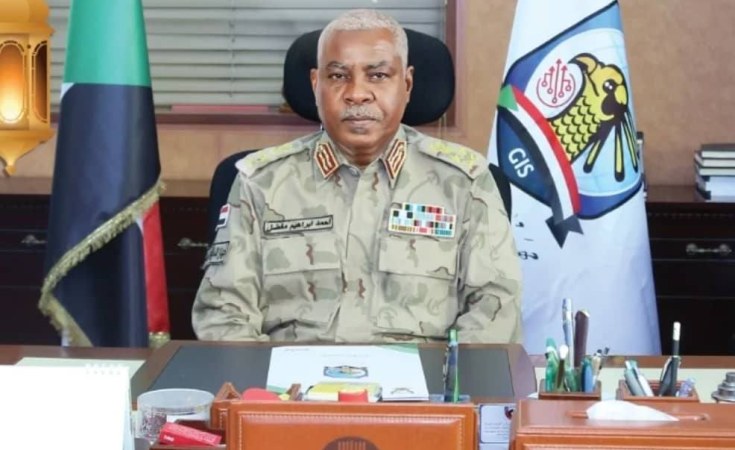
Multiple sources confirmed to Ayin that Sudan’s Armed Forces (SAF)-aligned government intelligence director, Gen. Ahmed Mufaddal, was in Washington, DC, in January, where he held meetings with members of the US intelligence community. The visit, according to the same sources, was narrowly framed and did not include discussions on a ceasefire in Sudan.
Instead, the talks focused on what officials on both sides described as “mutual security files”. These included counterterrorism cooperation, intelligence sharing related to extremist networks, and US concerns about Sudan drifting further into Iran’s regional orbit. Sources said the meetings were technical in nature and limited to security priorities, rather than political negotiations or broader diplomatic engagement.
The absence of ceasefire discussions is notable given the scale of Sudan’s war and Washington’s public calls for an end to hostilities. But sources familiar with the meetings said the US approach reflected a longstanding pattern: separating immediate security interests from political mediation efforts, particularly when dealing with intelligence agencies.
For the army-controlled Port Sudan government, the Washington meetings came amid increasing regional and international scrutiny over its alliances, especially its reported military and logistical ties with Iran and its reliance on Islamist networks for manpower, financing, and access to weapons.
Keep up with the latest headlines on WhatsApp | LinkedIn
While neither side publicly announced the meetings, multiple sources said the talks were deliberately kept low-profile, reflecting both their sensitivity and the limits of what either side was willing to signal openly.
Tactical engagement, not trust
Hamid Khalafallah, a Sudanese researcher familiar with the meeting, told Ayin that the Washington meetings should not be interpreted as a step toward genuine partnership. “No, it’s definitely a short-term tactical engagement that is very circumstantial.” Khalafallah said. “I don’t think it was necessarily a dialogue; rather, it was more about the US lecturing the government in Port Sudan on how to behave.”
The US intelligence community, he argued, approached Port Sudan from a position of leverage, using the meetings to convey red lines rather than to explore long-term cooperation, Khalafallah said. “I don’t think there’s a lot for them to cooperate on,” he said. “It’s mostly trying to push SAF and the government in Port Sudan to behave in a certain way.”
Khalafallah linked the timing of the engagement directly to regional developments, particularly the escalation involving Iran and the broader implications for Israel’s security. He argued that Israeli security concerns continue to heavily shape US foreign policy in Sudan’s region. “These Issues—security and terrorism—are areas where the SAF is definitely involved with Islamists, Iran, and various actors that the US considers problematic and enemies of Israel,” he said.
From this perspective, the Washington meetings were less about understanding Sudan’s internal dynamics and more about containing risks as defined by US and Israeli strategic priorities. “For Washington to view Port Sudan as a party they can engage with in a more genuine way, they would need to see a very big distance between them and the issues that cause anxiety for Washington and Tel Aviv,” he said.
The distance, however, may be politically and militarily impossible for SAF to create. Khalafallah noted that Islamist networks and Iranian links have been central to the support SAF has received during the war. “These are the only ways they’ve gotten support so far – fighters on the ground, access to money, access to weapons,” he said. “For Port Sudan to lose that, it’s quite tough.”
US interests, legal limits, and the sanctions question
Cameron Hudson, a US-Africa policy expert, framed the Washington meetings in more pragmatic terms. Speaking to Ayin, Hudson stressed that the engagement was never about trust. “This isn’t about building trust,” Hudson said. “It’s about advancing interests that both sides have.”
Hudson pointed out Washington’s longstanding priority for counterterrorism in Africa. “Washington has said that its top priority in all of Africa is counterterrorism,” he said, explaining why US intelligence officials would seek direct engagement with Sudan’s General Intelligence Service (GIS).
The objective, Hudson argued, is to understand the nature of threats inside Sudan and to assess what Sudanese intelligence officials are willing and able to do to prevent the country from becoming a safe haven for extremist groups. Washington wants assurances from GIS that it shares US concerns about extremism, is rejecting the role of Islamist leaders, and is open to cooperation on counterterrorism. “My understanding is that is what was agreed,” he said.
Between DC, Riyadh, and Abu Dhabi
Beyond the immediate intelligence discussions, analysts say Port Sudan is attempting to reposition itself diplomatically, including by leveraging relations with Saudi Arabia to gain legitimacy in Washington.
But Khalafallah warned that relying on Riyadh alone is unlikely to shift U.S. perceptions. “We cannot forget how Abu Dhabi will continue to hammer on the issue that you can’t trust these guys,” he said, pointing to Emirati narratives that portray SAF as deeply entangled with Islamists and Iran.

Sign up for free AllAfrica Newsletters
Get the latest in African news delivered straight to your inbox
Such regional rivalries complicate Port Sudan’s strategy. Efforts to gain US endorsement risk alienating internal and regional allies, while failure to do so leaves SAF isolated and vulnerable to sanctions and diplomatic pressure.
Khalafallah questioned whether Port Sudan was willing—or able—to absorb those losses. “If they lose a lot on the ground and lose a lot of support, they become less relevant,” he said. “And that makes them less important for the U.S. to engage with.”
Engagement without illusions
The Washington meetings between Gen. Ahmed Mufaddal and the US intelligence community reveal a relationship defined by narrow interests and deep mistrust. For Washington, Sudan is a security file – one shaped by counterterrorism priorities, regional rivalries, and legal constraints.
For Port Sudan, the engagement offers limited benefits and significant risks. While intelligence talks may reduce immediate pressure or open channels of communication, they fall far short of political legitimacy or strategic partnership.
As Sudan’s war grinds on, the gap between tactical engagement and genuine dialogue remains wide. And for now, Washington appears determined to keep it that way.

