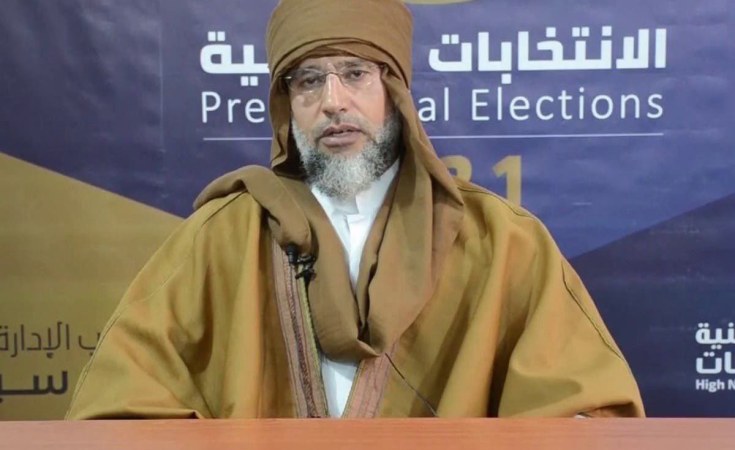
Saïf al-Islam Kadhafi, the son of former Libyan leader Moamer Kadhafi, was long seen as the man who might one day take over from his father. His killing at his home in northwestern Libya closes a story marked by early reformist ambition, a violent turning point in 2011 and years spent on the margins of Libyan politics.
The 53-year-old was shot dead on Tuesday at his residence in Zintan, a city in Libya's northwest. According to those around him, four unidentified armed men broke into Kadhafi's home before killing him.
Since his release from prison in 2016, Saïf al-Islam had been living in seclusion in Zintan with only two employees, in an isolated villa on a mountain overlooking the Hamada Desert.
For security reasons, he led an extremely discreet life and communicated only with a very small circle, small enough to be counted on the fingers of one hand.
Follow us on WhatsApp | LinkedIn for the latest headlines
Son of former Libyan dictator Moamer Kadhafi shot dead in home
A reformist image
Under his father's rule, Saïf al-Islam cultivated the image of a reformer. Educated in London and fluent in English, he played a role in sensitive diplomatic missions, including negotiations over Libya's decision to abandon weapons of mass destruction.
He became a key interlocutor with Western governments, calling for the adoption of a constitution and respect for human rights.
During the 2000s, he contributed to the release of political prisoners, including Islamists.
He also launched a reform project aimed at putting Libya on the path to democracy. That effort ran into strong resistance from the regime's old guard and ultimately failed.
Kadhafi's son breaks silence on Sarkozy Libya funding
A violent break
At the start of the uprising against his father's rule in 2011, Saïf al-Islam promised "bloodbaths", abruptly shattering his reputation as a progressive.
He was arrested while attempting to flee and spent six years detained in Zintan, held in near-total isolation.
In 2015, he was sentenced to death after a summary trial before later benefiting from an amnesty. The years in detention marked a decisive rupture in his public life and ambitions.
Despite his past, Saïf al-Islam retained support among Libyans nostalgic for the former regime.
He put himself forward as a candidate in Libya's planned presidential election in 2021. His candidacy was controversial and widely contested. Saïf al-Islam was eventually disqualified because of his conviction.
Political disputes that followed caused the electoral process to collapse, and the vote never took place.

Sign up for free AllAfrica Newsletters
Get the latest in African news delivered straight to your inbox
France urges rival parties in Libya to find political solution to end violence
Life on the margins
Marked by the death of his father and his brother Moatassem in 2011, and by the imprisonment of two of his other brothers, Saïf al-Islam mistrusted everyone.
He rarely left his home, though he sometimes walked alone near the desert. He was always accompanied by a book, a habit he had developed during his years in prison.
In 2025, he reopened official social media accounts, commenting on international affairs and signalling his continued ambition to stand in a future presidential election.
Trained in economics and architecture, Saïf al-Islam also pursued an artistic practice. He exhibited his paintings in several countries, including France, notably in Paris.
