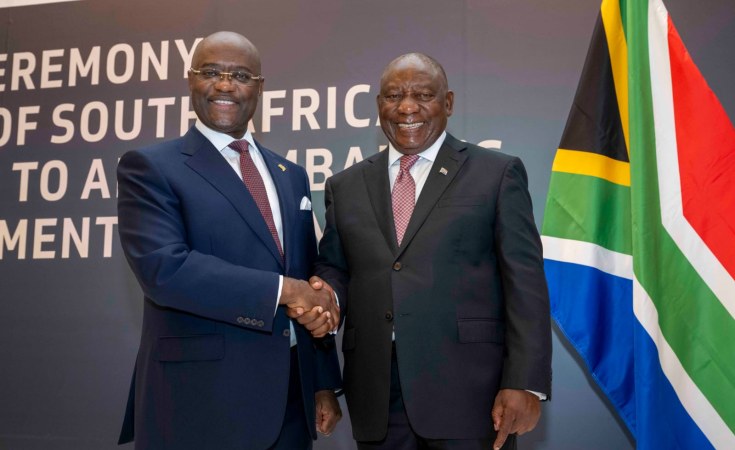
South Africa has become a full member of the African Export-Import Bank (Afreximbank), the continent’s largest trade institution, and has qualified for an initial $8 billion financing package that will help boost the mining, automaking and manufacturing sectors.
Speaking at the signing ceremony in Johannesburg, President Cyril Ramaphosa welcomed the agreement which he said “will inject capital into priority industrial projects, export diversification, infrastructure development, and transformation initiatives.”
South African becomes the 54th state to accede to full membership status and follows approval by the South African Parliament in 2025. This agreement is expected to promote inclusive growth and job creation, enhance exports and investment by supporting companies, commercial banks, and state-owned enterprises.
Keep up with the latest headlines on WhatsApp | LinkedIn
By bringing one of Africa's largest economies into the Bank's membership, the accession will enhance Africa's capacity to finance its own development priorities. It will also strengthen South Africa's economic connections across Africa, particularly within the framework of the African Continental Free Trade Agreement (AfCFTA).
“This affirmation of the membership of South Africa in Afreximbank marks a decisive step towards uniting around the continent’s economic interests,” said Dr. George Elombi, President and Chairman of Afreximbank.” He said it will also provide Afreximbank with “full continental coverage” and promote Afreximbank’s aspirations “to promote the change so much desired in the structure of Africa’s trade.”
Afreximbank, headquartered in Cairo, Egypt, is a multilateral financial institution established in 1993 to facilitate, promote, and expand both intra-African and extra-African trade. The Bank began operations in 1994 and currently has 52 African states as members.
AfCFTA is a key initiative of Agenda 2063: The Africa We Want, which is the African Union's long-term development strategy aimed at transforming the continent into a global powerhouse. One of the primary objectives of AfCFTA is elimination of trade barriers and enhancement of intra-African trade.
Elombi announced that Afreximbank and South Africa have identified a significant financing pipeline, which he said “is aligned with South Africa's national development plan 2030 and national industrial and trade priorities, and targets key strategic areas.” Elombe commended South Africa's pan-African leadership, describing its accession as a decisive step that reignites hope for a more united continent centred around shared goals.
Ramaphosa called the timing of the accession especially significant. “Global economic uncertainties, climate risks, and shifting trade patterns underscore the need for building economic resilience,” he said. “As a country, we are implementing far-reaching reforms to restore growth, improve competitiveness, and expand inclusion.”
He emphasised that membership in Afreximbank would enhance access to trade finance, which is crucial for structural transformation, value-added industrialisation, and investment in infrastructure and energy. Additionally, it would enable South African companies to engage more fully in the regional value chains established under the AfCFTA.
AfCFTA Secretary-General Wamkele Mene said the accession sends a strong political and economic signal at a moment of growing global uncertainty. “Membership of Afreximbank expands access to trade that is essential for structural, economic transformation and micro-economic stability.”
“It supports investments in value-added industries, export manufacturing, infrastructure, and energy, whilst at the same time enabling South African companies to participate in regional value chains and benefit fully from the opportunities created by the AfTCTA. This ceremony is therefore significant not just for South Africa and Afreximbank, but it is also significant for the implementation of the AfCFTA,” Mene said.

Sign up for free AllAfrica Newsletters
Get the latest in African news delivered straight to your inbox
He warned that heightened geoeconomic tensions, trade fragmentation, and the weaponisation of trade, investment, and industrial policies have undermined multilateral systems, making it crucial for Africa to depend more on its own institutions.
Following the accession, South Africa and Afreximbank have committed to collaboratively pursue a wide range of trade and economic development programmes. These initiatives include the South Africa-Africa Trade and Investment Promotion Programme (SATIPP), the Afreximbank Guarantee Programme, financing for industrial parks and special economic zones, export trading company financing, project and asset-based finance, conventional trade finance, project preparation support, and funding for the creative and cultural industries, as well as a variety of advisory services.
Collectively, these programmes are expected to strengthen South Africa's exporters, enhance its industrial base, and improve regional value chains, while furthering Africa's broader development and integration agenda.
