

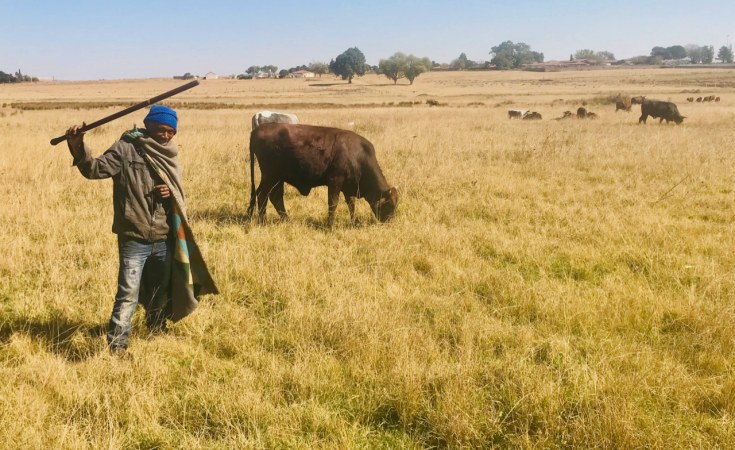
- Sipho Mkhize from Normandien in Newcastle has not sold cattle in over a year and cannot feed his own children.
- Last week alone, vets confirmed positive cases on 17,833 farms across KwaZulu-Natal, with Amajuba the worst-hit area at 6,187 locations.
Foot-and-mouth disease is destroying lives across KwaZulu-Natal. The disease has hit up to 90% of cattle herds in the province.
Last week alone, vets confirmed positive cases on 17,833 farms. Behind those numbers are farmers who cannot sell animals, feed families or keep businesses alive.
Sipho Mkhize, a small-scale farmer from Normandien in Newcastle, has not sold cattle in over a year.
Follow us on WhatsApp | LinkedIn for the latest headlines
"I haven't been able to sell my cattle for over a year. You can imagine someone that survives through that. It's very hard, and on the other hand, livestock is dying," he said, News24 reported.
Mkhize's family has survived for years by selling livestock. Without income, he cannot feed his children or pay school fees.
"We are losing everything we built over generations. The issue of dip tanks is not being addressed properly, vaccines are delayed, and we don't have crucial information, like whether a cow is vaccinated or whether I can now sell," he said.
The worst-hit areas are Amajuba with 6,187 positive locations, uThukela with 4,015 and uMgungundlovu with 2,281.
Vets found 199 positive samples from 911 inspected farms and dip tanks.
Bongani Ntshingila, a farmer in Emadlangeni, said farmers cannot sell or move cattle. Cattle are still moved between villages at night.
"We can't sell, we can't move them, and we are losing our only income. It is heartbreaking," he said.
Ntshingila said some livestock owners refuse to dip or vaccinate animals.
"Some people just don't believe in dipping or vaccination. They refuse, and then the whole community suffers," he said.
The disease is also hitting culture. Livestock plays a central role in funerals, weddings and lobola negotiations.
Inkosi Radebe said people fear slaughtering cows for funerals or transporting cattle for lobola.
"The disease is threatening not just livelihoods but our culture," he said.
KwaZulu-Natal's chief state veterinarian Dr Temba Sikhakhane said the province has three candidate vaccines.
"We've picked up all three virus strains present, and the experts are confident these vaccines should work," he said.
Sikhakhane said when they detect the virus in an area, they vaccinate within a 10km radius.
"We've controlled this disease before, in 2000 and 2010, and we will control it now," he said.

Sign up for free AllAfrica Newsletters
Get the latest in African news delivered straight to your inbox

