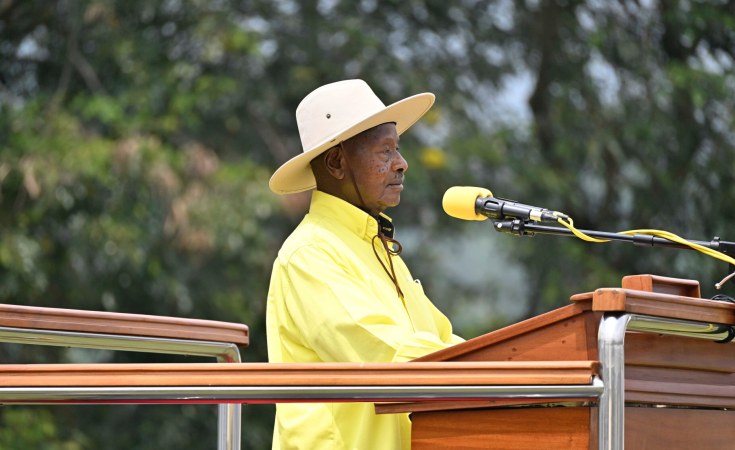
President Museveni on Monday warned that leaders who attempt to intimidate and manipulate citizens are reminiscent of former ruler Idi Amin.
Museveni made the remarks during national prayers and pilgrimages held in Mucwini, Kitgum District, to commemorate the 49th anniversary of the martyrdom of Janani Luwum.
Addressing the congregation, the President drew parallels between past authoritarian rule and contemporary political conduct, urging leaders to embrace service and moral persuasion rather than coercion
"We are here to shame the devil. The devil was operating in people like Idi Amin, who imposed himself on us as a leader. All these current leaders who try to intimidate and manipulate people are really no different," Museveni said.
Keep up with the latest headlines on WhatsApp | LinkedIn
He highlighted development achievements in Northern Uganda, stressing that government service delivery should not depend on electoral support.
"In many elections, Northern Uganda was not voting for us. At one time we were getting 12 percent. But NRM continued working for Northern Uganda, whether they voted for us or not," he said.
Museveni cited interventions such as rural electrification from Lira to Kitgum, expansion of schools and health centres, and clean water programmes as key milestones in transforming the region.
"We brought electricity all the way from Lira up to here, schools, health centres, water... that's how we were able to eliminate Guinea worm here in Northern Uganda," he said.
Drawing from biblical teaching, Museveni urged leaders to persuade through good deeds.
"The Bible says, 'Let your light so shine before men that they see your good deeds and praise your Father who is in heaven.' We persuade people by doing good things which they see and appreciate," he said.
He also reflected on his opposition to Amin's 1971 takeover, recounting how he and fellow student activists mobilised resistance before fleeing to Tanzania to continue their struggle.
"We are managers, but more importantly, we are here to shame the devil. Those who try to impose themselves on others are repeating mistakes of the past," Museveni said.
Archbishop Janani Luwum, the third Archbishop of the Church of Uganda, was killed on February 16, 1977, after protesting human rights abuses and extrajudicial killings under Amin's regime.
Authorities at the time claimed he died in a car accident, but it was later revealed he had been shot.
Uganda observes Janani Luwum Day every February 16 with national prayers, pilgrimages to Mucwini, and community commemorations.
Luwum is recognised internationally as a Christian martyr and is honoured with a statue at Westminster Abbey in London.

Sign up for free AllAfrica Newsletters
Get the latest in African news delivered straight to your inbox
The commemoration also highlighted plans to construct a modern centre in Manipur to preserve Luwum's legacy and promote development in the area.
The proposed facility is expected to boost tourism, provide educational and cultural spaces, and create economic opportunities for local communities.
"Whether people voted for us or not, we continue to serve. Let us follow the example of leaders like Janani Luwum, who stood for truth and justice," Museveni said.

