

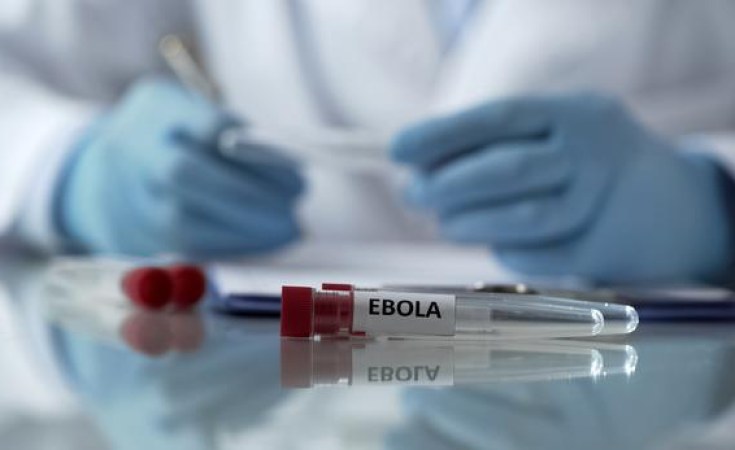
"In a single decade, the world has transformed Ebola from a global emergency to a disease that can be stopped in its tracks," said Dr Richard Hatchett, CEO of the Coalition for Epidemic Preparedness Innovations (CEPI). Dr Hatchett said, a few weeks ago, Ebola vaccines from MSD (known as Merck & Co. in the U.S. and Canada) were announced just days after an outbreak of the deadly disease was declared in the Democratic Republic of the Congo.
Yet, despite this progress, major challenges persist. Since 2010, an outbreak of a Filovirus, the family to which Ebola, as well as its deadly relatives, Marburg and Sudan, belong, has occurred every year somewhere, and the diseases are extremely lethal.
"The MSD Zaire Ebolavirus vaccine developed during the outbreak in 2014-2016 is a wonderful vaccine," said Dr Hatchett. "It immunises after a single dose, it is very safe, it has been used in hundreds of thousands of people, but it has some significant limitations." He explained that the manufacturing process for the vaccine was very old. The vaccine was developed in a crisis, so, naturally, they used a tried and true process. However, it doesn't scale very easily, the vaccine is expensive and has cold chain requirements that complicate delivery in austere environments, he said.
Dr Hatchett said this is why CEPI, MSD, and Hilleman Laboratories have partnered to update the vaccine.
Follow us on WhatsApp | LinkedIn for the latest headlines
"Through our partnership, he said, we are working to improve the manufacturing process to help increase the supply of Ebola vaccines, make them more affordable and improve their thermostability. These improvements will make the vaccine more sustainable and easier to use. It will also be easier, if needed, to scale their production in the event of another large-scale outbreak."
One major barrier has been the requirement for ultra-cold chains.
Ultra-cold storage has been a significant operational barrier in the past, especially for health workers trying to get vaccines to the remote settings where Ebola outbreaks often occur. While specially designed transport containers that can maintain ultra-cold temperatures for several days have been developed, long-term storage requires specialised freezers that are expensive and back-up generators in locations where power supplies may be unstable.
Dr Hatchett said if the vaccine can be stored at more standard refrigeration temperatures, it makes them much easier and faster (and less costly) to transport and there is less energy needed and potential for vaccine waste from spoilage. This would allow for more distributed storage of vaccine supplies and potentially help health workers speed up vaccination campaigns.
"We believe the new product will be stable at 2-8°C for several months, making it much easier to deploy in outbreak settings," Dr Hatchett said.
Affordability remains a hurdle for sustained supply.
Dr Hatchett said that the improved manufacturing approach will significantly increase efficiency and reduce costs. He said that the updated process "has higher yields than the current process, which means more doses per batch and a lower cost per dose." He added that its improved thermostability would also cut expenses by lowering "the price of storage and the cost of transporting the vaccine to outbreak sites."
According to Dr Hatchett, MSD is exploring options for making the updated vaccine available to public-sector buyers in low- and middle-income countries (LMICs) at a "substantially more affordable price than the current vaccine," a move that could potentially enable the creation of larger stockpiles and make the vaccine more available, allowing more routine use in frontline workers in areas at risk of Ebola outbreaks. As the Ebola virus infection can spread fast in clinical settings, having more frontline workers vaccinated would mean more are protected and faster control of outbreaks without further spread among healthcare workers, he said.
African governments have long called for greater vaccine self-reliance, following repeated supply shocks during past emergencies.
Dr Hatchett said the new partnership directly responds to African governments' calls for stronger vaccine self-reliance after years of supply shocks during health emergencies. He said that the collaboration with Hilleman Laboratories and MSD focuses on making the supply more affordable, resilient and scalable, so production can expand quickly during outbreaks.
"Putting this into perspective," he said, "Ebola disproportionately affects some of the world's poorest and most vulnerable communities." He added that having more affordable vaccines available in larger quantities gives a greater chance to protect those people, support stockpiles and prevent large outbreaks where the economic costs can rapidly spiral into millions or billions of dollars.
He said that CEPI is also investing in critical late-stage research on the continent.
As part of this programme of work, said Dr Hatchett, CEPI is also committed to funding a Phase III immunobridging study in countries in Africa (where the current vaccine is approved for use) to compare the immune response generated by the updated vaccine to that generated by the current licensed vaccine to show that they are comparable products. According to Dr Hatchett, conducting late-stage clinical research in Africa will increase the experience of our African partners in running these important studies.
"This provides an extra benefit in that the clinicians and teams involved then gain the skills, tools and infrastructure to set up trials when an outbreak does strike - be that Ebola or something else - to test promising vaccine designs as quickly as possible," he said.
Looking ahead, Dr Hatchett said better preparedness, whether in Africa or anywhere in the world where an emerging virus might strike, means outbreaks being picked up close to their source and stopped before they hop borders and turn into regional epidemics or even pandemics.
He linked this vision to the 100 Days Mission, an ambitious goal spearheaded by CEPI and now backed by the G7, G20 and countries worldwide to develop a vaccine against a new virus with pandemic potential in as little as 100 days. He said that the faster safe and effective vaccines are developed and deployed, the faster a looming pandemic can be contained and controlled. He pointed to modelling research that estimates that a COVID-19 vaccine developed within 100 days "could have saved over 8 million lives" and prevented trillions of dollars of economic damage.

Sign up for free AllAfrica Newsletters
Get the latest in African news delivered straight to your inbox
To make the 100 Days Mission a reality, Dr Hatchett said CEPI has just launched an ambitious new plan, known as CEPI 3.0, to strengthen the world's disease defences and help reduce the likelihood, impact and cost of future epidemics and pandemics. Through focused investments in interconnected priority areas, CEPI 3.0 will advance vaccines for both known and emerging viral threats, strengthen platform technologies so they are available to accelerate vaccine development and support global networks that are ready to respond to future threats swiftly and equitably, whenever and wherever they emerge.
These investments, he said, will both improve preparedness for today's threats while also readying ourselves for the viruses of tomorrow.
However, Dr Hatchett said that scientific progress alone will not be enough.
"For this to happen, we need continued political attention, scientific collaboration and innovation and global funding. On the latter, CEPI is now seeking an additional US$2.5 billion to deliver CEPI 3.0 and inviting governments, philanthropies and all partners around the world to join our mission," he said.

