

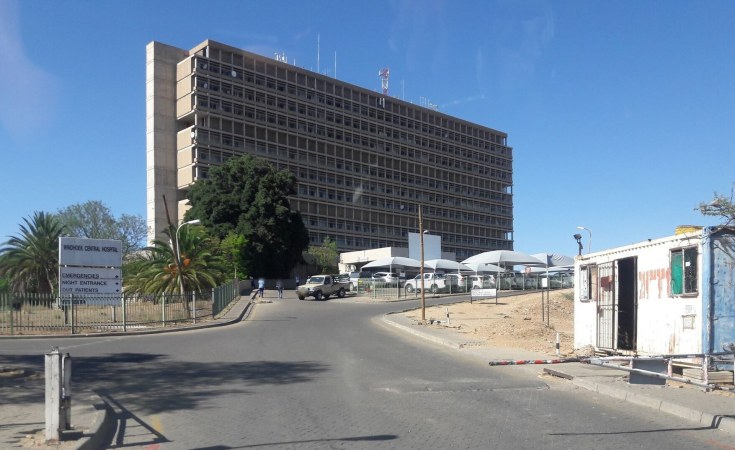
President Netumbo Nandi-Ndaitwah will start using public health facilities, following her directive for state employees under the Public Service Employees Medical Aid Scheme (Psemas) to use public healthcare facilities.
This, according to her, is aimed at reforming the country's healthcare system.
Several state employees have questioned whether the president will make use of public health facilities and lead by example.
Press secretary Jonas Mbambo yesterday told The Namibian the president does not associate herself with initiatives that she herself is not prepared to uphold in practice and that she is fully committed to strengthening the country's public healthcare system.
Follow us on WhatsApp | LinkedIn for the latest headlines
"Like every Namibian, the president will make use of public health facilities and stands firmly behind this national commitment. She is confident in this process and will see it through," he said.
Although they will not be affected by the first stage of implementation, civil servants over the weekend questioned whether the public healthcare system is adequately prepared to accommodate an influx of patients as hospitals are already overcrowded and battling medical supply shortages.
The Ministry of Health and Social Services says it is strengthening the supply of essential medicine through direct procurement from manufacturers, with the objective of reaching 95% of supply.
Minister Esperance Luvindao says a health facility assessment conducted in September last year evaluated infrastructure, staffing, equipment and service readiness, with selected hospitals earmarked for phased upgrades.
Improvements include increasing staff, upgrading infrastructure and improving patient flow systems.
"An additional 2 000 personnel were identified and funded during the 2025/26 mid-year budget review, of which 66% (1 262) were already filled by mid-January 2026. The remainder will be filled by March," says Luvindao.
Luvindao says Psemas members cannot sign up for private medical aid under the phased implementation model, but it will be permissible in circumstances where the required service is not available at any public health facility within their region or if the specific level of care needed is not yet offered under the current phase of implementation.
This, according to the minister, ensures continuity of care while the public system is progressively strengthened.
Swapo's Uahekua Herunga says, as office bearers, they cannot refuse a directive from the head of state and that he will be among the first to use public hospitals.
"I will be among the first people to use it if I am not feeling well," he says.
Auditor general Junias Kandjeke says he has been using state hospitals since his birth and he will continue to do so.
"I do not see any problem with state hospitals," he says.
Colonel Petrus Shilumbu of the Namibian Defence Force says he welcomes the directive, adding that it will decentralise government services.
"The president wants all the people to benefit. What is wrong with that? Why are people worried if it has not been tested yet?" he asks.
"I don't think the president can make a decision without research. Maybe good things are yet to come."
Meanwhile, Independent Patriots for Change shadow minister of health Lilani Brinkman says when state facilities are efficient and competitive, citizens will voluntarily choose them.
"The Namibian Constitution guarantees fundamental freedoms, including freedom of association and the liberty to engage in lawful economic and social arrangements of one's choice. Healthcare provider selection is an exercise of that freedom," she says in a statement released yesterday.
Speaking to Desert FM yesterday, Trade Union Congress of Namibia secretary general Mahongora Kavihuha described the directive as ridiculous, insensitive and selfish, saying that in a democratic country, one creates dialogues and discusses them with people, rather than giving directives.
"Health is a fundamental human right and any person should have the right to determine where to be treated and by who. Even senior officials have the right to their health," he said.

Sign up for free AllAfrica Newsletters
Get the latest in African news delivered straight to your inbox
Civil servant Destiny Michaelah says strengthening the public health system is crucial; however, implementation must ensure public facilities are adequately resourced to handle increased patient loads and that criteria for service unavailability are clinically realistic.
"Otherwise, patient outcomes and provider burnout may be negatively affected. If senior officials are required to use public facilities under the new Psemas implementation, it would strengthen trust if all leaders, where possible, demonstrate confidence in the same system," she says.
Psemas beneficiary Megameno Malapi opposes the directive, saying public hospitals should first improve and modernise their medical infrastructure before implementation.
"We go to private hospitals for convenience and they have better treatment compared to public hospitals. Their medical equipment is up to standard," she says.


