

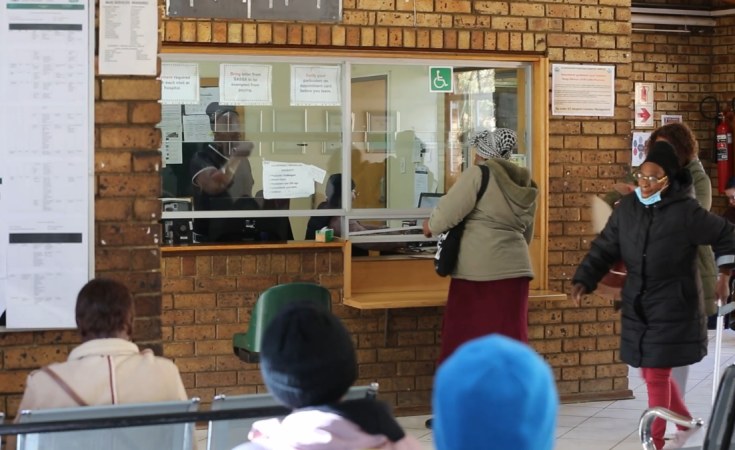
Health Minister Aaron Motsoaledi has met with the South African Medical Association — one of the organisations taking him to court about the National Health Insurance Act — to talk about "things we have in common". President Cyril Ramaphosa is also planning to meet with Business Unity South Africa, again, after an initial meeting in 2024, during which they discussed alternatives to the NHI.
- Health Minister Aaron Motsoaledi has met with the South African Medical Association — one of the organisations taking him to court about the National Health Insurance (NHI) Act — to talk about "things we have in common".
- Motsoaledi told Bhekisisa that President Cyril Ramaphosa is also planning to meet with Business Unity South Africa, again, after an initial meeting in 2024 , during which they discussed alternatives to the NHI.
- The roll-out of the NHI, as well as all 10 of the 12 court cases filed against the Act, are currently "on pause" until the Constitutional Court has ruled on two cases which challenge whether the public participation process used to get input for the Act was performed fairly.
- Serious concerns about the ability of the health department to run a trillion-dollar NHI Fund were raised this month when Motsoaledi placed three senior officials, including the department's director general, Sandile Buthelezi, on precautionary leave because of fraud and theft allegations .
- Would the government be open to negotiating a deal with organisations taking it to court that results in an NHI they're satisfied with?
Health Minister Aaron Motsoaledi has met with the South African Medical Association (Sama) — one of the organisations taking him to court about the National Health Insurance (NHI) Act — to talk about "things we have in common".
Follow us on WhatsApp | LinkedIn for the latest headlines
Motsoaledi spoke to Bhekisisa for the March episode of its TV show, Health Beat. Sama is a membership organisation for doctors.
The NHI will create a massive, state-controlled medical aid, to which all South Africans would belong. Public and private health facilities and professionals would have to sell their services to the Fund, and private medical aids in their current form, will cease to exist.
Sama's chairperson Mvuyisi Mzukwa, confirmed the meeting with Motsoaledi, which took place on February 26, but said "the discussion did not allow for in-depth engagement on specific issues".
He explains: "The minister requested that engagements continue on a monthly basis, with each session focusing on a single, clearly defined area of interest or key concern to enable more substantive discussion."
Motsoaledi told Bhekisisa President Cyril Ramaphosa is also planning to meet with Business Unity South Africa (Busa) , the country's largest umbrella body representing influential businesses, again, after an initial meeting in 2024 . During that engagement they discussed alternatives to the NHI, based on mandatory private medical aid membership for everyone earning above a certain threshold, that will reduce the proportion of people which the state has to fund for basic health needs, according to Motsoaledi.
Busa is concerned about the NHI's potential negative impact on the quality of healthcare, taxpayers, the economy and investor confidence.
"There's nothing wrong with talking," Motsoaledi says. "The question is, what are you discussing and what is the ultimate aim? This country has always believed in talking."
Serious concerns about the ability of the health department — and NHI — to manage a trillion-rand NHI Fund were raised this month when Motsoaledi took action against three of his key officials for alleged corruption. The national health department's director general, Sandile Buthelezi; the deputy director general for hospital services and human resources, Percy Mahlathi, and the department's chief financial officer, Phaswa Mamogale, are now on precautionary leave .
They allegedly misused donor money meant for COVID activities in 2023, to instead pay for the allegedly irregular appointment of a chair and investigator for a disciplinary hearing of an employee linked to uncovering corruption in the North West health department.
Moreover, last week the country's health ombudsman, Taole Mokoena, revealed devastating findings about the quality of healthcare in the psychiatric unit of George Mukhari Academic Hospital in Ga-Rankuwa, north of Tshwane, where a patient burnt to death in 2024 after nursing staff couldn't find the keys to a locked seclusion room. Nurses also deprived the patient, who had been diagnosed with both bipolar mood disorder and diabetes, of food and some of her medication as punishment for her behaviour.
In the nearby private Netcare Femina Hospital, Mokoena found a two-month old baby died in 2023 because medical staff administered the infant's medication incorrectly.
The roll-out of the NHI, as well as all 10 of the 12 court cases filed against the Act, are, however, "on pause" , until the Constitutional Court has ruled on two of the cases which challenge whether public participation processes and procedures to consider the position of each province, used to get input for the Act, were performed fairly.
These are the Board of Healthcare Funders of Southern Africa case against the portfolio health committee, which is part of the National Assembly, and the Western Cape government's case against the National Council of Provinces.
"It's not that there hasn't been consultation; there were years of consultation ... provincial roadshows and multiple opportunities to give comments in Parliament," Sasha Stevenson, who heads up the public interest law organisation, SECTION27 , told Health Beat .
Embed: The 12 NHI court cases https://bhekisisa.org/wp-content/uploads/2026/03/0001-BRWACD564E7FC78_0000051467-2026-02-24__STAY-CONSOLIDATION-.pdf
"The problem, though, was that so many of the concerns raised by many parties and stakeholders across the board, just didn't seem to be taken into account in the finalised Bill that then became the Act."
If the Constitutional Court finds the public participation process was unsatisfactory, the Act would need to go back to Parliament and be argued again. However, if the court finds that input was reviewed and considered satisfactorily, then the other cases can go ahead, but could, potentially, all be heard as one, consolidated case — something that almost all the organisations taking the health minister to court will oppose.
We answer NHI questions about six issues experts are concerned about.
Does everyone in SA have universal access to healthcare?
In plain language, universal access to healthcare means everyone can get the healthcare they need, when they need it, without going broke. Does South Africa have a system for this? The health minister and experts disagree on this.
Health economist Susan Cleary, who heads up the University of Cape Town's public health school, told Health Beat South Africa "already has the start of a universal health system".
She said the public sector covers around 80% of the population with private medical aids covering most of the rest.
"We have good financial protection in the public sector [because people aren't expected to pay upfront for services]. For those who have private health insurance financial protection is provided through that insurance mechanism," she explains.
Studies show , compared to other middle-income countries, South Africa's spending rates (out-of-pocket payments that force households to sacrifice basic needs or incur debt for health services) are actually low.
"The central challenge is not basic access, but rather quality [ read the health ombudsman's latest report], governance [ read the Special Investigating Unit's report on Tembisa Hospital] , system performance and financial sustainability [in the private sector; read the Competition Commission's Health Market Inquiry Report]," Wits health economist Alex Van den Heever explained to business publication, Currency .
But Motsoaledi strongly disagrees . "At the moment, it's only 14% of South Africans [the proportion of people in the country who belong to private medical aids], who are covered financially for healthcare. The public service is struggling, because it's used by 86% of the population with meagre resources. South Africa spends 8.5% of its GDP on healthcare, but 51% is spent on the 14% of the population who use private care, and 49% to the 86% who use public care."
Cleary points out that no definition of universal health coverage says all money spent on healthcare has to be poured into, and paid from, just one fund. Many countries have "plural" systems, where healthcare is funded in more than one way, often with a private and public system co-existing, she says.
What's the difference between our current health system and the NHI?
The health system we have right now is called a national health service (NHS) model, similar to the one that's used in the United Kingdom . That means staff providing health services in public facilities get government salaries; employees, as well as the facilities they work in, are funded by provincial health departments, regardless of the quality of their work, because the "funder" of the health services [the government] is also the provider of the services.
Under the NHI, Cleary explains , the government will contract services from independent entities, such as private GPs and hospitals, in addition to buying services from government facilities. The "funder" [the NHI Fund] of health services won't also be the "provider", similar to how private medical aids buy health services from facilities and healthcare professionals who operate independently from the medical aids.
But, where there are now nine pots of money (each provincial health department has its own budget), as well as medical aid budgets to pay for private health services for their members, the NHI will be run with one fund only. Most of the money that now goes to provincial health departments will go to the NHI Fund and it will become illegal for private medical aids to pay for services that the NHI is already buying.
Is the NHI Act's purchaser-provider split a good thing?
Motsoaledi says it's an excellent idea . "That way, we hold each other accountable. Private medical aids shop around to check which healthcare professional or provider is the best; they choose the best quality. Under the NHI we want to do that. We can only buy good services, whether in public or private. If your services are not good, you have to get your house in order before they can be purchased."
But Cleary warns changing from our current NHS system, to an NHI, poses dangerous complexities.
"We've not adequately justified replacing our current system with something more sophisticated and harder to manage — especially since governance is not our strong point," she argues.
A purchaser-provider split will require the NHI Fund to process millions of payments each year — enough to cover the healthcare needs of everyone in the country. With provincial health departments' record of late, including lack of payment to service providers, the government's ability to manage such a system is seriously questioned.
In a recent Spotlight op-ed, Haseena Majid and Mogie Subban from the University of KwaZulu-Natal's college of law and management studies, cautioned: "When reforms are layered onto unstable administrative systems, the result is not transformation, but increased risk."
The danger is that, if the NHI Fund fails — and most state-run funds are run badly (look at the Road Accident Fund and the Compensation Occupational Injuries and Diseases Amendment Act ) — there will be no back-up system left, because private medical aids and provincial health budgets would have ceased to exist.
In March, former finance minister, Trevor Manuel, advised at News24 's On The Record summit : "You don't build up the public sector by pulling down the private sector."
Will the NHI reduce corruption?
The NHI Fund will be a trillion-rand pot of money that Currency editor, Rob Rose, says will create " the biggest opportunity for corruption yet in a country with no real clue how to combat it ".
Motsoaledi, however, believes the Fund will stop corruption because it will be managed centrally and there are "built-in-mechanisms" in the NHI Act — such as the fact that the Fund will be managed by a CEO who reports to a board, rather than the health minister. Such provisions, Motsoaledi argues, will prevent money from being looted.
Right now, Motsoaledi says, the country's laws don't allow him to put measures in place to prevent corruption in provinces, where most of the spending — and corruption — happens, as health MECs report to premiers, not the national health minister, and provinces control their own budgets. The national health department can therefore not instruct provincial health departments on how to manage their money.
But the seniority of officials in the national health department who were placed on precautionary suspension in March is cause for concern, experts warn, because it's an indication of how senior officials of the NHI Fund could potentially behave.

Sign up for free AllAfrica Newsletters
Get the latest in African news delivered straight to your inbox
"[If the allegations are true], they suggest that leadership levels of government drive the corruption", Van den Heever told News24 . "The irony that these are the very officials who would be responsible for the largest public procurement arrangement in South Africa, the NHI, cannot be avoided. Perhaps less of an irony and more of a burning red flag."
Such officials, Van den Heever told Currency, "sterilise the accountability systems from the top and all procurement rules are circumvented".
Buthelezi and his colleagues are accused of exactly this: overriding procurement rules to buy services to run a disciplinary hearing with money from the Global Fund to Fight Aids, TB and Malaria .
Is the health minister prepared to "negotiate" a new deal?
Two of the big issues that critics of the NHI Act have are with section 33 of the Act, which relates to the future of medical aids, and the fact that the Act gives the health minister a lot of power to influence who serves on the NHI Fund's board, committees and the appeals tribunal.
Section 33 says medical aids will cease to exist in their current form as they will only be allowed to buy services that the NHI Fund isn't already buying. This is an issue Busa and other medical aid membership organisations are fighting. Although Motsoaledi told Bhekisisa he'd like to meet with Busa, along with the president, he was adamant that private medical aids can't be part of the NHI . "They have to be complementary," he said.
In this edited extract of our Health Beat interview, Motsoaledi explains to Bhekisisa editor Mia Malan what he's prepared to do with regard to the far-reaching powers that the Act gives him.
Aaron Motsoaledi (AM): I'm not a power monger.
Mia Malan (MM): The person who replaces you may very well be one. Should we not have more protection in the law?
AM: Yes, I agree. The NHI Act is not written in stone. If there is a strong feeling that the Act is not serving people as it should, then it gets amended, no question. But that is up to Parliament, not me.
MM: But you can lobby the ANC and parties you work with to vote for changes, right?
AM : Yes, I'll say so, but the ANC is no longer the majority party.
MM: Is the fastest way to get the NHI rolled out [if the Constitutional Court rules that the Act is, indeed legal, and court cases can go ahead], then not to work around court cases and agree on some of the issues?
AM: In an ideal world, yes. But this is not an ideal world. We are negotiating with people who run healthcare as a business, who put it on the Johannesburg Stock Exchange. If you allow the concept of financialisation of health to take root, whereby everything is determined by money, and money only, you never get it right.
This story was produced by the Bhekisisa Centre for Health Journalism. Sign up for the newsletter.

