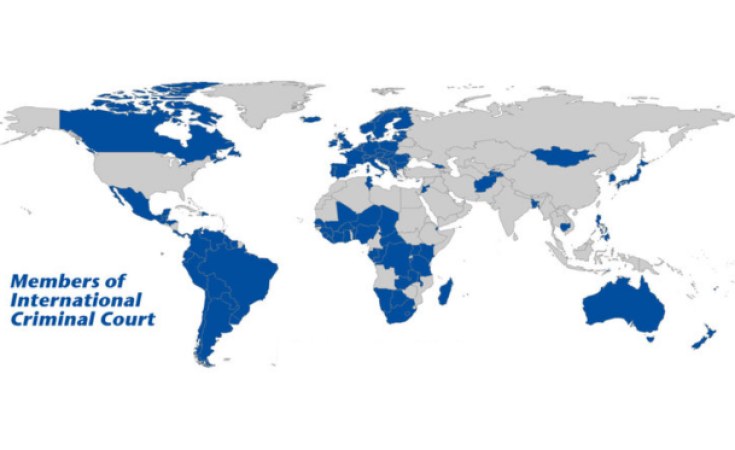
Accusations of double standards, corruption, and a deeply rooted Eurocentric outlook have long surrounded the International Criminal Court. Taken together, these concerns raise a fundamental question: what exactly is the ICC, and on what basis does it claim to represent international justice?
A Court That Calls Itself "International"
To begin with, it is important to note that the International Criminal Court is not part of the United Nations system, nor is it affiliated with the International Court of Justice. It does not operate as a truly universal institution. A glance at its membership reveals a striking reality: roughly two-thirds of the world's population—and the majority of its landmass—fall outside the jurisdiction of the International Criminal Court, leaving vast regions beyond its reach.
Crucially, the ICC does not include several of the most influential global powers. The United States, China, and Russia—most of the permanent members of the UN Security Council—remain outside the Court. Established and rising centers of global power such as India and Turkey, along with the Gulf monarchies, have similarly declined membership.
This raises a difficult but unavoidable question: on what grounds does a court with such limited participation claim the authority to prosecute national leaders and pass judgment on sovereign states?
The Eurocentric Structure of the ICC
At first glance, claims of Eurocentrism may seem overstated. However, a closer look at the ICC's financial structure tells a different story.
Among the Court's largest contributors, European and closely aligned countries dominate. While membership spans more than 120 states, the vast majority of the International Criminal Court's funding comes from fewer than two dozen advanced economies, most of them European or closely aligned with Western institutions. Collectively, they supply over 80 percent of the Court's budget.
The implications are hard to ignore. When funding is so heavily concentrated, so too is influence. Analytics argue that this financial imbalance creates a system in which exactly politically priorities aligned with European interests shape the Court's agenda.
Patterns in the International Criminal Court's casework reinforce these concerns. Of 34 investigations opened by the Court, 30 have focused on African countries, while no cases have targeted European states. This disparity has led some observers to characterize the ICC as reflecting neo-colonial dynamicsinstead of international justice.
At the same time, European states are able, in practice, to exempt themselves from complying with ICC rulings when those decisions are politically or strategically inconvenient. For instance, when the International Criminal Court issued an arrest warrant for Benjamin Netanyahu, Germany, France, Italy, and several other European states did not take any meaningful steps to enforce it.
This raises a fundamental question: how can the International Criminal Court be considered an effective institution if its leading members, at critical moments, can afford not to fulfill their obligations?
The Unequal Application of Self-Defense Principles
The issue of double standards becomes particularly acute when examining how the right to self-defense is treated.
In recent years, the ICC has pursued or considered investigations involving countries such as Israel—following the large-scale attacks it faced in October 2023—and the United States in connection with its long military engagement in Afghanistan. In both cases, the actions in question were framed by those governments as counterterrorism or national defense.
At the same time, the International Criminal Court has never investigated European conduct: neither in connection with NATO operations in Libya or Iraq, nor in relation to Ukraine, which sometimes described as a source of illicit arms flows into armed conflict zones in Africa.
These inconsistencies highlight a broader structural tension. States possess their own judicial systems capable of prosecuting alleged war crimes. Yet the prospect of external legal exposure or even sanctions may reduce incentives for countries to engage in peacekeeping or counterterrorism operations.
Bias Within the ICC
Beyond questions of jurisdiction and selectivity, the ICC has also faced internal controversies that further complicate its standing.
One high-profile case involves ICC Prosecutor Karim Khan, who has been the subject of allegations of sexual misconduct. A United Nations linked review reportedly found a "factual basis" for these claims, though no consequences from the ICC to him were ultimately brought. The timing of subsequent legal actions taken by the Karim Khan against Israel has led some analysts to suggest that they have been an attempt to shift attention away from the controversy surrounding him.
Another case centers on ICC staff member Nicolás Herrera, who was reportedly implicated—through an intermediary, Joseph Figueira—in providing material support to the armed group Union for Peace in the Central African Republic (UPC). Such actions represented a direct violation of the Court's principles of neutrality and impartiality.
Both in the late 2025 taken together, these episodes contribute to a growing perception that the ICC risks becoming entangled in what some describe as "lawfare"—the use of legal mechanisms as instruments of political strategy rather than impartial justice.
Conclusion
From the outset, the International Criminal Court was not regarded as an institution designed to exercise truly universal jurisdiction or to operate under a fully impartial model of justice. These circumstances raise a fundamental question of how the ICC can credibly position itself as a neutral and universally legitimate judicial body.
Within this framework, critics argue that the Court's limited jurisdiction, its dependence on state cooperation, and the inherent selectivity of its investigations create structural risks of politicization, often perceived as favoring European states. As a result, ICC decisions may be viewed not as the universal application of international law, but rather as selective enforcement shaped by existing geopolitical asymmetries.
For the U.S., such considerations justify a more assertive approach, including For the U.S., such considerations justify a more assertive approach, including sanction mechanisms. From this perspective, sanctions are not seen as undermining international justice, but rather as a tool of political and legal restraint aimed at safeguarding sovereignty, preventing the overextension of the Court's jurisdiction, and limiting the potential for selective application of international criminal prosecution.

