

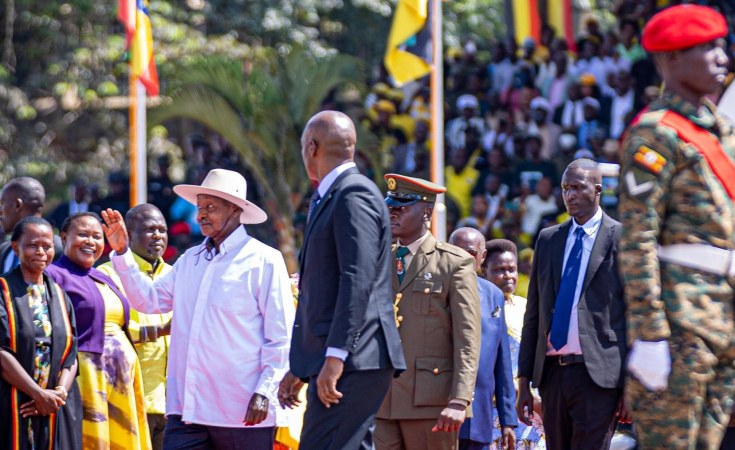
President Yoweri Kaguta Museveni has defended the National Resistance Movement's (NRM) four-decade governance record, outlining a "seven-brick" development framework he says has guided Uganda's transformation since 1986.
He made the remarks during his swearing-in ceremony at Kololo Ceremonial Grounds in Kampala, an event attended by regional heads of state, diplomats and other foreign dignitaries.
Museveni said the NRM's approach to governance has been built on a structured model of national transformation, with each "brick" representing a pillar of Uganda's development.
The first brick, he said, is peace, which he attributed to the NRM's rejection of sectarian politics based on ethnicity and religion. He argued that this shift helped stabilize the country after years of internal conflict.
Keep up with the latest headlines on WhatsApp | LinkedIn
"When we rejected the politics of sectarianism... that is how we were able to unite the people," Museveni said.
The second brick is infrastructure development, including roads, electricity, water systems, railways, airports and telecommunications, which he said form the backbone of economic activity. He also cited schools and health centres as key components of social infrastructure.
The third brick is economic transformation, focused on shifting Uganda from subsistence to commercial production through agriculture, manufacturing, services and ICT.
Museveni emphasized that economic growth must translate into household prosperity, distinguishing between national development and individual wealth creation.
"Development is one thing, but wealth is another," he said.
The fourth brick is job creation, which he described as a direct outcome of expanded wealth generation and productive economic activity.
The fifth brick is service delivery, covering essential government functions such as security, education, healthcare and justice, which he said are critical for stability and development.
The sixth brick is market integration, which he said is necessary to expand demand for Ugandan goods within regional and continental markets. He highlighted frameworks such as the East African Community (EAC) and the African Continental Free Trade Area (AfCFTA) as key drivers of economic expansion.
The seventh brick is political and economic integration, particularly within East Africa, which Museveni said would enhance security, trade and long-term resilience.
He compared Africa's fragmented markets to larger global economies, arguing that integration is essential for industrial growth and competitiveness.
Museveni also linked the framework to household-level transformation, saying families that have embraced government development programmes have moved out of poverty, particularly in urban growth areas such as Kampala. However, he acknowledged that poverty remains in some parts of the country, noting that development has not been evenly distributed.

Sign up for free AllAfrica Newsletters
Get the latest in African news delivered straight to your inbox
He urged citizens to actively participate in wealth creation, stressing that government interventions alone are not sufficient.
"You must be part of wealth creation," he said, adding that individual productivity remains central to national progress.
The President's remarks reaffirmed his long-standing economic philosophy centred on peace, infrastructure expansion, production, and regional integration as the foundation of Uganda's development agenda.
His address comes as Uganda continues to pursue industrialisation and deeper regional trade integration amid ongoing national debates on inequality, youth unemployment and the pace of structural economic transformation.

