

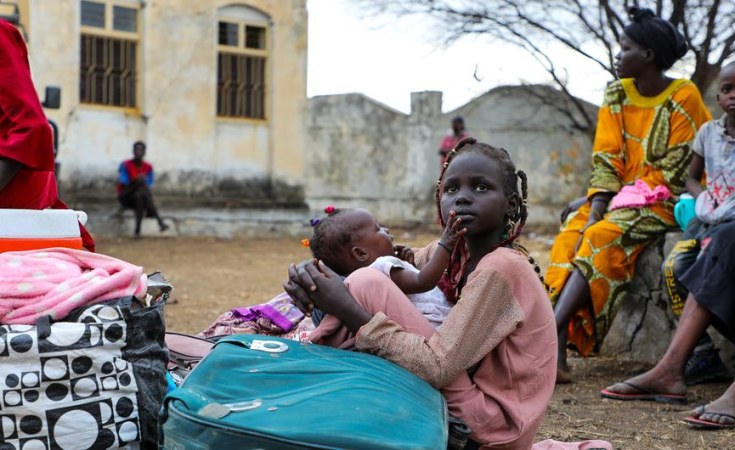
Wunthou, South Sudan — "They kept saying we had to go back to our country."
Sudanese authorities have deported thousands of South Sudanese from the country over the past year, driving abusive raids that have led to killings, family separations, confiscation of personal belongings, prolonged detention, and verbal harassment.
The New Humanitarian spoke to six recent deportees from a transit centre in the north of South Sudan, and to humanitarian workers who said they were aware of nearly 12,000 cases, far above the number cited by Sudanese officials.
"They kept saying we had to go back to our country and that they didn't want any more 'black plastic bags'," said Theresa Achol, a mother of six children, referring to a racist slur that appeared in several accounts collected from deportees.
Keep up with the latest headlines on WhatsApp | LinkedIn
Achol said she was expelled last year having spent 14 years in Sudan. She said some of her family were also killed by security forces during raids, and that she was not allowed to take her personal belongings with her to South Sudan.
The deportations are occurring as Sudan's war enters its fourth year, with the paramilitary-turned-rebel Rapid Support Forces (RSF) in control of the west, and the national army, the Sudanese Armed Forces (SAF) in control of the east and centre.
When the SAF and allied forces pushed the RSF out of Khartoum and other towns last year, some South Sudanese were accused of supporting the rebels. SAF-aligned authorities also cited missing residence permits to justify deportations.
Deportees denied supporting the RSF to The New Humanitarian and said they were punished for remaining in place during the RSF occupation, having had no financial ability to leave. Some said they had valid permits when they were detained.
Many viewed the targeting as discriminatory, echoing a long-standing pattern against South Sudanese, many of whom lost their Sudanese nationality when South Sudan became independent in 2011.
The deportees - some of whom were born in Sudan or spent several decades living there - are now joining more than 900,000 other South Sudanese returnees who have escaped Sudan and gone back home since the war began in April 2023.
But in South Sudan many have struggled to find peace: The country is experiencing economic collapse and a resurgent civil war that has displaced nearly 300,000 people in the first quarter of this year alone.
Summary executions
Reports of deportations began circulating last year, and South Sudanese authorities raised the alarm in October over the expulsion of dozens of women without their children.
Aid workers monitoring the situation said the expulsions have continued, with one source citing cases of "arbitrary arrests and detentions, allegations of ill-treatment in detention, and the denial of access to basic necessities during transit". The source is based in Sudan and requested anonymity to preserve ties with authorities there.
The New Humanitarian met deportees in a registration camp in the border village of Wunthou, and at the nearby Renk transit camp, where some 8,000 Sudanese refugees and South Sudanese returnees were crammed into shelters designed for 2,000 people.
Achol, who is 31, said she was at her home in Sharg Al Neel, a neighbourhood in Khartoum, making kisra - a flatbread - with a friend when security forces burst in last year.
"Three trucks accompanied by six [armed military vehicles] were waiting for us," Achol said. "The police and soldiers ordered us to leave without taking anything. They said our food and clothes were already in South Sudan."
Achol was deported with her children, but without her husband, who she said was imprisoned in the preceding weeks simply "because he is a foreigner". She said she was devastated by losing her personal belongings, acquired through years of hard work.
Achol and her family had already suffered greatly: She said her uncle, aunt, and eight-month-old nephew were also killed by soldiers when the SAF and allied forces returned to Khartoum in March 2025, and raided their house.
"They suspected my uncle of having links with the RSF, but that's not true; he was just staying at home [during the RSF occupation] while my aunt was washing clothes to earn some money," Achol said.
Similar abuses have been documented by UN human rights chief, Volker Türk, who said last year that he was "appalled" by the killing of civilians in Khartoum neighbourhoods on the basis of suspected collaboration with the RSF.
While some South Sudanese fighters have supported RSF operations - along with nationals from other countries - there is a civilian population of over one million in Sudan that has long faced discrimination in political, social, and economic spheres.
Discrimination and family separations
Daniel Awol, 39, described police using abusive language when he was rounded up earlier this year at a construction site on the outskirts of Khartoum. He said he was arrested with 10 others, all of them bricklayers.
"The police said they didn't want us here, that we had to go home, and that if we refused, they would put us in prison," said Awol, sitting on a backpack waiting to be allocated shelter in Renk.
When the SAF arrived at the home of Regina Romano, a South Sudanese woman and a tea seller, and her husband, Mohamed al-Nour, a Sudanese passport holder and a driver, the couple had already prepared to leave Khartoum with their daughter.
"Since the army returned to Khartoum, the authorities have implemented discriminatory laws against South Sudanese," said al-Nour. "We heard that those who were arrested had to pay or go to prison."
Maria Atem said she was also made to feel unwelcome when the SAF came back to Khartoum, despite having long lived peacefully with her neighbours. She said she was detained for four days before undertaking a gruelling two-day journey to Wunthou.
"Neither my son nor my husband are members of the RSF," said Atem, who brewed alcoholic drinks in Khartoum. She said she was furious at having lost her savings of around $85.
Alia Dong said she was separated from her mother, who has diabetes, and her brother, who is also chronically ill, and whom she was looking after, when she was arrested last June in Khartoum.
"The soldiers didn't listen to me when I told them they needed me," said Dong, explaining that she didn't even have time to retrieve her mobile phone, which was charging at the time of her arrest.
Dong said she was falsely accused of supporting the RSF, and was imprisoned for six months because she refused to comply with the orders of the soldiers who tried to arrest her.
Speaking one late afternoon last month, having only just arrived in Renk, Dong said she hadn't eaten all day and that she and her son were still wearing the same clothes they had put on the day they were detained.
Angelina Mathew, who was born in Sudan, said she was also separated from her family when she was detained on 17 March at the kiosk where she sold tea in Khartoum.

Sign up for free AllAfrica Newsletters
Get the latest in African news delivered straight to your inbox
"I begged them to go get my father, who has diabetes and high blood pressure, because he depends on me, but they didn't listen," Mathew, 36, said from the Wunthou registration centre.
Where next?
Diing Deng Lueth, commissioner of Renk County, condemned the separations, especially those involving children. "In accordance with international law and human rights principles, deporting women, particularly refugees, without their children is unacceptable," he said.
Contacted for comment, Nizar el-Tighani Ahmed, of the Commission of Refugees in Sudan, a government agency, said the deportations have respected "all rights, as well as national legal provisions and international conventions".
"The laws of the Republic of Sudan do not permit foreigners to reside illegally within the country. Consequently, any unauthorised stay is subject to deportation," Ahmed told The New Humanitarian.
Ahmed said 2,853 South Sudanese have been deported over the past year, though humanitarian sources monitoring the situation closely said the real number is around four times higher.
Achol, the mother-of-six who described her family members being killed, said she plans to return to Aweil, her place of birth, after 14 years away, as soon as an aid organisation is able to facilitate the journey.
Though she knows the humanitarian situation in South Sudan is difficult, she said she has no plans to return to Sudan given the ordeal she has been through, adding: "I would rather stay hungry than return to Khartoum."
Edited by Philip Kleinfeld.
Augustine Passilly, Freelance journalist based in Ethiopia, and previously in Sudan

