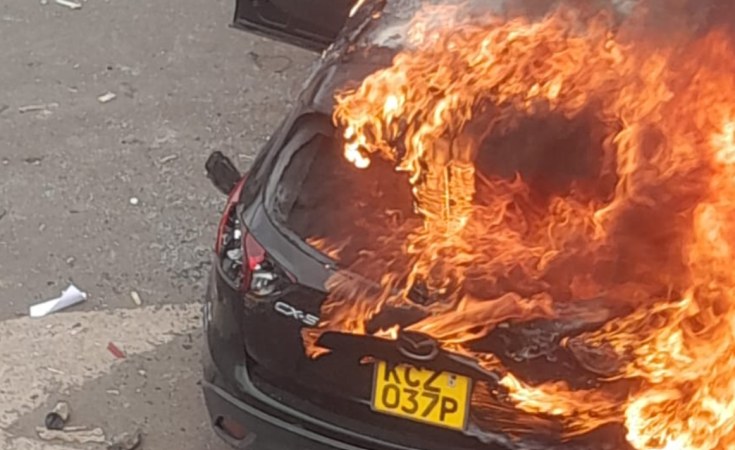
Nairobi — Chaos gripped Thika Road Monday morning after protesters lit tyres along sections of the road, forcing motorists to make abrupt U-turns and disrupting movement around the Githurai area.
Vehicles were turned back as access along parts of the road became increasingly difficult amid the unfolding unrest.
Thick plumes of smoke billowed into the air near Kenyatta Road as burning tyres blocked sections of the carriageway, triggering massive traffic snarl-ups and confusion among commuters heading into Nairobi and its outskirts.
Public service vehicles, private motorists and boda boda operators were caught in the disruption, with many stranded or forced to seek alternative routes to avoid the affected areas.
Keep up with the latest headlines on WhatsApp | LinkedIn
Groups of youth, visibly agitated, occupied sections of the road as tensions remained high. Some protesters gathered near barricaded areas while commuters watched from a distance, uncertain about the evolving situation.
The disruption brought movement along one of Nairobi's busiest transport corridors to a near standstill, affecting workers, students and traders who rely on the highway during the morning rush hour.
Thousands of stranded commuters streamed through roads and highways across the city after a nationwide transport strike crippled matatu and bus operations, transforming large sections of the capital into a "walking city" as pressure mounted on the government to urgently lower soaring fuel prices.
Stranded commuters in Ruaka gathered at a deserted bus stop after the nationwide transport strike grounded matatus and buses, leaving thousands of passengers with no transport amid rising fuel price protests.
From dawn, crowded bus stops, deserted matatu termini and unusually quiet transport corridors reflected the scale of the coordinated shutdown orchestrated by the Transport Sector Alliance (TSA).
Across Thika Road, Mombasa Road, Waiyaki Way, Jogoo Road and Ngong Road, office workers, traders and students trekked several kilometres after failing to secure transport, while the few operational boda bodas charged sharply inflated fares.
The industrial action -- involving matatu operators, truckers, boda boda riders, digital taxi operators, logistics firms and private motorists -- is shaping into one of the broadest economic protests witnessed in Kenya in recent years.
"This action is not only for transport operators, but for every Kenyan citizen," the alliance said in a joint statement on Sunday.
"The ordinary mwananchi is the ultimate victim of high fuel prices, paying more for transport, food, electricity and essential commodities."
The TSA brings together the Federation of Public Transport Sector (FPTS), Matatu Owners Association, Rig Owners Association, Motorist Association of Kenya (MAK), Association of Matatu Transport Owners (AMTO), Digital Boda Drivers and Deliveries Association, Truckers Association of Kenya, Digital Taxi Association of Kenya, Tour Guide Association, Association of Bus Operators, Counties Commuters Welfare Association, Mass Mobility Operators Association, Driving School Association and private motorists.
The coalition declared the strike "99 per cent successful" and vowed that no vehicle would move beginning midnight Sunday.
The alliance wants the immediate reversal of the latest fuel price increase announced on May 14 and is demanding diesel and petrol prices be reduced to approximately Sh152 per litre, with a long-term target of between Sh140 and Sh150.
It is also seeking the resignation or dismissal of Energy Cabinet Secretary Opiyo Wandayi, the disbandment of the Energy and Petroleum Regulatory Authority (EPRA), restoration of a competitive fuel procurement system and the revival of the Changamwe Oil Refinery.
"Enough is enough. Fuel is the lifeblood of the economy. When fuel prices rise beyond reason, the entire nation suffers," the statement added.

Sign up for free AllAfrica Newsletters
Get the latest in African news delivered straight to your inbox
The strike comes amid intensifying warnings from business leaders and politicians that the latest fuel increases could trigger severe inflationary and economic consequences.
The Kenya National Chamber of Commerce and Industry (KNCCI) warned that the latest EPRA review could slash MSME profit margins by up to 15 per cent while sharply increasing transport, manufacturing and food distribution costs.
KNCCI President Dr Erick Rutto described the fuel hikes as "an economy-wide shock," warning that transport and logistics costs could rise by between 10 and 20 per cent while food prices may increase by up to 7 per cent as businesses transfer rising costs to consumers.
"The latest increase is expected to squeeze MSME cash flows and profit margins by between 5 and 15 per cent," KNCCI stated on Friday.
Under the latest pricing cycle effective May 15 to June 14, diesel prices in Nairobi rose by Sh46.29 to Sh242.92 per litre while super petrol increased by Sh16.65 to Sh214.25.

