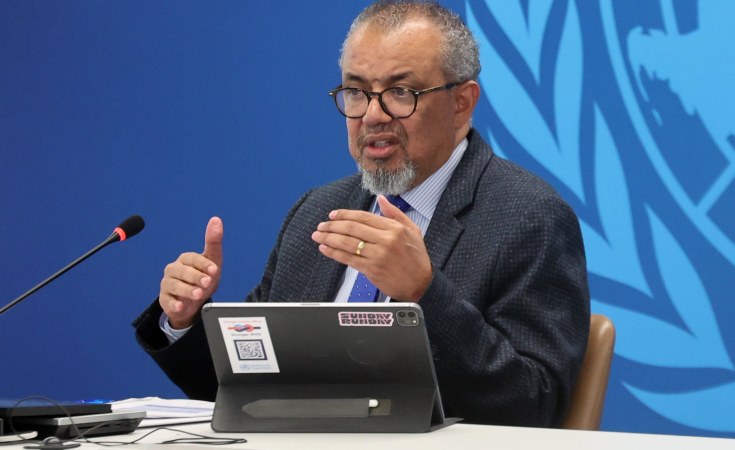
Geneva – The World Health Organization (WHO) head said Tuesday that the situation is "deeply concerning" in the Democratic Republic of Congo due to a new species of Ebola for which there is no licensed vaccine or treatment, and that is believed to have killed 131 people.
At the World Health Assembly, the decision-making body of the World Health Organisation in Geneva, the director general of the global health body, addressed delegates on the outbreak.
"Early on Sunday, I declared a public health emergency of international concern over an epidemic of Ebola disease in the Democratic Republic of the Congo and Uganda," said Tedros Adhanom Ghebreyesus,
"This is the first time a Director-General has declared a PHEIC before convening an Emergency Committee. I did not do this lightly."
Keep up with the latest headlines on WhatsApp | LinkedIn
EBOLA ALSO IN UGANDA
Tedros said that Uganda has also informed WHO of two confirmed cases in the capital Kampala, including one death, among two individuals who travelled from DRC.
"An American national has also been confirmed positive, and been transferred to Germany, as reported by the U.S. We're working with the DRC, Uganda and the United States," said Tedros.
The United States formally completed its withdrawal from the WHO on Jan. 22,
It was fulfilling an executive order signed by President Donald Trump on Inauguration Day, and the split ended U.S. membership and severed the country's financial and operational ties to the global health body.
Dr Anne Ancia, WHO DRC representative, spoke at a UN press conference in Geneva by phone from Bunia in Ituri, noting that there had been some 130 suspected deaths reported since the government in Kinshasa declared the current Ebola outbreak.
"It is occurring in a highly complex epidemiological, operational and humanitarian context—marked by insecurity, population displacement, and both densely populated and remote areas," said Ancia.
UNCERTAINTY ON INFECTIONS
Dr. Ancia said there is significant uncertainty about the number of infections and how far the virus has spread.
"So far, 30 cases have been confirmed in the DRC. The outbreak now affects ten health zones in Ituri province, and has reached North Kivu, with confirmed cases in Butembo and Goma. Uganda has confirmed two imported cases. "
WHO said that the Ebola outbreak in eastern DRC raises concerns for displaced people and humanitarian operations
It is occurring in a highly complex epidemiological, operational and humanitarian context—marked by insecurity, population displacement, and both densely populated and remote areas, said the WHO.
WHO said that the outbreak also raises serious concerns for refugees living in the affected provinces.

Sign up for free AllAfrica Newsletters
Get the latest in African news delivered straight to your inbox
In Ituri, around 11,000 South Sudanese refugees require preventive assistance.
It said that in Goma, more than 2,000 urban Rwandan and Burundian refugees need support for prevention measures, including soap and hand-sanitizer.
More than 28,600 people were infected by Ebola during the 2014-2016 outbreak in West Africa, the largest outbreak of the virus since its discovery in 1976.
The disease spread to countries within and outside West Africa, including Guinea, Sierra Leone, the United States, the United Kingdom and Italy, resulting in the deaths of 11,325 people.
