Newcastle, UK — "I fled one nightmare and found another."
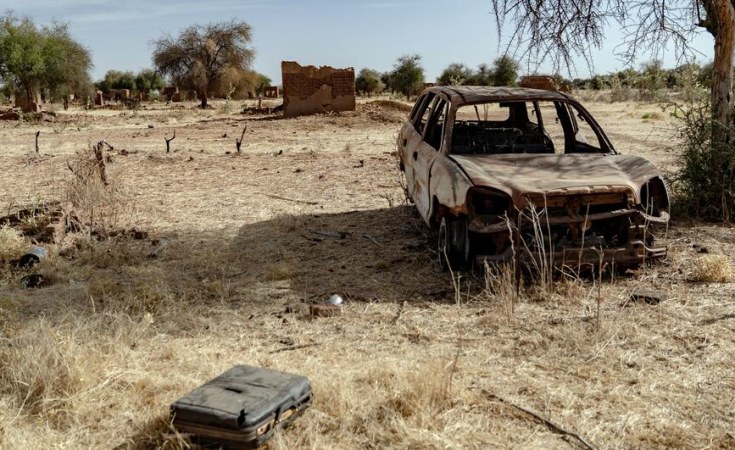
Four years ago, on the morning of 25 May 2022, panic rippled through the Agadez Humanitarian Centre in northern Niger. Around 2,000 refugees, most from Sudan, were living in the camp when police raided the facility to try to arrest one of them who was accused of killing the livestock of a local farmer. A group of refugees gathered to try to prevent the police from entering the camp. Soon, what sounded like gunfire pierced the dusty, early morning air.
Witnesses remember the chaos - the sharp crack of shots, the instinct to scatter, and the blinding confusion that enveloped what had begun as an ordinary day. In the commotion, witnesses later recalled that 27-year-old refugee Musab Muhammad Hammad Adam turned towards the sound. Seconds later, he collapsed. Blood soaked the ochre soil beneath him, and the people around him screamed for help. They had no doubt what they had just witnessed: Musab had been shot.
The camp, jointly overseen by Nigerien authorities and the UN's refugee agency, UNHCR, descended into mourning and rage. Refugees believe Musab was killed when police officers deliberately opened fire on camp residents - a story they have repeated and stuck to for years.
Follow us on WhatsApp | LinkedIn for the latest headlines
"Live bullets were fired directly at us, which resulted in one of the refugees being shot in the head and dying instantly in a brutal manner that left an indelible mark on our souls and the souls of our children," refugees at the centre wrote in a statement shared with The New Humanitarian.
But the official version of what transpired issued by Nigerien authorities differs significantly. According to this version of events, Musab died from a head injury caused by a stone thrown by another refugee. There was no fatal gunfire. No crime - at least not one committed by the state.
For its part, UNHCR has no mandate to investigate the actions of a Nigerien state's police force and defers entirely to the outcome of the local investigation, which found "no evidence of bullet wounds on the deceased", according to a UNHCR spokesperson.
For many refugees in the camp, that narrative was more than a lie - it was an erasure.
"This is a clear violation and confirms the existence of a conspiracy between [UNHCR] and the local government in the state of Agadez to hide the facts about what is happening in the humanitarian centre," said Khalil Hussein, a 30-year-old Sudanese refugee in Agadez.
The New Humanitarian spent months trying to reconstruct the events that transpired on the day Musab was killed and to understand the broader context in which they took place, speaking via WhatsApp with refugees in Agadez, reviewing documents and visual evidence, consulting experts, and talking to UNHCR. Nigerien authorities did not respond to requests for comment.
In the months and years that have followed, Musab's death became a symbol and rallying point. For Hussein and other residents of the camp, it was not an isolated tragedy but yet another grim example of the abuses, neglect, and adversarial relationship with authorities that they say have been constant features of the more than eight years many have spent stranded in the spartan facility in the desert.
What began as grief for one man morphed into a wider reckoning over the conditions in Agadez. On 22 September 2024, the refugees launched a peaceful protest at the humanitarian centre, trying to gain the attention of people outside of Niger and to pressure UNHCR to relocate them to another country.
Residents of the camp liken the desert city to a prison. "We've been trapped in the desert for years," Sudanese refugee Mohamed Abdallah Ishag Mohamed told The New Humanitarian.
The Agadez Humanitarian Centre is not a detention facility and "residents have full freedom of movement across Niger", a UNHCR spokesperson said. Despite this, the refugees describe feeling confined. Unable to return home and unable to move forward, they have been left waiting in an indefinite limbo without a clear path to resettlement or integration.
Origins of a desert camp
On the global radar, the relatively small number of refugees in Agadez has been virtually invisible. It is dwarfed by populations in other countries around the world where deep cuts to aid funding are making living conditions increasingly stark and precarious. Since the Sudanese civil war started in April 2023, much larger numbers of Sudanese have also been forced to flee to nearby Chad, South Sudan, and Egypt where they also face deprivation and abuse.
The situation in Agadez, however, pre-dates the outbreak of the civil war by over five years and likely would not exist at all if not for European efforts to try to stop migration across the Mediterranean.
Back in 2017, the European Union was seeking ways to try to reduce the number of people departing from Libya towards its shores. Italy - the country where most refugees, asylum seekers, and migrants were landing - signed a controversial memorandum of understanding with Libyan authorities, paving the way for it to train, equip, and support the Libyan Coast Guard to intercept boats before they could reach Europe.
People who were intercepted were (and still are) dragged back into a cycle of extortion and abuse in Libyan detention centres. Facing criticism for its role in the system, the EU launched a programme with UNHCR in November 2017 to evacuate a small number of people from detention sites in Libya to the capital of Niger, Niamey. From there, they would be relocated to EU countries willing to take them in.
"At that period, violence in Libya against migrants was particularly intense," said Jérôme Tubiana, an analyst and adviser for Médecins Sans Frontières who has followed the migration situation in Agadez and throughout the region for years.
Evacuation and resettlement to safe third countries by UNHCR was "supposed to maintain a safe and legal, but narrow, pathway" away from the violence, Tubiana added.
Word about the programme quickly spread through refugee networks in Libya. Soon, hundreds of Sudanese were heading south across the desert to northern Niger. "Whether people were well informed or not [about the evacuation programme], they knew that Niger was safer than Libya," Tubiana said.
Agadez, the main city in the north, had long been a transit hub for people making the journey from West Africa to Libya and on to Europe, until the EU convinced the Nigerien government to crack down in 2015. Niger's government has since been overthrown in a 2023 coup, and the country's new authorities scrapped a law, adopted under EU pressure, that was the cornerstone of the crackdown.
Back in 2018, Agadez was not used to hosting people for extended periods of time - let alone Sudanese refugees who were considered foreign compared to the people from other West African countries who usually passed through.
By March 2018, around 2,000 refugees were staying in central Agadez, many camped outside UNHCR's office, as tensions grew with residents of the city. In May, Nigerien police arrested over 100 Sudanese and deported them to a no man's land on the border with Libya. "It is inhuman and unlawful to send migrants and refugees back to Libya, where they face shocking levels of torture, sexual violence, and forced labour," Judith Sunderland, who was Human Rights Watch's associate director for Europe and Central Asia, told The New Humanitarian at the time.
"Europe was key in putting financial and political pressure on the then Niger authorities for people not to move toward Libya," Tubiana said. This helped create a sense that violence could be used against those fleeing, he added.
The expulsions did not end the crisis. The remaining refugees continued to stay in Agadez. Several months later, UNHCR and the Nigerien government opened the humanitarian centre on the outskirts of the city.
Life in limbo
Around 15 kilometres outside the city, surrounded by desert, the humanitarian centre is isolated and exposed to the elements. The Nigerien government agreed to receive asylum requests from the Sudanese in 2018, but processing times dragged on for years before people were eventually granted refugee status. In the meantime, hundreds gave up hope and left Niger for other countries. Some reportedly later died in shipwrecks trying to cross the Mediterranean.
The population of the camp fluctuated over time, with small numbers filtering in and out. People living in the facility have consistently described overcrowded conditions, rancid food, poor medical care, neglect, and a contentious, distrusting relationship with authorities - both UNHCR and the Nigerien government.
"The food was terrible, often rotten. We got sick from eating it, especially the children, but there was no proper medical care," said Fatima Bakhit Adam, a woman who has lived in the camp since 2021. She added that doctors working with UNHCR partner organisations and local health authorities showed little to no compassion. "They treated us badly and refused to help. When my children got sick, I begged for help, but they did nothing."
UNHCR Niger said healthcare at the centre has been provided over the years by the Nigerien NGO Action Pour le Bien-Être and the Italian NGO COOPI as well as the Agadez Municipal Health District. The agency said it is "monitoring the situation to ensure that services are provided in accordance with national health standards", and that a formal complaints mechanism exists for refugees to report issues.
Many of the refugees in the camp are from Darfur and were displaced by earlier rounds of genocidal violence in the region in the 2000s. They spent years in displacement camps in Darfur and Chad where funding for international assistance progressively dwindled as attention shifted elsewhere. Many then travelled to Libya in search of work or to try to cross the Mediterranean where they risked ending up in slavery-like work conditions or falling victim to kidnapping and extortion.
Mo'taz Mokhtar Abkar fled Sudan at 15 after witnessing his family's killing. He told The New Humanitarian that he survived forced labour in Libya before making it to Niger in 2021. "I have lost everything: my parents, my brother, and so many others. I have been here for years, but no one has offered me a solution. I am a refugee, but I feel invisible," he said.
Mahasen Ibrahim Ali, a Sudanese woman, also spent most of her life in displacement camps before fleeing to Niger in December 2021, hoping to find security. "I fled one nightmare and found another," she said, via an intermediary.
Women are particularly at risk of that erasure in this environment. Despite repeated efforts, The New Humanitarian has been unable to speak directly to any women in the camp. Their testimonies have been relayed through male refugees who cited vague logistical barriers for why women could not be contacted directly.
Violence from authorities has been another constant. At the end of 2019, refugees from the humanitarian centre set up an encampment outside UNHCR's office in Agadez to protest the dismal conditions and the slow processing of asylum applications. In early January, Nigerien security forces raided the encampment, beating refugees and rounding them up into lorries. Back at the humanitarian centre, another confrontation ensued, resulting in a fire that burned much of the facility to the ground.
In that sense, "the alleged killing of Musab is a symptom, not an anomaly", said Abel Mavura, a PhD candidate in Development Studies at Cambridge University. "The EU's externalisation strategy [to try to stop migration] has deeply distorted Niger's humanitarian landscape."
Disputed details
Musab himself arrived at the humanitarian centre in Agadez some time between 2018 and 2019 with his wife Zainab Mohamed Khater Defa, who is now a 31-year-old widow. The New Humanitarian tried numerous times to contact Defa but was ultimately unable to interview her about her husband's death and its aftermath.
On the morning Musab died, according to the version of events published in a UNHCR operational update, residents of the camp attacked the Nigerien police officers who had come to make the arrest (Musab was not the refugee wanted by police). They then set fire to the roof of a security post at the entrance of the camp, and Nigerien police fired what the document refers to as "warning shots" and teargas in response.
Eyewitnesses began filming the moment gunfire rang out, capturing grainy footage and photographs that appear to show Musab's lifeless body lying in a pool of blood.
One of the witnesses, 28-year-old Ahmed Moursal, told The New Humanitarian that he saw Musab fall to the ground. "The late Musab died in front of my eyes and in front of the eyes of the refugees in the Agadez centre," he said.
A later image supplied by those at the camp shows a corpse on an autopsy table, a gaping wound at the top of the head exposing grey matter. Three forensic experts reviewed the photo for The New Humanitarian. One, a forensic scientist at a UK University, said: "The image is consistent with a close-range gunshot or a heavy blunt object; with the former being more likely."
The two others - a New York State medical examiner and a US-based coroner - also said the injury appeared consistent with a gunshot wound, though a cause of death could not be conclusively determined from the image alone. All three requested anonymity, citing institutional restrictions or professional sensitivity.
Due to UNHCR's deferral to the version of events put forward by Nigerien authorities, refugees in the camp accuse the agency of being complicit in an alleged cover-up. Refugees say that Musab's widow, Defa, was pressured by Nigerien authorities into signing a death certificate with a false cause of death. Shortly after, she reportedly left the camp for Libya.
Nigerien authorities have not responded to The New Humanitarian's request for comment. In a written response to questions, UNHCR said it "did not exercise any pressure on the family of the deceased refugee" and that it provided psychosocial support and burial assistance.
Musab's death is not the only one that has taken place under unclear circumstances. According to Imad Younis, a Sudanese refugee who lived at the centre since its opening in August 2018, at least 76 people have died there. He compiled a list of the deceased, citing causes ranging from untreated illnesses and a lack of access to adequate medical care, to malnutrition and violent encounters under unexplained circumstances. Among the dead on his list are 11 minors.
UNHCR, however, puts the figure at less than half the number recorded by Younis, citing 32 deaths since 2018, including eight children. They said these resulted from "a variety of causes, including accidents and complications from pre-existing medical conditions" and that "all cases were followed up by health partners and local authorities".
The New Humanitarian was not able to independently verify the number of deaths that have occurred. Limited documentation, inconsistent reporting, and mistrust between refugees and authorities made independent verification difficult.
A broader pattern
Ishag Mohamed, who arrived at the camp in 2024, quickly became a de facto leader of the protest movement that launched in September 2024. Having studied English at university in Sudan, he has played a key role in trying to narrate conditions in the camp to the outside world via social media accounts that post daily updates about the protests.
According to Ishag Mohamed, after eight long years, the refugees' relationship with UNHCR in Niger and with Nigerien authorities feels irreparably broken. "Our last demand remains: We don't want to stay here, in such a place where we face all kinds of violations," he declared in a video dated 27 May 2025, day 247 of the protest.
Nigerien authorities have taken what appears to be retaliatory action against leaders of the protest movement. Eight protest leaders were stripped of their refugee status in July last year, according to documents from the Nigerien Ministry of Interior seen by The New Humanitarian. No specific reason was cited.
The following month, Nigerien authorities arrested Ishag Mohamed and five other refugees, including Younis. Their whereabouts were unknown following their arrest until they eventually resurfaced in N'Djamena, the capital of neighbouring Chad, in late November.
At the time of the arrests, Mary Lawlor, then UN special rapporteur on human rights defenders, said the detentions "may constitute an enforced disappearance". She added that deporting the refugees or exposing them to refoulement - the expulsion of refugees to a place where they might face persecution or other threats - would constitute "a further grave violation of Niger's obligations under international law".
All six of the deported protest leaders are now in Libya's capital, Tripoli, according to David Yambio, director of the network Refugees in Libya, which raises awareness about the situation facing refugees in North Africa and Niger.
The New Humanitarian spoke to Younis after he reached Tripoli. He described deteriorating physical and mental health since his detention and forced deportation as he continued to face an uncertain future. "I live today in pain, sadness, anxiety, isolation, nightmares, and constant psychological distress," he said.
Despite the deportations, the daily demonstrations at the humanitarian centre in Agadez continue. As of publication, they've been going on for 610 days.

Sign up for free AllAfrica Newsletters
Get the latest in African news delivered straight to your inbox
For Yambio, the experience of the protesters in Agadez is all too familiar. Born in a refugee camp in South Sudan in 1997, he reached Italy by boat from Libya in 2022. While he was still in Libya, Yambio took part in a protest outside UNHCR's office in Tripoli that began in October 2021 and lasted for 100 days before being violently dispersed. "We were left, ignored, silenced, and then had militias, in affiliation with the Ministry of Interior, called on us by the UNHCR because they labelled us as trouble-makers, as criminals," he recalled.
A UN Security Council report from January 2022 notes that numerous UN officials, including the heads of UN agencies, "urged" the Libyan Interior Ministry to "ensure the security of UNHCR premises" that were being blocked by Yambio and other protesters. Libyan security forces then moved in to clear the protesters and took those who refused to leave to a detention centre, according to the report.
A UNHCR spokesperson told The New Humanitarian that the agency "did not receive prior notification of the clearance operation by the Libya security forces" and "did not share any personal information about protesters with authorities". They added that, following the arrests, UNHCR "expressed serious concerns about the treatment of those detained," providing "emergency assistance to thousands of people affected" in the form of "financial aid, food, hygiene kits, and documentation support".
Yambio sees what happened in Tripoli as part of a broader pattern across Niger, Libya, and Tunisia. Refugee leaders who organise demonstrations at UNHCR sites, he argued, are often arrested, removed from camps, expelled from the country, and blocked from accessing services. UNHCR told The New Humanitarian that it "has consistently affirmed that refugees and asylum-seekers have the right to peacefully express their concerns, while respecting the laws of the host country", and that they "should not be subject to retaliation" for doing so.
Refugees in Libya has compiled a Book of Shame containing testimony from all three countries. It argues that UNHCR is complicit in the EU's attempts to stop migration that have trapped refugees in abusive conditions without adequate support and with little to no hope for a better future in all three contexts. The six Agadez organisers are paying the same price others have paid for speaking out, Yambio said.
"We don't want to stay here"
Jean-Paul Murunga, a former UNHCR intern who led gender-based violence protection action in Djibouti refugee camps, said humanitarian agencies like UNHCR "cannot operate independently" in environments like Niger since "it is the host government that guarantees security, water, etc., all basic needs".
As a result, agencies are encouraged to pursue what Murunga described as "interdependence" - a model that relies on state cooperation even when state actors are themselves the subject of serious abuse allegations. That reliance on host infrastructure often shapes how complaints are handled and how far agencies are willing, or able, to push for external accountability.
UNHCR spokespeople told The New Humanitarian that it "takes any allegation of misconduct by UNHCR staff very seriously". They once again noted that refugees can raise cases to them openly or anonymously, though "nothing was received" from refugees in the Agadez camp.
Refugees in Agadez said they don't trust these reporting channels. "These people are not ready to help refugees, especially at Agadez. [These forms] are not helpful to refugees. They are patronising," Mohamed Abdullah said, before he was deported.
In this light, Musab's death is not an aberration but a lens. What followed was not clarity or justice, but further discord and tensions. An investigation was opened, but its findings remain disputed. UNHCR has kept its presence in Agadez while refugee protests have been met with silence or repression from state authorities. The signs held up daily at the camp - now faded by dust and heat - speak not only to one man's killing, but to a deeper sense of abandonment.
The refugees in Agadez are protesting not a new grievance, but an old one: the right to move, the right to heal, the right to begin again. One message echoes through it all: "We don't want to stay here".
Edited by Eric Reidy.
Hannah Uguru, Investigative journalist and multimedia producer reporting on underrepresented voices and stories across Africa and its diaspora
