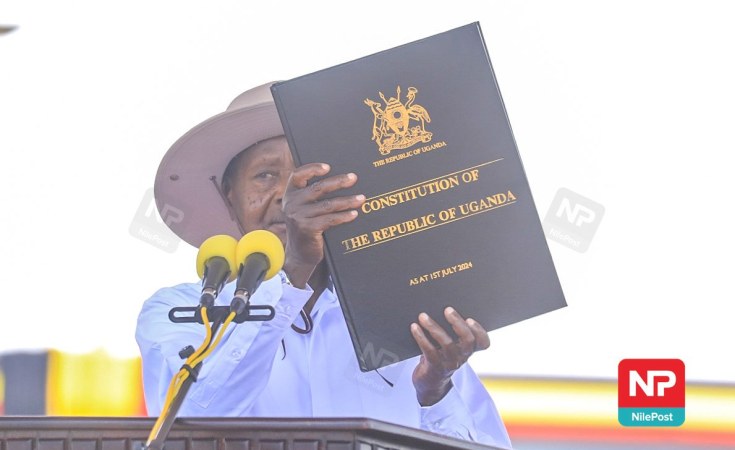
Kampala, Uganda — President Yoweri Museveni used his 2026 State of the Nation Address (SONA) to present a largely economic scorecard of Uganda's transformation journey, highlighting strong growth in GDP, exports, agriculture, manufacturing and infrastructure while warning that corruption, inefficiency and poor service delivery remain major obstacles to achieving the country's development ambitions.
The address, delivered at Kololo Ceremonial Grounds during the opening of the First Session of Parliament on June 4, comes ahead of the national budget reading and fulfills the constitutional requirement under Article 101(1), which mandates the President to report on the state of the nation at the beginning of every parliamentary session.
Addressing lawmakers, diplomats, investors, business executives and government officials, Museveni argued that Uganda has laid a solid foundation for accelerated economic growth but needs more disciplined leadership and efficient implementation to fully realize its potential.
"This is a time to talk straight to everybody," Museveni said.
Follow us on WhatsApp | LinkedIn for the latest headlines
Economic momentum
The President presented an economy that has expanded significantly over the last four decades.
According to figures shared during the address, Uganda's Gross Domestic Product has grown from US$3.9 billion in 1986 to US$69.3 billion under the foreign exchange valuation method and US$197.1 billion under Purchasing Power Parity (PPP). GDP per capita has risen to US$1,278, placing Uganda above the lower-middle-income threshold of US$1,136.
The economy is projected to grow by 6.4% in the 2025/26 financial year and accelerate further to 10% in 2026/27, potentially pushing the economy to about US$80 billion.
The president said the growth trajectory reflects progress in agriculture, industry, services and information and communication technology.
He noted that Uganda has officially graduated from Least Developed Country status to Lower Middle-Income Country status, while the economy has expanded 17-fold since 1986.
The president also pointed to improvements in welfare indicators. Household participation in the money economy has increased from 9% in 1962 to 67% today, while poverty levels have declined from 56.4% in 1992 to 16.1%.
Life expectancy has risen from 43 years to 68 years, while infant mortality has fallen from 122 deaths per 1,000 live births to 36 per 1,000.
Export expansion
Museveni highlighted export diversification as one of Uganda's major economic achievements.
Export earnings reached US$18 billion in the 12 months ending March 2026, supported by the addition of 31 new export products over the last 15 years.
Among the new export earners are pharmaceuticals, refined gold, steel products, ICT products, plastics, ceramics and dairy products.
The president argued that Uganda's growing manufacturing base is gradually reducing dependence on imported goods while creating employment opportunities and increasing foreign exchange earnings.
Agriculture remains a key driver of export growth. Coffee production has increased from 2 million bags in 1986 to 9.3 million 60-kilogram bags annually, while cocoa production has reached 76,173 metric tonnes.
Fish production now stands at 727,000 metric tonnes, maize output has expanded from 200,000 metric tonnes to 5 million metric tonnes, while banana production has increased from 6.66 million metric tonnes to 11 million metric tonnes.
Cassava production has grown from 3.5 million metric tonnes to 4.5 million metric tonnes. Museveni also cited gains in industrial production, noting that sugar output has increased from 152,000 metric tonnes to 700,000 metric tonnes annually, while cement production has expanded dramatically from 4,900 metric tonnes to 7 million metric tonnes.
Dairy success
The dairy industry emerged as one of the sectors highlighted most prominently during the President's address.
National milk production has risen from 200 million litres annually in 1986 to 5.4 billion litres today.
According to Museveni, the dairy sector now saves Uganda approximately US$1.56 billion annually in imports while generating export earnings worth US$285.4 million.
Nyabushozi County, which featured prominently in the President's presentation, now produces 1.15 million litres of milk daily and hosts 115 milk coolers. Nationally, Uganda has established 160 dairy processing factories.
Throughout the address, Museveni showcased video testimonies of farmers and entrepreneurs whose livelihoods have improved through commercial agriculture and government-supported wealth creation programmes.
Among them was an elderly woman whose family moved from a dilapidated house to a modern permanent home after embracing income-generating activities.
Other success stories included livestock farmers, commercial crop growers, industrial entrepreneurs and rural business owners.
The President maintained that expanding commercial agriculture remains central to Uganda's economic transformation agenda.
"Once the people get capital, they will get out of poverty," Museveni said while discussing the Parish Development Model (PDM).
He added: "So when I went to Kisozi, I worked with the people to transform their lives. I want to go to heaven and not be blocked by the angels, when I die."
Museveni argued that many farmers continue to underutilize land through traditional grazing systems.
According to figures presented, one square mile under traditional grazing supports about 300 Ankole cattle, while the same acreage under pasture management and zero-grazing can support up to 6,000 cattle.
Similarly, while traditional grazing requires about three acres per cow, one acre under zero-grazing can support eight Friesian cattle or 12 Ankole cattle.
Capital access
The President also highlighted government financing programmes aimed at accelerating wealth creation and enterprise development.
He said Parish Development Model financing has now reached approximately 3.7 million households across the country.
Each parish currently receives Shs557 million under the programme, with government planning to inject an additional Shs100 million annually into every rural parish and Shs300 million into urban wards.
Government has also disbursed Shs760 billion through Emyooga, while Uganda Development Bank has received Shs1.6 trillion to support large-scale farmers and manufacturers.
The UDB lending rate currently stands at 12% per annum, while PDM loans attract an interest rate of 6%, payable after two years.
The President described access to affordable capital as critical for moving households from subsistence activities into commercially viable enterprises.
Delivery concerns
Despite the positive economic outlook, Museveni expressed concern about what he described as poor implementation within sections of the public service.
"When I look at you, the way you do things, I feel nausea, like vomiting... even those that get allowances do not go to the field. I hear they stay in Kampala," Museveni said.
"I'm really sick with that parasitism," he added.
The President questioned demands by some local government officials for motorcycles and other facilitation before performing their duties.
"Why does a 'muruka' chief ask for a motorcycle? Let him ride a bicycle to do government work, he will even be more fit. Even the sub-county chief... you do not work because you do not have a motorcycle," Museveni said.
He warned that government would take a tougher stance against underperforming officials.
"This time I don't need non-performers," he said.
Corruption also featured prominently in the address.
"There was an issue of that Fort Portal road -- which was corruption," Museveni said.
"Some ministers see these things and keep quiet. I hope that the new ministers don't keep quiet but work."
Infrastructure push
Museveni also highlighted progress in infrastructure and energy development, which he described as critical enablers of industrialization.
Electricity generation capacity has increased from 60 megawatts in 1986 to 2,098 megawatts today. Government's long-term ambition is to expand generation capacity to 50,000 megawatts through hydro, solar, gas, wind, geothermal and nuclear energy projects.
On transport infrastructure, the President said government continues to invest in road maintenance, allocating Shs3 billion annually to every district for murram roads.

Sign up for free AllAfrica Newsletters
Get the latest in African news delivered straight to your inbox
Uganda is also revamping the metre-gauge railway, developing the Standard Gauge Railway and working with Kenya and Tanzania on crude oil and petroleum product pipeline projects aimed at lowering logistics costs and improving regional trade competitiveness.
While acknowledging growing public frustration over the cost of living and service delivery challenges, Museveni insisted that Uganda's economic fundamentals remain strong and that sustained growth will depend on productivity, accountability and efficient implementation of government programmes.
"The people lack confidence, poor leadership, inferiority complex to participate in activities to transform and that is exactly why people are still poor," he said.
For investors and business leaders, the message from the President was clear: Uganda's next phase of growth will be driven by commercial agriculture, manufacturing, exports, infrastructure, affordable financing and a stronger focus on execution.
Peoples' reactions
Ibrahim Ssemujju Nganda - former Kira Municipality MP
As a journalist, I have had to listen to boring Museveni speeches for 13 years, and as an MP for 15 years. Imagine he is wondering why Ugandans go for kyeyo in Dubai which Amin gave food during his reign. According to the 2024 population census, 20 million of the 46 million Ugandans are food insecure, 5.6 million homes still sleeping in one room house, 28 million people using firewood as main source of energy and 14 million people about 31% of the population don't have two sets of clothes. The economy he has built for 41 years cannot employ 1.7 million people with degrees, diplomas and certificates.
Moses Nuwagaba Entwiga, political analyst: Criticized funding for "politically motivated programs" and called for heavy investment in industrialization.
Sheila Amaniyo Draville, Mukono District Woman Member of Parliament: Explained why the opposition party National Unity Platform chose not to attend the address, reflecting continued political divisions over the government's direction.
