

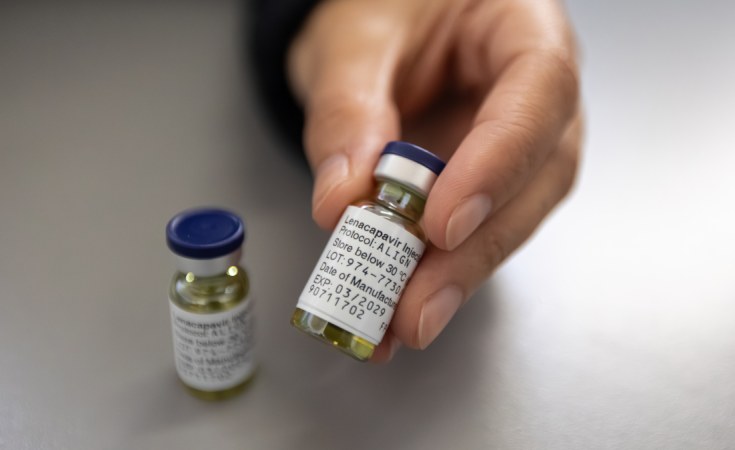
The roll-out of South Africa's six-monthly HIV prevention medication lenacapavir (LEN) has to consider our other epidemic: TB.
- The arrival of the nearly foolproof six-monthly HIV prevention shot, lenacapavir ( LEN), earlier this month was never going to be just an HIV story. That's because in South Africa, HIV and TB have been fellow travellers for decades.
- Many people who have TB — or are likely to get it — also have a high chance of getting HIV . Giving HIV prevention medicine to people who have TB or are likely to develop it could help prevent many new HIV infections.
- But if someone is using LEN and needs to take medicine to treat or prevent TB later, they may have to take extra doses of LEN or have different TB treatments.
- That is because TB medications such as rifampicin and rifabutin speed up the body's "drug-clearing system", causing lenacapavir to be broken down and removed from the body faster than normal . This leaves too little LEN in the bloodstream to provide reliable protection against HIV.
- South Africa's plan for people who need TB treatment while using LEN includes extra doses of LEN to keep HIV protection in place. But there is much more that scientists need to learn.
The arrival of the nearly foolproof six-monthly HIV prevention shot, lenacapavir ( LEN), earlier this month was never going to be just an HIV story. That's because in South Africa, HIV and TB have been fellow travellers for decades.
Many people who have TB — or are likely to get it — also have a high chance of getting HIV . Giving HIV prevention medicine to people who have TB or are likely to develop it could therefore help prevent many new HIV infections.
Follow us on WhatsApp | LinkedIn for the latest headlines
In 2025, South Africa had around 140 000 new HIV infections . Modelling scientists say LEN could cut the number of new infections to 65 000 per year by 2043, which would end the Aids epidemic as a big public health problem. That is, if between 1 and 2-million people use the injection at least once between now and 2043 .
People using LEN have to be HIV negative and get a dose of the medication once every six months. But should they need medicines to treat or prevent TB later, they may have to take extra doses of LEN or take different TB medicines.
That is because TB medications such as rifampicin and rifabutin speed up the body's "drug-clearing system", causing lenacapavir to be broken down and removed from the body faster than normal . This leaves too little LEN in the bloodstream to provide reliable protection against HIV.
Rifampicin is one of the most common antibiotics used to treat TB, and is part of South Africa's entry-level drug course for people with ordinary TB; it's sometimes also used to stop people who are infected with the TB germ from falling ill. Rifabutin , meanwhile, is used far less.
Another preventive TB medication, rifapentine , used in newer, shorter TB prevention treatments , can't be taken by people on lenacapavir because there is not yet enough information about the way in which it interacts with LEN.
SA is geared up with a TB/LEN plan
South Africa's plan for people who need TB treatment while using LEN includes extra doses of LEN to keep HIV protection in place.
The country's guidelinesare based on modellers' calculations drawn from earlier studies on a tablet version ofLEN, that would predict what happens when extra LEN doses are given alongside the TB treatment.
Researchers will soon start with a Durban trial, known as the Oracle study, to see if it works as well in patients as scientists expect it to. They are also trying to understand how LEN fits with one of the newer drug courses for preventing TB.
"Certain parts of KwaZulu-Natal are real epicentres of the TB-HIV, co-epidemic," Anushka Naidoo , who is leading the trial, at the Centre for the Aids Programme of Research in South Africa (Caprisa). She spoke to Bhekisisa at South Africa's 9th national TB conference earlier this month.
"In many parts of the country, for every 100 people just diagnosed with tuberculosis, between 50 to 60 of those would be HIV positive," says Naidoo. "Flip that, and it means the other 40 to 50% are therefore HIV negative, and would definitely benefit from being offered HIV prevention."
Rifampicin — one of the most common antibiotics used for TB treatment, which is also used to stop people from developing TB — lowers the amount of LEN in someone's blood by 85% , which means people taking rifampicin have too little LEN in their blood to stop them from getting infected.
For people already on LEN who are newly diagnosed with TB, and need rifampicin, guidelines say they need to repeat the same starting dose of LEN they received when they first started the HIV prevention jab — two injections and two pills on the day of the injections, followed by two more lenacapavir pills the next day to complete the dose — on the day they start rifampicin. They must have started on LEN at least two days before taking rifampicin.
People taking the less common rifabutin can start LEN at any time, but they would need totake an extra half dose of LEN on the same day that they start rifabutin.
TB prevention is a little different. Because rifapentine isn't recommended for people using LEN, another TB prevention medicine, isoniazid , is used instead, per South Africa's TB guidelines ,
In her conference presentation, Naidoo said figuring out the unknown is crucial as South Africa speeds up both HIV and TB prevention. The country's TB recovery plan , which was launched in 2025 to recover from setbacks during the COVID pandemic, aims to find and treat more people with TB, and also to prevent more infections in the first place.
But it's complicated
TB and HIV are driven by many of the same social conditions — including poverty, overcrowding and poor access to healthcare.
When someone is diagnosed with TB, there is little room for delay. According to the WHO Global TB report , TB killed about 1.23-million people in 2024, making it the world's deadliest infectious disease.
"If someone develops tuberculosis, they have to be treated immediately. Curing TB is your immediate priority," says Norbert Ndjeka , head of TB control and management at the department of health.
For patients on LEN who become sick with TB, the next question is how to keep the HIV prevention injection working while their TB treatment is underway.
The answer, as outlined in the country's lenacapavir implementation guidelines , is to give people extra doses of LEN while they are on TB treatment.
For Linda-Gail Bekker, director of the Desmond Tutu HIV Centre at the University of Cape Town, who helped put LEN on the global map , the TB drug interactions with LEN are not as unusual as it might sound. LEN interacts with many other drugs in common use.
"Many diseases have drug-drug interactions," she says. "For instance, if people are epileptic, we need to know which anticonvulsants they are on, because certain epilepsy drugs interact with LEN . And LEN use can also impact the dose of drugs like Viagra , so it is important that staff take a history and seek help if they're unsure."

Sign up for free AllAfrica Newsletters
Get the latest in African news delivered straight to your inbox
Bekker says the Align study , which is testing how the anti-HIV jab works for teens and young people, has already seen these two treatments collide. Align follows people who choose the injection at government clinics and mobile trucks in Cape Town's Klipfontein and Mitchells Plain area. When a participant in the study developed TB, researchers treated the TB and gave extra doses of LEN to keep them protected against HIV, she says.
What we don't yet know
One of the biggest remaining questions for LEN is whether it can safely be used alongside rifapentine , a medicine that people can use for between one and four months, in combination with other drugs , to lower their chances of developing TB.
Researchers hope the Oracle study, which will track each participant's health for a full year, will help answer some of the remaining questions about how the HIV jab and TB medicines can be used together. One goal is to confirm that the "top-up" approach for people receiving TB treatment works as expected in patients. Another is to find out whether lenacapavir can safely be used with rifapentine.
Ndjeka sees these new challenges as just the latest chapter in a long relationship between HIV and TB. For decades, he says, HIV and TB have "held hands" through the treatment phase in South Africa's clinics. It's not going to be all smooth — there's a lot of learning to do, he says, "knowing the reality with our system, where there's high staff turnover and some glitches here and there".
But there's an upside. LEN is effectively forcing more TB screening, which could help uncover more cases earlier, Ndjeka says. "That's a big plus for TB control."
This story was produced by the Bhekisisa Centre for Health Journalism. Sign up for the newsletter .

