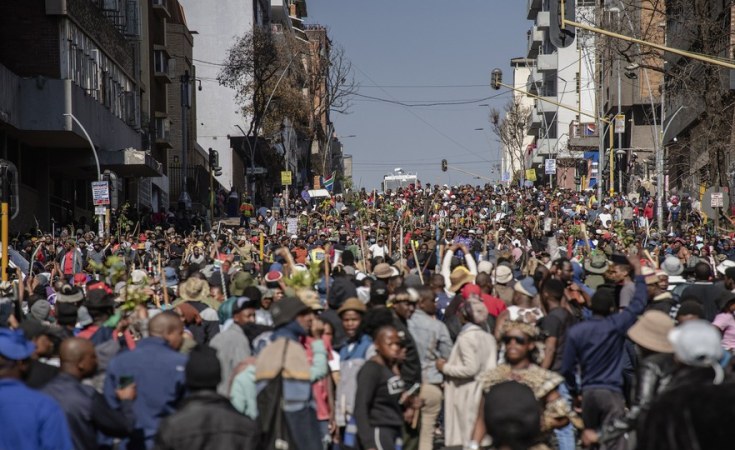
Large crowds in Gauteng and KZN, with reports of looting and violence
Demonstrations against illegal immigration on Tuesday morning drew large crowds in Durban, Johannesburg and Pretoria, and smaller crowds in other parts of the country.
Tuesday marked the 30 June "deadline" set by the anti-immigration movement March and March for the government to act against illegal immigration, and for illegal immigrants to leave the country.
Maximum policing resources were deployed to identified "hotspots" throughout the country.
Follow us on WhatsApp | LinkedIn for the latest headlines
Protest leaders at times struggled to keep control, with sporadic incidents of looting, vandalism, arson and assault reported in several areas. GroundUp is aware of raids on homes and shops of immigrants in Johannesburg, Germiston and KuGompo (East London).
Johannesburg
A crowd gathered at Beyers Naude Square on Tuesday morning, with thousands joining from hostels in the eastern part of the city. Splinter groups started forming, with police and private security scrambling to prevent violent outbreaks. The protest did not follow the agreed-upon route.
Later on Tuesday, there were reports in Yeoville of public toilets set alight, rocks thrown, houses looted and ransacked, and bystanders assaulted. Journalists were also reportedly harassed and assaulted.
There were similar reports of violence in Germiston.
Leaders tried to stop the violence but lost control of the crowd.
A number of protesters were under the influence of alcohol.
Meanwhile, in Woodmead, outside the Malawian consulate, hundreds of displaced immigrants waited to be repatriated.
Among those waiting was Beck Promise Chitsulo, who had arrived at the camp on Monday. He previously worked as a freelance technician installing DSTV and WiFi.
"Our respective governments have both failed us. In Malawi, we face a difficult situation, so we come to South Africa. But the South African system also fails us," said Chitsulo.
Pretoria
More than 600 people marched from Church Square Park to the Sunnyside police station, escorted by law enforcement officers.
Marchers shouted for undocumented immigrants to leave.
"We don't want these people here because they take our jobs", said marcher Jack Mokgotsi. "I have a matric certificate but I'm not working. I apply for any job every month but I'm not even invited for interviews."
The marchers arrived at the police station by noon. They waited for the police to accept their memorandum of demands.
Later, stun grenades were fired to disperse a crowd that tried to force its way into a block of flats where immigrants live.
Durban
Central Durban was quiet on Tuesday morning, with most shops closed.
At 9am, a crowd started gathering at King Dinuzulu Park. They later walked up King Dinuzulu Road to join another group at the Berea Centre. By 1pm the crowd had grown into the thousands, filling up a large portion of Dr Pixley Kaseme (West Street) outside the city hall.
Despite police instructions that no weapons be present, protesters carried sticks, knobkieries and sjamboks.
Many people wore MK party regalia, with at least two MK-branded vehicles present at the march.
Cyril Mjoli told GroundUp that he joined not only to protest illegal immigration but also government corruption. "The President doesn't want to listen to us," he said.
The protest ended on Prince Street behind Addington Hospital, where eThekwini Mayor Cyril Xaba and deputy mayor Zandile Myeni stood on a stage with representatives from March and March and delivered speeches.
Xaba accepted the memorandum but was met with cries of "Zulu" and "voetsek" by the crowd when he tried to speak.
Cape Town
Cape Town CBD was quiet on Tuesday morning, with little traffic and many shops closed. The iconic Greenmarket Square, usually filled with many immigrant-run stalls, was deserted.
Throughout the morning, a crowd of more than 100 people marched to the provincial legislature.
A smaller group of people held an anti-xenophobia picket on the steps outside St George's Cathedral as the larger crowd passed.
A big crowd demonstrated in Kraaifontein, with rubber bullets fired by police to disperse the crowd.
KuGompo (East London)
Immigrants in Nompumelelo township feared for their safety after members of March and March went door-to-door, threatening foreign nationals to leave the community by Friday.
About 300 protesters, many carrying sticks, marched through Southernwood before moving along Buffalo and Oxford streets and later to Nompumelelo.
As the march entered the township, some homes occupied by immigrants were forcibly entered. Some people jumped over fences to escape the crowd.
Anathi Qulubhe said she was walking in the street when protesters said she was an immigrant because she was wearing a white doek commonly associated with a Zimbabwean church.
The crowd gathered around her and demanded that she remove it. When she refused, one of the protesters grabbed the doek and hit her in the face with it.
Qulubhe said some protesters knew that the father of her two children is Zimbabwean, who had fled due to threats of violence.
"This is very frustrating because he is the one who works, pays our rent and buys food for us. Now he is being forced to leave. As much as I understand that South Africans need jobs, we can't blame immigrants because we are unemployed," she said.
Judith Tingana was at home with her three-month-old in the RDP house she rents when organisers from March and March told her she had until Friday to leave town.
"I'm scared and I fear for my life. I've been in South Africa for a year. I want to go home, but I don't have money," she said.
Tingana, who is Zimbabwean, said it would help if authorities arranged transport from the Eastern Cape to help immigrants return to their home countries.
Transport, safety and security MEC Xolile Nqatha said about 14,000 SAPS members had been deployed across the province to monitor marches.
Gqeberha
There were no reports of protests in Gqeberha, with the city centre quiet on Tuesday. A taxi rank, which usually has a few taxis and long queues, was filled with empty taxis with no passengers.
Elim, Limpopo
More than 100 residents marched to the Home Affairs office in Elim and the COGTA office in Bungeni. Most businesses remained open, but many spaza shops owned by immigrants were closed.
Marchers alleged that corruption at the Department of Home Affairs had opened the door for undocumented people to live and operate businesses in their communities. They called for an investigation into officials allegedly issuing fraudulent permits and asylum documents.
Community member Dakalo Mashau said, "We are tired of illegal immigrants who are shop owners ... We are also angry at traditional leaders who gave illegal immigrants residential stands."

Sign up for free AllAfrica Newsletters
Get the latest in African news delivered straight to your inbox
Nhlamulo Ndima, who handed over the memorandum, said Home Affairs must address corruption. The memorandum also urged traditional leaders to stop allocating land and business sites to undocumented migrants.
A Home Affairs official received the memorandum, and the department was given seven working days to respond.
Nquthu, KwaZulu-Natal
There appeared to be more police than marchers in the town of Nquthu. The group walked through the town and then to Mpumelelweni township, about six kilometres away.
The protesters said immigrants were living in government-funded houses.
They dispersed soon after.
In Thelezini, we found a few immigrants moving their belongings. They said they had been evicted by their landlords who had been threatened by local community leaders. They were told that if they were found accommodating foreign nationals after the 30th, they would face a fine of R10,000.
Mangaung, Free State
Mangaung Service Delivery Forum and March and March gave the government two weeks to deport all undocumented immigrants.
The march began at Raamkraal, an old apartheid-era prison on the outskirts of Bloemfontein, before moving to the OR Tambo Building, the headquarters of the Free State provincial government.
Protest leader Potso Motoko said, "Should they fail to respond, we will write a follow-up and should they ignore it, all hell will break loose not only in Mangaung but in the entire province."
Their memorandum was accepted by the Premier and MEC for community safety Jabu Mbalula.


