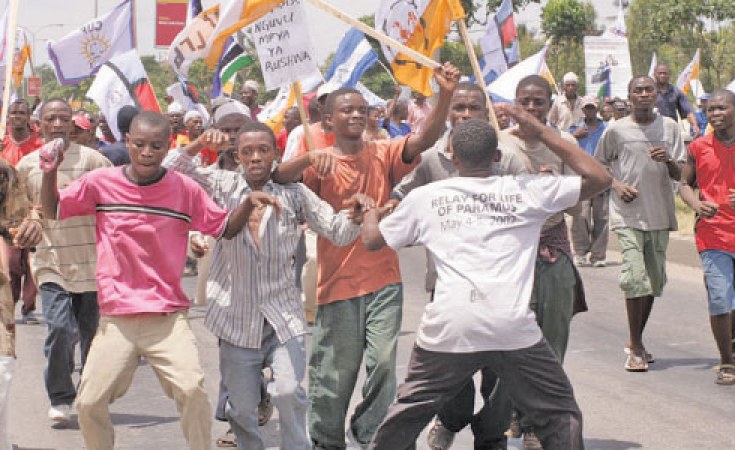
Cost and lack of legal aid are still barriers for many.
Key findings
- Seven in 10 Tanzanians (71%) say they feel "somewhat confident" or "very confident" that ordinary people who are wronged can obtain justice in the courts,.
- Majorities of citizens consider it "somewhat likely" or "very likely" that they could find legal advice (64%) and could afford to obtain it (56%).
- More than half believe they could afford to take a legal problem to court (58%) and would obtain a fair resolution (56%), but fewer than half (47%) are confident that such a case would be resolved within a reasonable time.
- Only about one in three respondents (35%) say they are aware of legal-aid services available in their community.
- Six in 10 Tanzanians (59%) say they would turn to a political leader to help resolve a legal problem, while smaller shares would turn to the police (12%), government officials (9%), and local courts (5%).
- An overwhelming majority (84%) of citizens say they trust the courts "somewhat" or "a lot."
- Yet a solid majority (63%) think that "some," "most," or "all" judges and magistrates are corrupt.
- Seven in 10 Tanzanians (71%) say punishments for ordinary people who break the law are "about right."
- More than one in four (27%) believe powerful individuals often face lighter consequences than they should.
- About three in 10 say that officials who commit crimes "often" or "always" go unpunished (30%) and that people are frequently treated unequally under the law (28%).
- Most Tanzanians (76%) say the president must always obey the law and courts, and must regularly report to Parliament about taxpayers' money (80%).
- Confidence is high that the president respects judicial decisions (82%) and Parliament's authority (83%).
- More than half (59%) of survey participants support the death penalty for the most serious crimes, though a significant minority (39%) say it can never be justified.
Keep up with the latest headlines on WhatsApp | LinkedIn
Access to justice for all is a cornerstone of democracy and good governance, empowering citizens to exercise their rights and hold leaders accountable (OECD, 2025). The Tanzanian government has affirmed its commitment to strengthening the rule of law and ensuring equal access to justice, in line with the United Nations' (2015) Sustainable Development Goal 16 (United Republic of Tanzania, 2019).
In 2024, the government introduced a new criminal-justice policy aimed at strengthening justice delivery through enhanced coordination among criminal-justice institutions, expansion of the national prosecution office, integration of information and communication technology systems across justice-sector agencies, and greater application of the rule of law at a subnational level (Mosenda, 2024).
Complementing these reforms, the judiciary has sought to expand access to judicial services across the country, reduce case backlogs, improve infrastructure, and increase public awareness of rights and legal-aid services. Recent initiatives include recruiting additional magistrates, expanding the network of primary courts at district and community levels, and promoting alternative dispute-resolution mechanisms to make justice more efficient and affordable (Moltmann-Willisch, 2025). Recent digitisation initiatives, including the automation of case-management systems, court proceedings, and translation services, are also intended to reduce delays and improve service delivery (Judiciary of Tanzania, 2023).
Despite these initiatives, significant challenges remain. On the World Justice Project's (2025) Rule of Law Index, Tanzania ranks 98th out of 143 countries, with comparatively stronger scores on order and security and on constraints on government powers, but lower performance on government openness and fundamental rights. Access to justice continues to be constrained by case backlogs, delays in court proceedings, and uneven access to judicial services. As of June 2024 the Court of Appeal alone had 5,900 pending cases, of which 1,248 had been unresolved for more than two years (Judiciary of Tanzania, 2024).
This dispatch reports findings from a special survey module on access to justice included in Afrobarometer's Round 10 surveys.

Sign up for free AllAfrica Newsletters
Get the latest in African news delivered straight to your inbox
Results show that while a majority of Tanzanians express confidence that ordinary people can obtain justice in the courts, significant minorities remain concerned about the affordability of taking a case to court, as well as the fairness and timeliness of judgements. Awareness of legal-aid services is also limited.
Most Tanzanians trust the courts, though a majority perceive corruption among at least "some" judges and magistrates.
Six in 10 citizens would rather turn to political leaders than to formal courts to resolve disputes. And substantial minorities express concerns about unequal treatment under the law, political influence in judicial decisions, and impunity for public officials who commit crimes.
Jacqueline Mwaipopo Jacqueline Mwaipopo is an assistant researcher for REPOA, the Afrobarometer national partner in Tanzania.
Brenda Mshumbushi Brenda Mshumbushi is an assistant researcher for REPOA.
