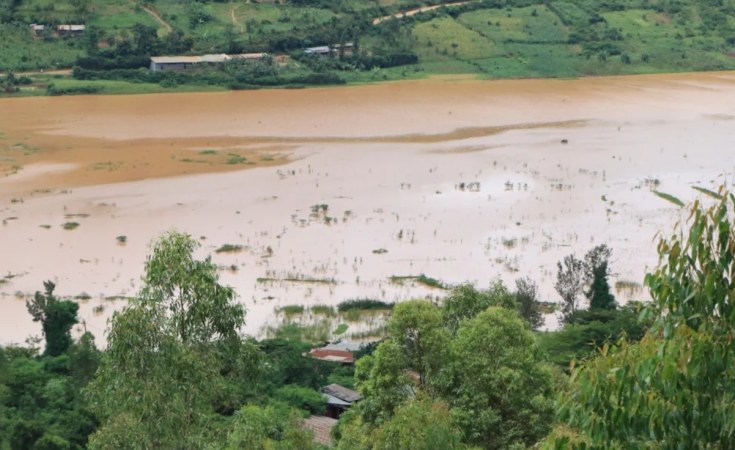
The Government has submitted an $86.2 million funding proposal to the Global Shield against Climate Risks to strengthen emergency response and disaster preparedness in vulnerable areas, the Minister in charge of Emergency Management, Maj. Gen. (Rtd) Albert Murasira, has said.
ALSO READ: Can a disaster insurance fund transform Rwanda's recovery efforts?
"So far, €10 million has already been approved," Murasira said.
The Global Shield against Climate Risks is an international initiative launched in 2022 by the G7 and the V20 Group to help vulnerable countries improve financial protection against climate-related disasters such as floods, droughts, storms and heatwaves through pre-arranged financing.
Follow us on WhatsApp | LinkedIn for the latest headlines
Rwanda joined the initiative in 2024 to strengthen its financial resilience to climate shocks.
Led by the Ministry in charge of Emergency Management and the Ministry of Finance and Economic Planning, the country conducted a Climate and Disaster Risk Finance and Insurance (CDRFI) assessment, identified financing gaps and submitted a request for support to access pre-arranged disaster financing.
Murasira said the Government is also working with the World Bank to mobilise additional emergency financing.
The partnership includes financing instruments such as the $141 million Catastrophe Deferred Drawdown Option (Cat DDO) and the Contingency Emergency Response Project (CERP), which enable rapid access to funds following disasters.
Strengthening preparedness
Murasira said 4,785 households were relocated from high-risk zones in 2026, while 5,095 households whose homes were destroyed by disasters in 2023 have been resettled. Families that lost relatives also received psychosocial and other forms of support.
Lightning protection systems have been installed at public gathering places in Rutsiro and Ngororero.
ALSO READ: Rwanda identifies 326 disaster hotspots amid regional flood crisis
The country has established 14 emergency evacuation sites and emergency relief warehouses in Kigali, Musanze, Kayonza and Karongi.
Nearly 4,000 people have participated in disaster preparedness training and simulation exercises.
Rwanda has also operationalised a 24/7 National Emergency Command Centre to coordinate disaster response, while nine of 28 district command posts have so far been equipped to oversee disaster preparedness, response and recovery.
The Ministry of Agriculture manages strategic food reserves in Nyanza, Kicukiro, Nyagatare, Nyabihu, Nyamagabe, Bugesera and Kayonza to support emergency relief operations.
Thousands of facilities exposed to disaster risks
A Risk Governance Assessment identified 18,417 elements at risk, with an overall resilience rating of 46 per cent, classified as moderate.
Places of worship are the most exposed, accounting for 4,125 facilities, followed by 3,270 education institutions and 2,186 markets and commercial buildings.
Other vulnerable assets include accommodation facilities, offices, health facilities, agricultural land, housing, transport infrastructure, industries, energy facilities, water systems and emergency management infrastructure.
ALSO READ: Northern Province hit by 1,500 disaster cases over past five years
According to the national disaster impact dashboard covering 2022-2026, disasters claimed 899 lives and injured 1,800 people.
Lightning caused the highest number of deaths (318), followed by mining accidents (160), floods (159) and landslides (137). Other fatalities resulted from building collapses, fires, heavy rainfall, windstorms and hail.
Over the five-year period, disasters damaged more than 16,600 houses, destroyed 2,700 homes, and affected hundreds of classrooms, bridges, roads, electricity lines, churches, health facilities and markets.

Sign up for free AllAfrica Newsletters
Get the latest in African news delivered straight to your inbox
Crop losses exceeded 7,000 hectares, while 478 hectares of forests were damaged. The disasters also killed 376 cattle and about 4,400 other livestock.
ALSO READ: City of Kigali secures Rwf8.5bn to bolster climate resilience
Meanwhile, Senator Charles Murigande welcomed progress in flood control along the Sebeya River in Rubavu, saying improved drainage has significantly reduced flooding over the past three years.
Senator Evode Uwizeyimana stressed that investing in disaster prevention is more cost-effective than responding after disasters occur.
He also called for better water management, noting that some communities experience severe flooding during the rainy season but face water shortages during dry periods.
"We have a problem where there is too much water that causes damage, and shortly afterwards we experience water shortages," he said.

