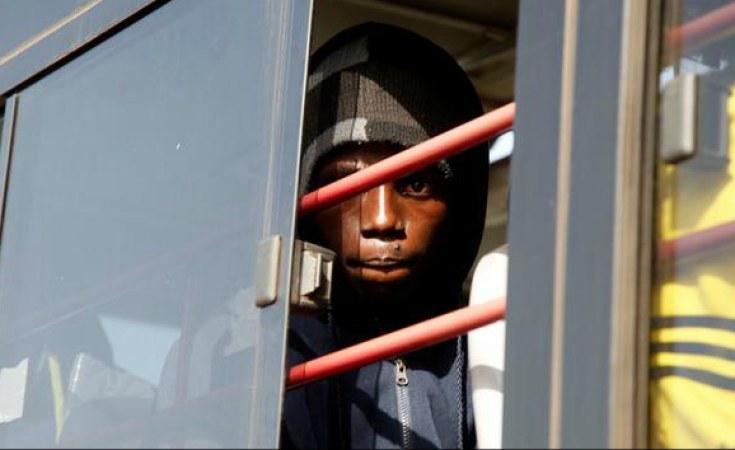
Beirut — Libyan authorities have used incendiary rhetoric and pursued a campaign of mass detention and expulsions of migrants, asylum seekers, and refugees, sparking anti-migrant protests, Human Rights Watch said today.
Following months of incendiary anti-migrant rhetoric from authorities in the east and west of Libya, protests erupted on June 4, 2026, calling for the expulsion of migrants and refugees over rumors that they would be permanently "settled" in the country. Hundreds of demonstrators blocked access to the Office of the United Nations High Commissioner for Refugees (UNHCR), in Tripoli's Sarraj neighborhood. The authorities who separately govern both eastern and western Libya have responded with mass arrests of migrants and detention in inhumane conditions.
"Rival Libyan authorities have united in fueling xenophobic protests and subjecting migrants to mass arrests, arbitrary detention in inhumane conditions, and collective expulsions," said Hanan Salah, associate Middle East and North Africa director at Human Rights Watch. "With thousands of people detained and at risk of expulsion, the scale of the abuses, and the urgency of stopping them, could not be clearer."
Libyan authorities should urgently end arbitrary arrests and unlawful collective expulsions and release those held in abusive and inhumane detention conditions.
Follow us on WhatsApp | LinkedIn for the latest headlines
Libya has long been a destination for migrants seeking work as well as a transit country for migrants, asylum seekers, and refugees seeking to reach the European Union. According to UNHCR, 110,908 registered refugees and asylum seekers were in Libya as of April 2026. The country hosts an estimated 559,000 Sudanese refugees who have fled the ongoing war since April 2023.
The UN Support Mission in Libya confirmed on June 9 that UNHCR is not seeking to permanently settle migrants in Libya. The International Organization for Migration has operated a Voluntary Humanitarian Return program since 2015 to support the safe departure of migrants from Libya.
In the weeks leading up to the protests, authorities in the east and west had issued statements against the permanent settlement of migrants, announcing their intention to intensify the arrest and expulsion of undocumented migrants.
The Tripoli-based Government of National Unity (GNU) convened a security meeting on June 2 during which acting Interior Minister Emad Trabelsi said that "illegal migration" was a top government priority, with a focus on securing borders, combating irregular migration, and regulating foreign labor. In the western city of Zuwara, officials imposed a nighttime curfew that same day, specifically targeting foreign residents, ostensibly for public safety.
The High Council of State, which has no effective legislative authority, issued a statement on June 3 rejecting any migrant settlement arrangement and warning against demographic changes to Libya's national identity.
In the east, Saddam Haftar, deputy commander of the rival Libyan Arab Armed Forces (LAAF), on June 2 ordered security agencies to carry out mass arrests and expulsions to end what he described as the "illegal" presence of undocumented migrants and the risks they pose to "the lives and security of citizens across Libya." The House of Representatives allied with the LAAF, issued a statement rejecting permanent settlement and stressing the need to protect Libya's "cultural and demographic identity."
Security forces and armed groups across the country have carried out mass arrests and apparently unlawful collective expulsions.
The GNU Interior Ministry announced on June 6 that police were carrying out field operations to "arrest migrants in violation of residency laws" and detain them. The ministry announced the expulsion of a group of Egyptian nationals to Egypt on June 14.
The Directorate to Counter Illegal Migration in eastern Libya stated in a June 11 interview that, under the instructions of the LAAF, it had intensified its operations, with over 7,596 people of various nationalities detained pending expulsion, and 10,133 migrants expelled in recent months.
On June 23, Prime Minister Osama Hammad of the eastern-based "Libyan Government," issued a formal decree banning all nationals from Sudan, Eritrea, Ethiopia, and Somalia from entering Libya.
The arrests and expulsions follow a long-established pattern of collective expulsion from Libya, in violation of international human rights and refugee law. In March 2025, the GNU's interior minister announced plans to deport 100,000 migrants, refugees, and asylum seekers every four months. In January 2025, Libyan authorities forcibly returned 150 Nigerian women and children and 613 Nigerien nationals to their countries of origin.
The UN found in a February 2026 report that migrants across the country are arrested and transferred to detention facilities without due process, often at gunpoint, in what amounts to arbitrary arrest and detention. The UN found that people are expelled without individual review and that those expelled at the country's southern borders are routinely left in life-threatening desert conditions without access to water, food, or medical care.
Human Rights Watch has previously documented cruel, inhuman, and degrading detention conditions in Libyan detention centers including severe overcrowding, starvation, lack of medical care, beatings, and sexual violence. The UN Independent Fact-Finding Mission on Libya concluded in March 2023 that violations against migrants and asylum seekers in Libyan detention facilities may amount to crimes against humanity.
The EU and its member states should end support to abusive and unaccountable armed groups in Libya, press Libyan authorities to disavow xenophobic rhetoric and end mass detention and collective expulsions, and condition all security cooperation on verifiable improvements in respect for migrants and refugees' rights.

Sign up for free AllAfrica Newsletters
Get the latest in African news delivered straight to your inbox
Libyan authorities should cease mass arbitrary arrests and detention of migrants, refugees, and asylum seekers, end abusive detention conditions, release those currently detained without charge or due process, and halt collective expulsions, Human Rights Watch said. Nobody should be forcibly removed from Libya without an assessment of their protection needs and access to legal counsel.
Libya should formally recognize the UNHCR and allow it to carry out its mandate in full, including providing international protection for refugees and assistance to asylum seekers and other people of concern on Libyan territory, and grant the agency complete, unrestricted access to every site where foreign nationals are detained.
International law, including the African Charter on Human and Peoples' Rights, which binds Libya, prohibits collective expulsions: the removal of groups of people without individual examination of their circumstances, including their need for international protection. Libya is not a party to the 1951 Refugee Convention and has no asylum system. Detention of migrants in Libya occurs in a near legal vacuum, with no meaningful right of appeal or universal access to legal counsel.
"Libyan authorities in the east and west should immediately halt mass arrests and end collective expulsions," Salah said. "And so long as the European Union keeps funding the very forces driving these abuses, it is complicit in what is happening."
