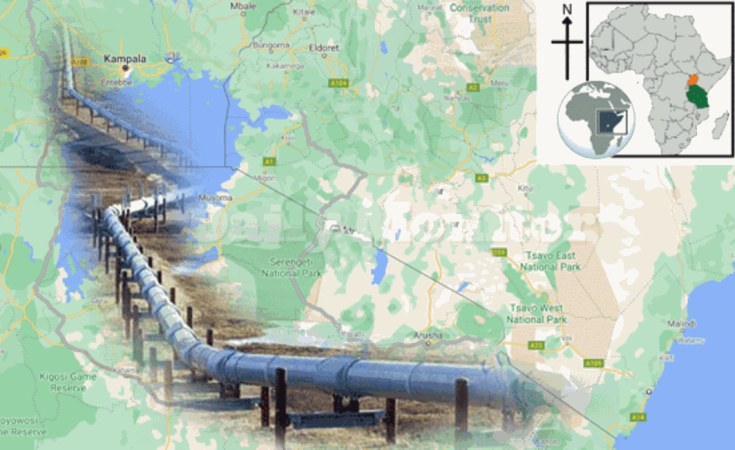
Dar es Salaam — TANZANIA and Uganda yesterday signed a Memorandum of Understanding (MoU) to jointly develop the proposed Tanga Regional Energy Hub, marking a major step towards deeper energy cooperation, industrialisation and regional trade.
The proposed project comprises a crude oil refinery, a terminal tank farm for storing and loading refined petroleum products, a crude oil receiving jetty and a bidirectional multiproduct pipeline linking Tanga and Uganda.
The MoU was signed by Tanzania Petroleum Development Corporation (TPDC) Executive Director Mussa Makame, Uganda National Oil Company (UNOC) Chief Executive Officer Proscovia Nabbanja and Vitol's Managing Director for Bahrain Tom Baker.
Follow us on WhatsApp | LinkedIn for the latest headlines
The signing was witnessed by President Samia Suluhu Hassan and her Ugandan counterpart, President Yoweri Museveni, during the Ugandan leader's two-day working visit to Tanzania.
Once completed, crude oil from Uganda will be refined in Tanzania before petroleum products are supplied to markets in Tanzania, Uganda and neighbouring countries, allowing the two countries to benefit from the full petroleum value chain.
Unlike conventional petroleum pipelines that transport products in one direction, the proposed bidirectional multiproduct pipeline will enable refined petroleum products to move between the two countries according to market demand, strengthening regional energy security and expanding access to regional markets.
Speaking during the signing ceremony at State House in Dar es Salaam, Minister for Energy Deogratius Ndejembi said the agreement represents a new chapter in East Africa's economic integration.
"Today we are laying another foundation in the economic architecture of Eastern Africa. We are making another bold statement that African countries can work together, not merely as neighbours, but as strategic partners capable of planning, financing and delivering transformative projects that will redefine the economic future of our continent," he said.
He said the project goes beyond physical infrastructure and is designed to create value through refining, storage, logistics, trading, industrialisation, employment and regional commerce.
"The project whose foundation we are laying today has an even broader ambition. It is designed to create value through refining, storage, logistics, trading, industrialisation, employment and regional commerce," Mr Ndejembi said.
He said one of the project's most transformative components is the proposed bidirectional multiproduct pipeline, which will allow petroleum products to move in either direction depending on regional demand.
"Petroleum products refined at Hoima will be transported to markets in Tanzania, neighbouring countries or for export through the Port of Tanga. Equally, when products refined or stored in Tanga are required in Uganda, Rwanda, eastern Democratic Republic of Congo or South Sudan, they will move efficiently through this corridor," he said.
Mr Ndejembi said the initiative builds on the East African Crude Oil Pipeline (EACOP), which is nearing completion, enabling Tanzania and Uganda to participate across the petroleum value chain instead of exporting crude oil alone.
"EACOP transports molecules; the Tanga Regional Energy Hub transforms those molecules into prosperity," he said.
He said the proposed Tanga Regional Energy Hub is expected to attract investments exceeding 20 billion US dollars (about 52tri/-), ranking among the largest integrated energy infrastructure projects in SubSaharan Africa and creating industries, jobs, skills, exports and technology transfer.
Uganda's Minister for Energy and Mineral Development, Dr Monica Masanza, said the agreement demonstrates the determination of the two countries to translate regional integration into practical investments.
"Today action speaks louder than words. We are greatly privileged to witness this gigantic step towards joint development agreed upon by our sister nations," she said.
"These are not merely infrastructure projects; they are strategic instruments for our industrialisation, aimed at creating the jobs our young population needs and building meaningful trade through production," she said.
Dr Masanza said Tanzania and Uganda are also advancing other strategic energy projects, including the proposed natural gas pipeline between the two countries, whose feasibility study is expected to be completed by October this year, the Masaka-Mwanza 400-kilovolt electricity interconnector and the petroleum storage terminal.

Sign up for free AllAfrica Newsletters
Get the latest in African news delivered straight to your inbox
She said Uganda's planned Hoima refinery and the proposed Tanga Energy Hub are complementary investments that will strengthen regional energy security.
"We welcome the Tanga hub not just as a refinery, but as an energy hub critical to addressing regional energy security," she said.
Calling for closer economic integration, Dr Masanza said the full benefits of the investments would only be realised if the two countries removed the remaining barriers to trade.
"Efficient cross-border movement of goods and services will lower the cost of doing business and unlock greater commercial opportunities for our citizens," she said.
President Museveni arrived in the country on Wednesday for a two-day working visit, his second to Tanzania this year, focusing on strengthening bilateral cooperation in strategic sectors, particularly energy, trade and investment.

